Before Joseph Colangelo had a bus business, he had a driveway and a question. Would a commuter pay to park there? He handed out flyers at the Cranford train station, found a customer, and charged a dollar a day. The customer emailed the dates; Colangelo processed the card. A suburban inconvenience had become a transaction. No grand unveiling was required. The first useful piece of evidence arrived in a parking space.
That modest test contains much of the character of Boxcar, the commuting company he co-founded and runs. Colangelo is interested in the things a suburb already has: train stations, civic organizations, neighbors who need to get somewhere. He keeps finding ways to rearrange them. The ambition has grown from parking to reserved coach seats and ferry connections, but the basic question has survived. Will somebody actually use this?
There is a pleasing lack of glamour in the original proposition. A driveway has little patience for a pitch deck. It can accommodate a car or it cannot. By starting there, Colangelo gave himself a small, inexpensive way to learn before the stakes rose.
The town he came back to
Cranford is more than a convenient starting location in his biography. Colangelo grew up there, went away, and returned. He attended Delbarton, graduating in 2003, then studied at the University of California, Berkeley on a Navy ROTC scholarship. He earned a BA and served as a naval officer. His work took him to Afghanistan and Washington before he settled again in his hometown.
In December 2024, he returned to Delbarton to speak to seventh graders. He described how witnessing September 11 had prompted his desire to serve. His naval career included working with Admiral William McCraven. By that school visit, he and his wife Sarah, an attorney and Navy veteran, were living in Cranford with six children and two dogs. The daily logistics of suburban life were close at hand.
His attachment to the town has a practical cast. He talks about walkability and people volunteering for local institutions. A founder selling easier access to the city has chosen a life rooted outside it. That gives his work a particular point of view: the journey matters because of the place you leave and the place you hope to return to.
Before the buses, a little honey
Transportation was not his first experiment in making a business out of an overlooked possibility. In 2010, Colangelo co-founded Golden Coast Mead with Frank Golbeck and Praveen Ramineni, friends from Berkeley. Their product was fermented honey. Their early infrastructure was borrowed and rented, an arrangement familiar to anyone who has tried to discover whether an idea deserves premises of its own.
The beginning involved cold emails seeking a place to make mead. Sixty messages produced three replies; Triple B Ranches offered a workable opening. The company moved from small batches to commercial production. The number is an agreeable antidote to the tidy founding story: most of the correspondence went nowhere, and one useful reply was enough to continue.
One early episode puts Colangelo in a barn at night, holding up his phone's flashlight while Golbeck cleaned a tank for an urgent transfer. It is a useful picture to keep beside the title of CEO. In a young business, someone has to supply the light.
He also worked in consulting at Booz Allen Hamilton and led Consumers' Research from 2013 to 2017. That career brought together selling, policy, analysis and service before Boxcar required its own mixture of them. A bus route needs customers, but it also needs places to stop and people willing to let it stop there.
What happened when the trains changed course
The parking business found inventory in church lots and other civic properties near stations. Places built to gather a community could have spare spaces during the working week. Colangelo connected that unused capacity with commuters looking for a dependable place to leave their cars. In a 2022 explanation of the model, he described a $6 booking: $1.50 for Boxcar, the balance for the organization. Both sides had a reason to participate.
Then, in summer 2017, Midtown Direct train service was diverted to Hoboken. Colangelo offered commuters a coach into Manhattan. The temporary disruption supplied a test that a parking app could never have delivered by itself: whether riders wanted Boxcar to handle more of the journey.
The result was concrete. Reporting to Chatham's council that September, he said 124 borough commuters had used the service during its eight-week run. Seventy-six had taken it more than twenty times. Boxcar added an East Side stop at 41st Street and Park Avenue, plus evening service back to Chatham. Riders continued using it after their direct trains returned.
The most revealing number is the repeat use. Trying an unfamiliar bus during a disruption is understandable. Taking it twenty times suggests that the arrangement has earned a place in a person's routine. Colangelo had found something more durable than a temporary detour.
When the customers stayed in the suburbs
A commuter business depends on people commuting. When that demand disappeared in 2020, Colangelo's company had to find other uses for its relationships and its app. Boxcar organized groceries, local deliveries and drive-in movies. It sold pools, too. The suburbs still contained customers; those customers needed different things.
This was a difficult period with consequences beyond a clever list of new services. Colangelo had to lay off his entire team in August. By the following January he had brought three people back. Survival meant putting an existing connection to work, then rebuilding the organization around it.
Boxcar also experimented with rentable office rooms at the Cranford Hotel and services such as car detailing and grill cleaning. There is something wonderfully suburban about a company that can discuss a Manhattan commute and the state of your barbecue in the same breath. The common customer makes the combination less peculiar than it first sounds.
A reservation is a promise
The bus operation puts sharper demands on that relationship. A parking space can sit still all day. A coach must bring dozens of people through traffic at a particular time. Boxcar works with outside bus operators, selling reservations and coordinating the service rather than assuming that a friendly app will settle every difficulty on the road.
The bargain is a paid exchange of money for time and convenience. In 2024, the service used dedicated drivers on individual runs, encouraged familiarity between riders and drivers, and sent passengers updates when a bus ran late. There was even a backup bus available for problems. The details are small until the morning they become the only details a rider cares about.
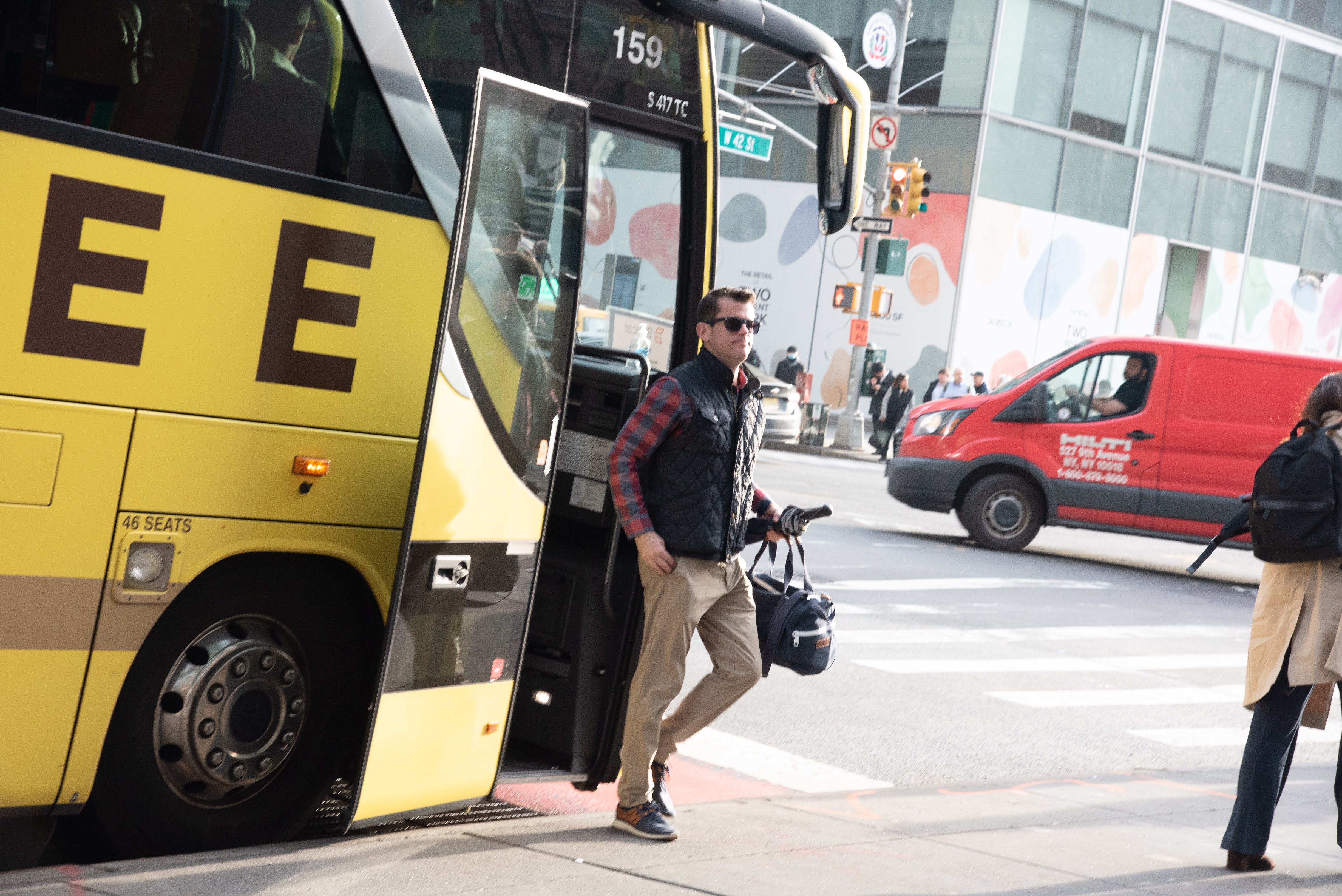
New routes bring the old question back. When DeCamp ended its commuter service in April 2023, Colangelo followed its buses to assess stops and ridership. Boxcar prepared the Essex Express, with fewer stops and reservations for a specific departure. Before launch, roughly 1,200 people had expressed interest and 140 had already booked. Once again, the difference between an encouraging response and a purchased ticket mattered.
“Our customers are willing to trade money for time and convenience.”
Joseph Colangelo, 2024
There are limits to the proposition. A premium fare asks riders to make a choice about their budgets. Road traffic remains road traffic. Colangelo's 2024 account of experiments from Connecticut acknowledged that congestion on I-95 had made those trips late. A service built around convenience has to treat an inconvenient result seriously.
How much room is enough?
In 2023, Colangelo encountered Napaway at a bus convention in Orlando. Its coach interiors made him think of Pullman sleeping cars. He arranged a pilot on Boxcar's Morris Meteor, including seats that could become private suites with lie-flat beds. The weekday commute briefly acquired the possibility of considerably more elbow room.
The pilot's reasoning was as interesting as the upholstery. Colangelo priced it to learn whether the extra comfort justified a fare that could support the service over time. He offered early access to longstanding customers and frequent riders, including people who had kept memberships or bought Boxcar's other products during the lean period.
This was another paid experiment, with better seating than the driveway had offered. Preference alone would not answer the business question. Customers might like an upgrade and decline to buy it at a sustainable price. By making the price part of the trial, he kept the test connected to the company he would actually have to run.
The next stop still needs passengers
Demand can arrive suddenly. In May 2025, as a possible NJ Transit rail strike approached, Boxcar asked residents to nominate communities for service. Metuchen shared the request with its residents. Submissions jumped from ten to 140, and within six hours Boxcar announced a new route. Colangelo was working with bus companies on driver training and the altered schedules. The fast announcement came with slower, physical work behind it.
That same spring, a partnership with NY Waterway extended the proposition beyond a direct coach ride. Starting May 2, commuters from Morris County could buy a combined shuttle-and-ferry ticket, connecting through Jersey City to Manhattan. Colangelo said customers working in Jersey City and downtown Manhattan had long asked for an easier trip. This answered a different destination problem using another operator's existing network.
The ambition has become larger, but its scale can still be measured in practical choices: a pickup location, a useful departure, a seat someone will reserve again. Colangelo's biography has room for naval service, consumer policy, honey fermentation and a growing transportation company. The thread running through it is his willingness to enter the ordinary work each venture demands.
The driveway was a small place to begin. It was also a place where an answer could be obtained. A commuter parked, paid, and returned. Years later, with a coach to arrange and a river to cross, that remains a persuasive way to decide what comes next.