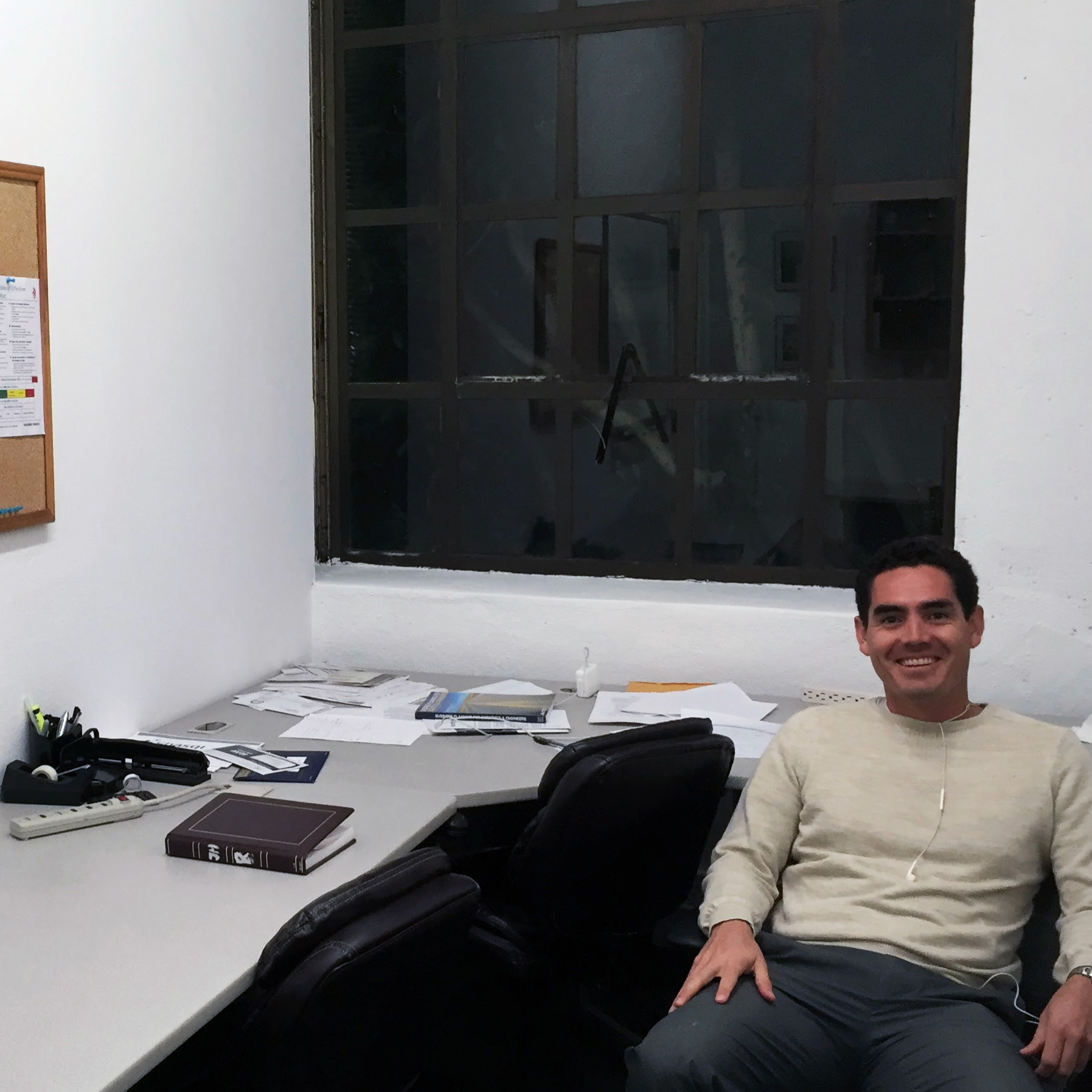
The desk is crowded. Loose papers gather beside a stack of books. A black chair occupies the foreground; José M. Mejía Oneto sits to the right, smiling, with earphones hanging down his sweater. Behind him is a large, dark window. It is an early Shasqi office photograph, and its chief luxury appears to be room for more paperwork.
It is a useful place to begin a founder’s story. The familiar version starts with an idea and jumps to a funding announcement. This photograph supplies the missing furniture. Someone has to sit down and turn the idea into a working organization. A doctorate can prepare a person to investigate a question. Running a company introduces a rather different examination.
For Mejía Oneto, a Peruvian scientist who became Shasqi’s founder and chief executive, that second education included online lectures, an accelerator, investors, collaborators and an old friend. His company’s history contains enough chemistry to fill a technical seminar. His own history raises a more everyday question: whom do you need beside you when your training takes you somewhere it never promised to go?
The scientist goes back to school
His formal education had already covered considerable ground. At Macalester College in Saint Paul, he studied biology and chemistry, graduating in 2001. He then earned a doctorate in organic chemistry at Emory University. These are disciplines in which a plausible explanation must eventually face an experiment. A pleasing story has a short shelf life if the result refuses to cooperate.
By 2014, he was leaving an established training path to pursue the idea that would become his business. To learn how companies worked, he watched Y Combinator’s Startup School talks. The detail deserves a moment. After years inside universities, he was using freely available lectures to begin learning another craft. The person with the advanced degree had become a beginner again.
When he learned that Y Combinator was funding biotechnology startups, he applied. The accelerator’s account places him in its first wave of such founders. There was no long corporate apprenticeship between the scientific work and this application. He was learning how to organize a business while trying to give the business something worth organizing around.
An accelerator can provide deadlines, introductions and an audience. It also asks a founder to explain the same work to people who have never spent a day studying it. For a scientist, that is a demanding change of register. Years of specialized thinking must become a proposition another person can understand, question and decide to support.
- 2001Macalester
Biology + chemistry - EmoryDoctoral study
Organic chemistry - W15Y Combinator
Company building
A company name with a long memory
Shasqi belongs to Y Combinator’s Winter 2015 batch. Mejía Oneto’s founder biography adds an easily missed detail: he joined the program with Tambo, and Shasqi became its spinoff in 2018. The company’s early chronology includes both names. A business can have a beginning before it has the name by which most people will know it.
The eventual name reaches much further back. Mejía Oneto drew on the chasquis, the runners who carried messages and goods through the Inca empire. It is a reference to his native Peru, placed on the front door of a San Francisco company. In a field fond of abbreviations, he chose a word with a human occupation behind it.
The attraction of the image is easy to understand. A runner has somewhere to go, something to carry and a responsibility to arrive. The name gives a specialized enterprise an ordinary verb: deliver. It also allows a piece of the founder’s background to travel with the company. His American education did not require him to leave every earlier association at the campus gate.
The company credits a chance meeting with chemist Carolyn Bertozzi as a catalyst in his route to Y Combinator. Bertozzi later shared the 2022 Nobel Prize in Chemistry. The sequence matters: the meeting belongs to the uncertain early period. Its place in the story is an introduction that helped a young enterprise move forward, years before the Nobel announcement.
The person he already knew
One important business relationship began well before there was a business. In 1997, Mejía Oneto met Sebastian Sanchez de Lozada during their opening weeks at Macalester. They were two South American students on a college van trip to obtain Minnesota identification cards. They later shared a room in Kirk Hall.
After graduation, their professional lives separated. In 2015, they met again in Washington, D.C. Mejía Oneto discussed the venture he was developing. By 2017, Sanchez de Lozada had moved to San Francisco to join him, taking responsibility for functions including finance and human resources.

There is a pleasing lack of ceremony in that origin. The future colleague first appeared on an administrative errand. Much later came the job title. Their story is a reminder that a professional network may begin before anyone has a profession, and that knowing someone’s habits can become valuable when the stakes change.
The division of responsibilities also gives the partnership substance. A scientific founder needs other people to own parts of the enterprise. Payroll, hiring and financial planning have their own standards of correctness. An organization becomes more credible when those responsibilities belong to people trusted to exercise judgment, rather than waiting indefinitely for the founder to finish everything else.
Learning what money is for
On October 31, 2019, Shasqi announced a $10 million Series A. Its investors included Y Combinator and a group composed primarily of private individuals. The announcement assigned the proceeds to manufacturing and the next stage of development. The number made the headline; the allocation described the work.
That distinction is helpful when looking at Mejía Oneto as an executive. A financing announcement records a transaction. Inside a company, the transaction must become contracts, schedules and decisions. Scientific founders are often described through their ideas, but the chief executive’s job also includes making an idea financially and operationally possible over time.
Individual round sizes, shown on the same scale. Announced October 2019 and November 2021.
In November 2021, Shasqi announced a $50 million Series B. Named participants included Juan Jaen and William Rieflin, both experienced company leaders. The announcement paired support for existing work with investment in additional programs. It described a business preparing to carry several projects, with the accompanying demands on time and attention.
Rieflin praised the team’s use of its earlier capital. That was an investor’s assessment, but it reveals what he chose to notice: the relationship between resources and work completed. For a founder, raising a larger round brings a larger obligation to make those resources useful. The arithmetic is straightforward. The management rarely is.
Adding people who have done it before
Mejía Oneto has also built a circle of experienced advisers around the company. In February 2021, Shasqi announced strategic advisers spanning corporate strategy, development and science. He described the selection as deliberate, tied to the capabilities the company would need during its next period of growth.
Such appointments are easy to skim past. They can look like a list of biographies appended to an announcement. In a founder’s working life, however, access to experienced judgment can matter as much as another introduction. Someone who has already managed a difficult transition can ask the question a first-time chief executive has not yet learned to ask.
The business relationships continued to widen. In June 2023, Shasqi announced a research collaboration with Johnson & Johnson Enterprise Innovation. An expansion followed in October. Those two announcements show another part of the founder’s work: building relationships in which a small company contributes specialized expertise to a much larger organization.
In October 2025, Roger Dansey joined Shasqi’s board after senior roles at Pfizer and Seagen. Mejía Oneto emphasized the experience Dansey would bring to the company’s next stage. The appointment fits a recurring pattern in this career: acquire knowledge through people, then make a place for that knowledge in the organization.
“We’re just scratching the surface of what can be done with this technology.”
José M. Mejía Oneto, 2022
His public writing offers another view of the job. On LinkedIn, he has published reflections titled “Notes from the road” and “Learnings from the Road,” alongside technical articles. The titles suggest the travel and conversation that accompany running a specialized company. A chief executive must keep explaining the work outside the room where it happens, then return with something useful for the people doing it.
Still a student, now the chief executive
The title at the end of this journey is founder and CEO. Yet the more revealing progression runs through the ways he has learned: university study, experiments, online talks, an accelerator, an old friendship and the accumulated experience of colleagues. None supplies the whole education. Together they help explain how a scientist becomes responsible for a company.
Return to the early office photograph. The papers are still scattered across the desk. The books are within reach. There is room for another person to sit down. It is an ordinary scene, which is precisely its appeal. Before an enterprise can become a series of public announcements, it has to become a place where people can get on with the work.