Jonathan Dambrot once earned his money by making people wonder how something worked. As a high school magician, he performed on weekends, manufactured three tricks and shipped them around the world. The business helped pay for college and bought his first car. Years later, running Cranium AI, he is asking companies to look rather more closely at the machinery. Somewhere inside their software, an artificial intelligence system is doing something. He would like them to know what.
The connection is tempting, though Dambrot's route into security involved a few stops that resist the tidy founder biography. There was a chocolate business. There was an online MBA. There was a cybersecurity company built while he studied, followed by a partnership at KPMG. The through line is a practical habit: learn a subject, find a problem people will pay to solve, and build a business around it.
The trick was a business
Magic required more than a willing audience. Dambrot collected books, including volumes he remembers being roughly 150 years old, and searched them for material other performers had overlooked. He liked the depth of the subject and the company of people equally absorbed in it. A weekend performance was the visible part. Reading, making and selling supplied the rest.
His next venture had a family apprenticeship. His grandfather was a chocolatier, and Dambrot learned the trade from him before running a chocolate business during college. It gave him time with his grandfather as well as experience making and selling a product. The career path from confectionery to cybersecurity is unlikely to become a standard university prospectus. It does, however, suggest a founder who was learning commerce before he chose an industry.
“I found joy in just this very deep knowledge of a subject.”
Jonathan Dambrot, in conversation with Jim Barrood, March 2026
An MBA with a company attached
Dambrot completed his MBA through Penn State World Campus in 2005. He was building Prevalent during his studies, putting the relationship between coursework and work under immediate examination. Business school supplied a community of people with different backgrounds, living in different places. The company supplied problems with deadlines.
He later described communicating online and working with people around the world as skills in their own right. That is a useful detail in a career often summarized by funding rounds and titles. His education included the mechanics of cooperation: making a group function when its members did not share a room, a background or a working day.
The arrangement also complicates the familiar image of the founder abandoning education because business could not wait. In Dambrot's case, the two proceeded together. He could bring the business into his studies and take the experience of a distributed classroom back into the business. Long before AI governance became his daily subject, he was learning how people with different perspectives could work on the same problem.
The risk came through the supplier
Prevalent, which he co-founded in 2004, concentrated on third-party risk. A company could invest in its own security and still depend on suppliers handling sensitive information beyond its direct control. Those relationships created a difficult question: how much did the customer really know about the organizations it depended on?
By November 2016, Prevalent had secured a $60 million Series C led by Insight Venture Partners. Its Synapse platform combined assessments, monitoring and shared information about vendors. The announcement said more than 200,000 vendors were being monitored and managed through the platform. Dambrot was its CEO and co-founder; Norman Menz was co-founder and chief technology officer.
The significance for his later career is straightforward. He was already building a business around visibility across organizational boundaries. Security did not end neatly at the edge of a company's own systems. The supplier mattered, and so did the supplier's information. An enterprise could outsource a service while retaining plenty of reasons to worry about it. The contract, regrettably, could not do the worrying on its behalf.
A question inside KPMG
At KPMG, Dambrot led third-party security globally and worked with teams using machine learning to address clients' problems. It was an opportunity to apply new tools to a field he already understood. It also exposed a gap between building AI and defending it.
He dates the idea for Cranium to around June 2021. AI systems were being developed and delivered, but he was concerned about their protection against adversarial threats. When he took the question to cybersecurity leaders at major clients, he found another difficulty: security teams and data scientists did not necessarily have a working relationship. They used different technical languages. Security could struggle to see the AI already running inside the enterprise.
That observation gives the origin story its bite. A sophisticated organization could employ capable specialists and still leave an important responsibility between them. The missing conversation became a product opportunity. Dambrot began developing a platform through KPMG Studio, bringing clients into the process as design partners. The people who would eventually use it could help determine what it needed to show them.
From an internal pitch to an independent company
He has described assembling the business plan and pitch deck over a weekend. His recollection of the deck is cheerfully unflattering. KPMG nevertheless supplied an initial $3 million to begin building. Cranium became the first spinout from KPMG Studio, emerging from stealth in April 2023.
Six months later, the company announced a $25 million Series A led by Telstra Ventures, with KPMG and SYN Ventures participating. The October 2023 announcement put total funding at $32 million at that point. The money was intended for product development, research and expansion.
The commercial proposition followed the original observation. Data science, cybersecurity and compliance needed a shared view of AI risk. Cranium set out to provide one while fitting the processes teams already used. This was a founder selling the value of a conversation, then building software to give that conversation something concrete to discuss.
Cranium's announced Series A, led by Telstra Ventures. Total announced funding then: $32 million.
A company rule short enough to remember
For all the technical language around his business, Dambrot's approach to colleagues includes a policy requiring very little translation: “no jerks.” He talks about building an environment where talented people can work together on substantial problems, with respect as part of the bargain.
There is a practical reason to care about that in his particular business. Cranium began with a problem spanning teams that did not communicate well. A founder trying to connect disciplines has a strong interest in hiring people who can listen across them. Expertise needs to travel without making every conversation a contest.
His public account of a 2025 leadership gathering offers another detail. The group read Carol Dweck's Mindset and discussed leadership alongside sales, marketing and company results. It is a small glimpse of how he wants the business to develop: people preparing to lead, with a book on the table as well as a plan.
Take the inventory to Washington
On June 12, 2025, Dambrot brought his argument to the House Homeland Security Subcommittee on Cybersecurity and Infrastructure Protection. The hearing concerned securing artificial intelligence to strengthen cybersecurity. His written testimony asked for security throughout an AI system's life, from development into everyday operation.
He described an AI Bill of Materials: a record of components such as models, datasets and external services. He also discussed adversarial testing and documentation that could help customers, regulators and internal teams understand a system's security posture. An inventory becomes useful when someone can test what is on it and act on the result.
His policy argument favored measurable security outcomes, including weaknesses found and addressed, and continuing oversight as systems change. Autonomous agents added urgency to that position. Once software can take actions, its permissions and behavior become part of the security question. The familiar demand to know what a supplier is doing had acquired a new subject capable of doing things for itself.
- 01DiscoverFind the AI
- 02ObserveWatch behavior
- 03GovernApply policy
- 04SecureTest and defend
- 05ProveShare evidence
The AI Trust Loop repeats as systems change. An inventory is the beginning of the work.
Back on campus, with something to give
Penn State remained part of Dambrot's working life after graduation. He served as both a member and chair of its Outreach and Online Education Advisory Board. He and his wife, Alana, supported the university through gifts including the Dambrot Fund for Excellence in the World Campus and AI Excellence Awards.
The university recognized him with its 2015 World Campus Outstanding Alumni Award and the 2023 Fischer Award of Distinction. His support also reached Shaver's Creek Environmental Center. The range matters: the public record includes students, online learning and an environmental center alongside the enterprise software career.
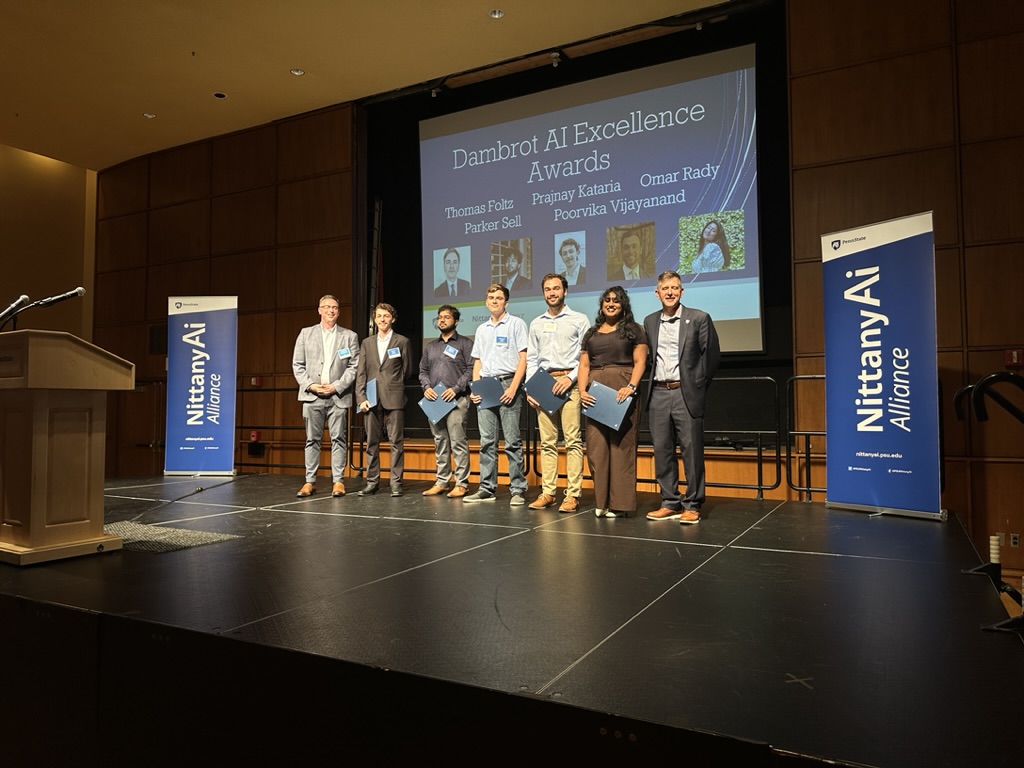
The awards continued into 2026. At the April Nittany AI Challenge celebration, Dambrot presented five students with $1,000 each through the Jonathan and Alana Dambrot AI Excellence Awards. For a founder whose own company grew alongside graduate study, the connection is unusually tangible. Students get resources while their projects are still taking shape, at the point when an idea needs work and encouragement more than a polished biography.
The next thing that needs explaining
In May 2026, Cranium announced its acquisition of Aiceberg, adding technology and people focused on agentic AI security and risk management. The announcement said Aiceberg's employees would move to Cranium and its CEO, Alex Schlager, would join as chief technology officer. Dambrot's company was extending its attention from understanding AI systems to the behavior of increasingly autonomous ones.
There was recognition outside the software business, too. In September, the Financial Women's Association named him its 2026 Male Ally of the Year for its October anniversary gala. The same public profile described his work advising boards and policymakers and his participation in New Jersey's AI Task Force innovation subgroup.
The teenage magician learned to build a business around a mechanism the audience could not see. His current business depends on getting the mechanism into view. There is still room for surprise. Dambrot would prefer that a company's security team did not have to applaud it.
Keep looking
Interviews, appearances and further reading.