A company can spend years building something and still struggle to persuade Wall Street to look up. John R. Exley III has made a business out of that awkward interval between doing the work and getting anyone to notice. The founder and CEO of Acorn Management Partners approaches it with a broker's instinct: find the people who speak to investors, give them a reason to listen, then keep the conversation going.
There is a pleasing lack of glamour in the mechanics. Telephone calls. Follow-ups. Comparisons. Questions answered more than once. In an industry that can make a spreadsheet sound like a religious revelation, Exley's proposition has a practical streak. A public company needs a way to carry its story into the offices where investment decisions are discussed.
His career has taken him through brokerage, investment management and the supervision of brokerage offices. At Acorn, he has turned that experience toward companies that may have a stock-market listing but little of the attention that a listing appears to promise. Being available to buy and being understood are two different milestones. He calls the problem the “Neglect Effect,” and his ambition is to help smaller public companies work their way out of it.
The education before the pitch
Exley attended Virginia Commonwealth University's School of Business from 1989 to 1993. His professional background includes senior investment roles associated with Raymond James and JP Turner, managing private-equity and institutional accounts, with work involving smaller and midsize companies. He also owned multiple offices of supervisory jurisdiction, or OSJs, for regional broker-dealers.
The abbreviation is worth unpacking. Supervising a brokerage office puts someone close to the business of how securities are explained and sold. Exley's later emphasis on training, repeat contact and the financial professional as an intermediary makes sense against that background. He had worked on the receiving side of the corporate pitch before building a company to improve its delivery.
Acorn dates its establishment to 2009. Its present business combines broker education, distribution and support for investor communications. The familiar audience for a company's announcement is the investing public. Exley concentrates on a more particular audience: licensed professionals with existing client relationships.
That choice gives the enterprise its shape. The person answering the phone needs more than a company's enthusiasm for itself. A broker has to understand the business, compare it with alternatives and decide whether it belongs in a further conversation. Exley built Acorn around doing that explanatory work repeatedly.
Six steps between a name and a conversation
Acorn describes a six-step engagement process that moves from qualification and investment thesis through comparative analysis, supporting evidence, dialogue and access to executives. Read in plain English, it is a sequence of increasingly demanding questions. Is this relevant? What does the company do? What makes the proposition credible? Who can explain the difficult parts?
The sequence matters because information does not arrive in a broker's office on an empty desk. It competes with existing holdings, other opportunities and clients who quite reasonably expect attention of their own. A good explanation has to survive that competition. A second call may be necessary. So may a third.
- 01 Qualification
- 02 Investment thesis
- 03 Comparisons
- 04 Validators
- 05 Dialogue
- 06 Executive access
For each client, Acorn says it makes 3,000 outbound calls and delivers around 700 broker presentations a month. These are the firm's descriptions of its activity, rather than a promise that every call becomes a shareholder. The distinction is essential to understanding the job Exley has chosen. He can organize outreach; the eventual investment decision belongs elsewhere.
The numbers also give his philosophy a physical scale. Whatever the sophistication of the presentation materials, somebody must still make contact and establish relevance. The telephone, a device rarely accused of being fashionable, retains a substantial supporting role in this version of capital markets.
“Although we believe in technology, we know that investor relations really boil down to relationships.”
John R. Exley III · AMP Marketing, 2012
That line appeared in his 2012 description of Acorn's marketing approach. More than a decade later, the company's reporting materials still put the individual broker relationship near the center. Technology records the conversation and helps organize the next one. The relationship supplies the reason to have it.
The bill arrives with the promise
There is a commercial contract underneath all this talk of understanding. On September 28, 2026, Massimo Group entered a strategic outreach and consulting agreement with Acorn. The term runs through September 27, 2027, unless terminated earlier. Services include investor awareness, broker outreach and professional relations.
The arrangement provides $15,000 a month in cash compensation. If it continues beyond the initial six months, it also provides deferred equity compensation valued at $125,000, capped at 90,000 shares. Those details turn a general proposition about visibility into something a management team must budget for and assess.
Massimo Group's agreed cash fee to Acorn, with conditional deferred equity compensation after six months.
The history includes a less comfortable document. On October 15, 2013, Mister Goody's president, Joel Arberman, sent Exley a letter cancelling the company's September 11 agreement with Acorn for alleged non-performance. The letter establishes the client's stated reason for ending that engagement. It does not settle what happened across Acorn's other work.
For a business built around communications, the question of performance is unavoidable. Activity can be counted. Its contribution to a company's market reception is harder to isolate. Exley's firm's current materials describe broker reports, perception audits and measures of engagement. Those are ways to make the work inspectable, while leaving room for the distinction between a completed task and a satisfied client.
A seat at the smaller-company table
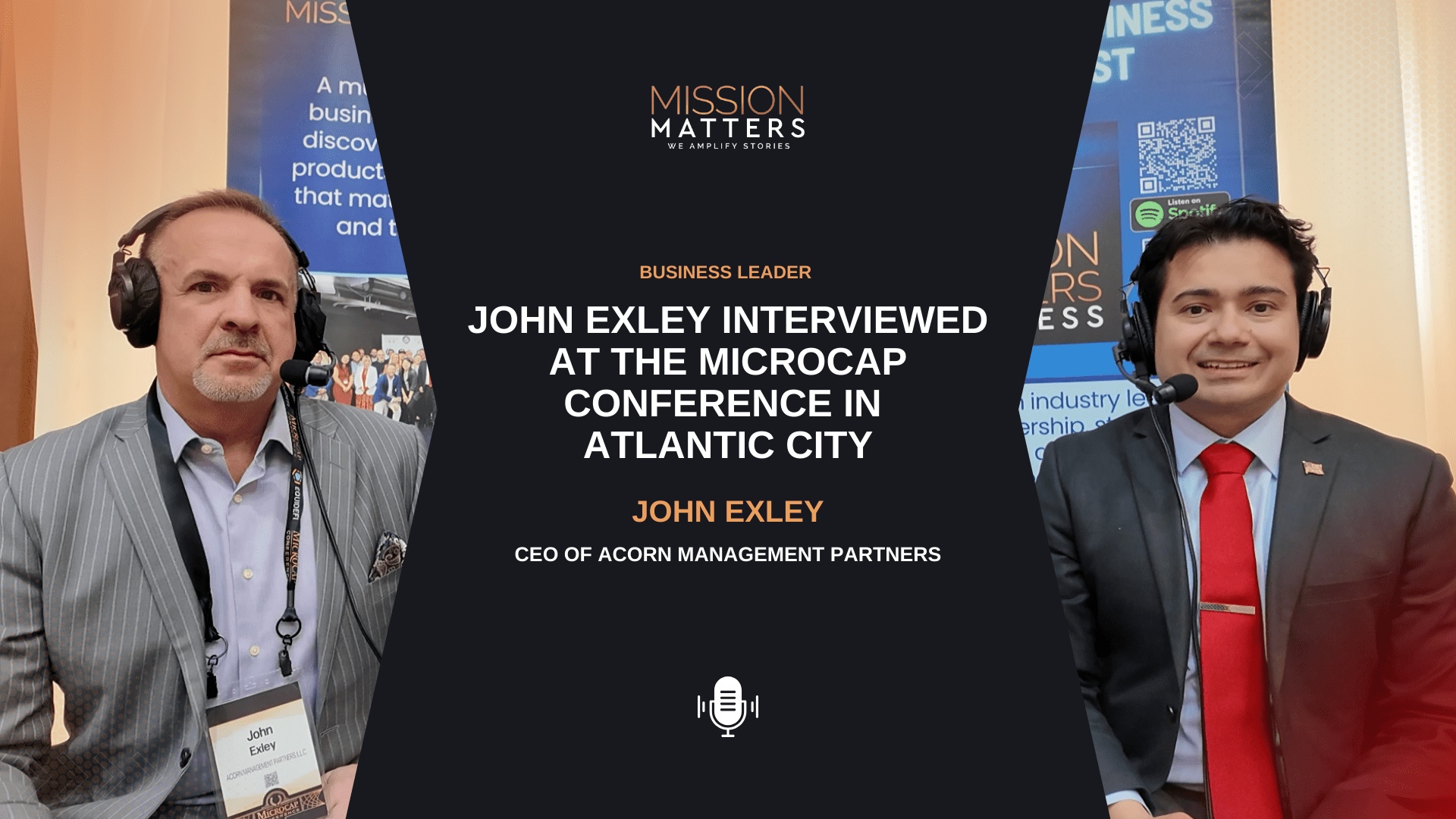
In February 2025, Exley appeared in a Mission Matters interview with Adam Torres recorded around the Microcap Conference in Atlantic City. The episode runs 10 minutes and 46 seconds. It puts him in the setting where much of his professional world meets: executives, advisers and service providers gathered around companies that must make a case for attention.
Acorn has also listed him among its participants at the Planet MicroCap Showcase in Las Vegas, alongside Greg Lowe, Austin Gilbert and Shelby Exley. These gatherings make the relationships in his business model less abstract. The people presenting companies and the people evaluating them can occupy the same room.
His work sits in that meeting place. He runs a service company whose customers are themselves trying to explain operating businesses to financial audiences. That requires translation in both directions: management has a strategy to describe, while brokers have questions about relevance, comparisons and timing. The useful conversation begins when those concerns meet.
The argument travels onto the page
Exley has become a regular publisher of market commentary on LinkedIn. In summer 2026, his subjects included workflow software in the AI economy, the power constraints facing cloud infrastructure and the funding demands surrounding artificial intelligence. The subjects range beyond the daily operations of an investor-communications firm, but remain close to its basic concern: where attention and money go.
In September, he applied that concern to Xperi. His article argued that the company's market reception failed to reflect the operating business, and connected that gap to the distribution of its investment story. He explicitly said Xperi was not an Acorn client. His interpretation of the stock remains an argument, rather than an established explanation for its valuation.
The example is revealing because he is willing to connect his company's general proposition to a named business. It gives readers something concrete to examine and disagree with. A theory about overlooked companies becomes more useful when it has to contend with one company's actual circumstances.
His writing also shows the extent of his interest in the machinery around a stock. He moves between business performance, ownership, liquidity and the institutions through which a company reaches potential buyers. The recurring subject is how information travels, and what may happen when it fails to travel far enough.
The coach in the brokerage office
Outside work, Exley coaches youth football, plays golf and follows the Georgia Bulldogs. He identifies as a Christian, and Acorn places faith and education among its stated principles. His biography describes mentoring newer colleagues and taking satisfaction in an employee or young athlete achieving something previously beyond their expectations.
The coaching connection offers a modest, useful way into his professional interests. Instruction requires repetition. Progress has to be observed. An explanation that makes sense to the teacher may still need work before it makes sense to the person learning. Those are also the practical demands of introducing an unfamiliar company to a busy financial professional.
There is room for some humor in that parallel. Football has the advantage of a scoreboard everyone can see. Corporate visibility is a more argumentative sport. A broker may listen carefully and still decline. A company may explain itself well and still face difficult market conditions. Patience is part of the work; proof remains a separate obligation.
Exley has built his business around the distance between a company's own understanding of its value and the market's willingness to engage. Across calls, conference appearances and articles, he keeps returning to the people who can help close it. His proposed remedy begins with an ordinary act that a listed company can easily underestimate: explain the business to someone who has a reason to ask another question.