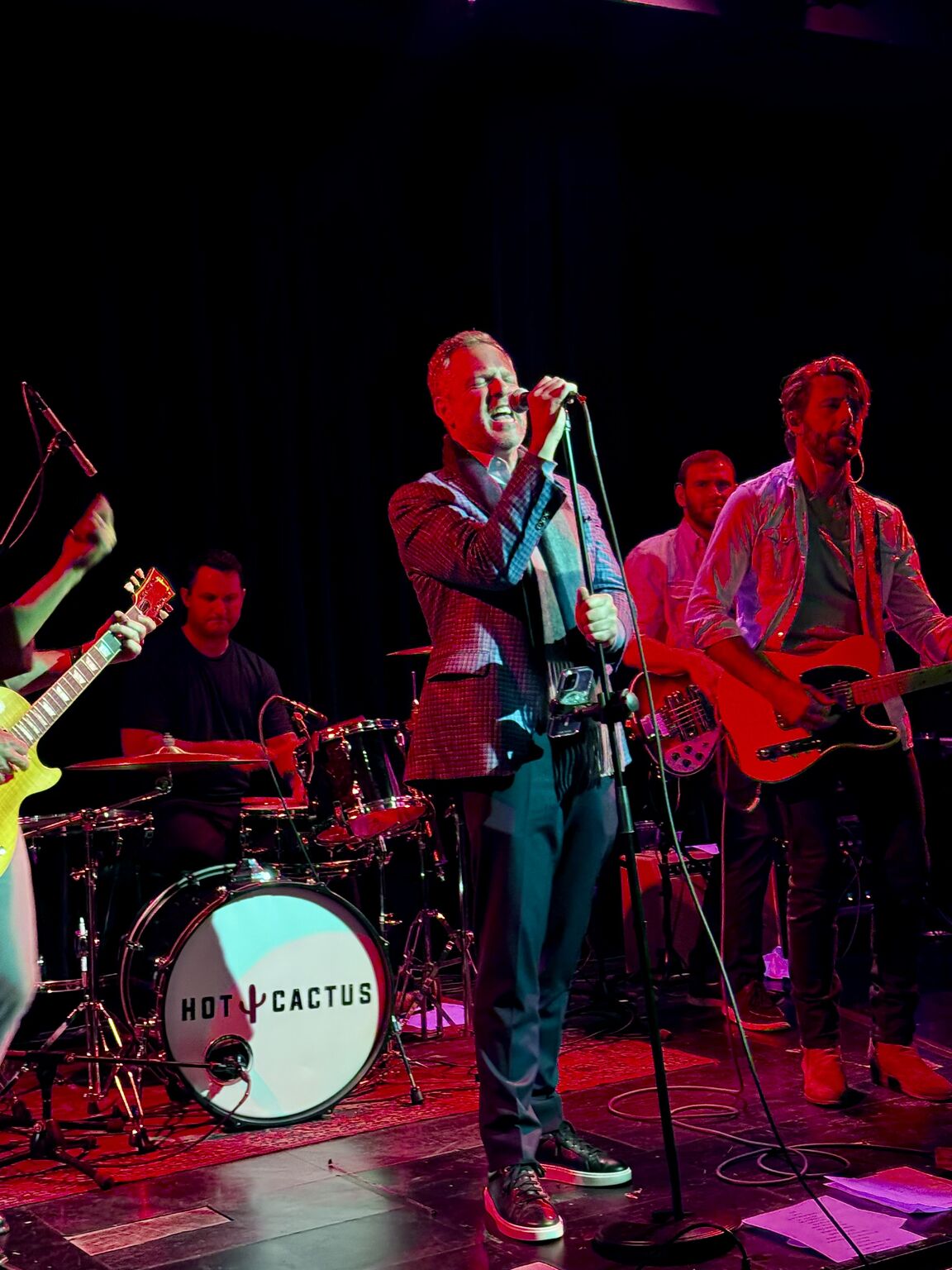
John Murray is holding a microphone, wearing a checked jacket and standing in front of a drum kit marked Hot Cactus. Red stage light washes across his face. A guitarist stands beside him; cables gather at his feet. The photograph has all the ingredients of a respectable evening becoming a considerably less respectable one. It also offers a useful entrance into a career usually described with the words strategic communications.
Murray shared the picture among a collection celebrating his years at Monument Advocacy. There are colleagues, outings and a company history in the same collection. The microphone is a small reminder that public affairs involves people looking up from what they were doing and deciding whether to listen. A job title can arrange a meeting. It cannot arrange attention.
For much of his working life, Murray has occupied the space between a message and its audience. On Capitol Hill, that meant communications, political outreach and strategic initiatives for Eric Cantor. At Monument, it meant adding a public affairs practice to an established government relations business. Since July 2024, it has meant running the firm.
Cantor had a peculiar description for his aide: “national chess piece person.” The phrase suggests movement, placement and an eye for consequences. It is also a delightfully awkward thing to put on a business card. Murray’s career gives it substance: campaigns, congressional leadership, consulting, advocacy organizations and, eventually, the responsibility of coordinating a growing company.
There is a tempting way to tell this story as an uninterrupted ascent. The more interesting version follows the changes in what he was asked to do. First came getting a political message across. Later came building a business around that skill. Now comes making sure other people can do it together.
An eastbound beginning
Murray’s route to Washington began in Seattle, took him east for college and then south to the capital. He attended Franklin & Marshall College in Pennsylvania. When he describes the next step, he dispenses with the grand origin myth: he did not have a better plan and wound up working on Bob Dole’s 1996 presidential campaign.
That admission is worth keeping. Political careers often acquire suspiciously tidy beginnings in retrospect, as if every college graduate had already drawn a map to a leadership office. Murray’s account leaves room for the practical accident: take a job, find people who know the work, discover that you want to learn it.
At the Republican convention in San Diego that year, he met communications professional Mark Merritt. Murray remembers him as an early mentor. The apprenticeship matters more than the glamour of the convention setting. Campaign communications compresses a demanding task into a short deadline: determine what matters, put it into usable language and get it to people who have plenty of other things to think about.
His subsequent work crossed consulting firms, corporations and trade associations. He was a founder and partner of AB+M Partners, a strategic communications and public affairs firm, and worked at Burson-Marsteller. These were different institutional settings for a recurring problem: a message has to survive contact with someone outside the room where it was written.
By the time Murray worked for Cantor, communications had become part of a wider brief. As deputy chief of staff, he dealt with press, strategic initiatives and political outreach. Each involves a different clock. A reporter needs an answer now. A political relationship develops over time. A larger initiative can require patience long after the first announcement has disappeared.
Learning to work beyond the office
Murray went on to found and lead the YG Network and the YG Action Fund, organizations associated with the conservative Young Guns movement. The distinction between them matters: the network was an issue advocacy organization, while the action fund was a super PAC supporting candidates. Ideas and elections meet often in politics, but they involve different jobs.
In spring 2013, he became a resident fellow at Harvard’s Institute of Politics. The fellowship placed a practitioner of political communications in an academic setting. It is a useful waypoint in his story: the work that had occupied campaigns and leadership offices could also become something to examine, explain and discuss with students.
He founded JAM Strategies, too. In 2015, he joined Burson-Marsteller’s Direct Impact operation as a senior adviser, alongside Luke Albee, a former senior Democratic Senate aide. The pairing is a concrete example of communications work bringing people with different political histories into the same professional enterprise.
Those changes in setting help explain the breadth of the eventual Monument assignment. Murray had worked inside political institutions and outside them, with leaders and with organizations seeking to influence the debate. The client problem could arrive in the language of business while the response had to make sense in the language of politics.
A communications consultant cannot assume that a company’s internal explanation will travel intact. What seems obvious to an executive may need unpacking for an elected official, an employee or a reporter. Each audience brings its own interests. Murray’s path through campaigns, Congress and consulting put those translation problems close together, years before they became the organizing principle of his work at Monument.
A new practice, then a larger table
Murray joined Monument in 2015 to build its public affairs offering. The firm had been founded by C. Stewart Verdery Jr. in 2006 and had established its government relations business. Murray’s assignment added communications to that foundation. Policy expertise could inform the message; the message could help create the circumstances in which a policy argument was heard.
The fit was practical. A client might need a meeting with a lawmaker, a coherent explanation for stakeholders and a response to public criticism at the same time. Separating those tasks creates opportunities for the answers to drift apart. Bringing them into one firm asks the people doing the work to keep comparing notes.
In June 2024, Murray looked back at the scale of the change. When he arrived, he recalled, there were fewer than 15 people and a small client roster. By 2024, the team exceeded 50. The figures describe the organization he helped build, rather than a personal scorecard. More colleagues also means more handoffs, more specialties and more decisions about who should be involved.
The CEO transition became effective July 1, 2024. Verdery remained active, turning his attention toward business development, long-term planning and key clients. An expanded seven-person senior leadership team accompanied the handoff. The arrangement made the transition a redistribution of responsibilities within the business, with its founder still at work.
Verdery’s own explanation was revealing: running a company with more than 50 people and over 120 clients had consumed time he wanted to spend with clients and policymakers. Murray inherited that managerial demand. The same growth that creates opportunities also fills the diary with decisions that have little resemblance to writing the next statement.
Seattle, with room for colleagues
Murray is based primarily in Monument’s Seattle office. For an executive whose career included years in Washington, that gives the story a return journey. The two cities appear throughout the firm’s description of itself, and Murray’s role requires a shared enterprise to work across that distance.
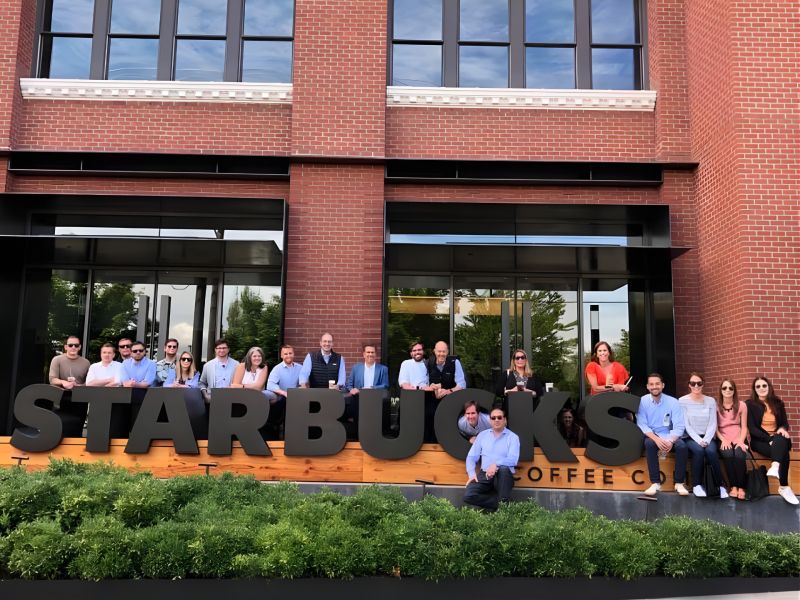
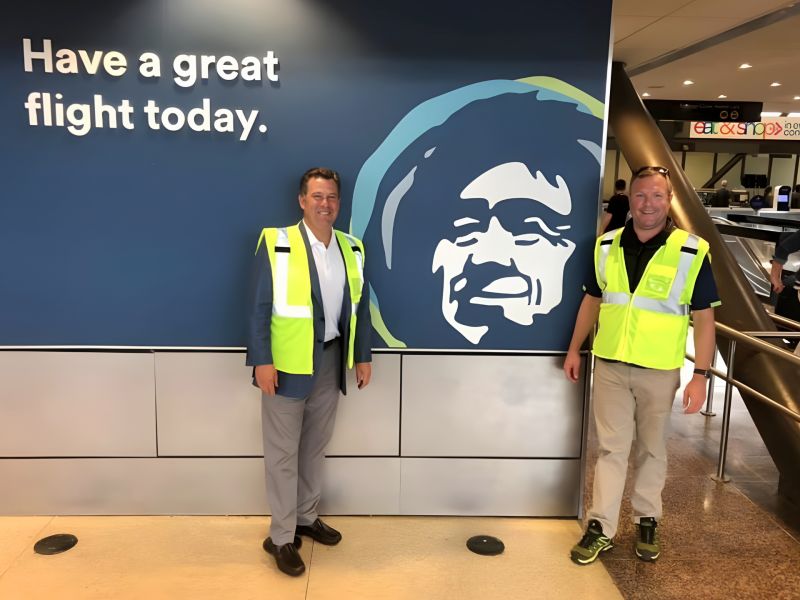
His account of a Seattle team retreat supplies a more approachable picture of what that can mean. Colleagues visited Starbucks for a coffee tasting, toured the Amazon Spheres and took a tarmac and luggage tour with Alaska Airlines. Murray and partner Timothy Punke hosted dinners at their homes. The itinerary combined the city’s familiar corporate landmarks with the less ceremonial business of feeding people.
A photograph from the collection shows colleagues arrayed around a large Starbucks sign. Another shows an airport visit and fluorescent safety vests. These are pleasant souvenirs, but they also make the phrase team building less abstract. The group has left the meeting room. People who usually encounter one another through scheduled work have something else to talk about.
The onstage picture adds another dimension. Years earlier, his Harvard biography recorded that he produced live concerts involving national rock acts from Los Angeles and Boston. Music was already part of the public account of his life in 2013. The later photograph puts him at the microphone himself, a change of position that the picture captures without needing a theory about his character.
There is an easy joke here about political communications and amplification. The better detail is the continuity: the person coordinating policy and public affairs also appears in settings organized around gathering an audience. A concert, a dinner and a client meeting have different purposes. All become more interesting when the people in them have a reason to pay attention to one another.
Capital arrives; the compass stays
Three months after Murray became CEO, Monument announced an investment from Boston-based Everlane Equity Partners. The October 9, 2024 announcement set out an expansion agenda: additional markets, policy areas and capabilities. Murray, Verdery and the senior leadership team would continue leading the business.
Murray’s current biography identifies him as CEO of Monument Policy Group Holdings, the private equity backed platform providing government relations, strategic communications, public affairs and digital services. The wording describes the broader operating structure behind the Monument Advocacy name. His job now reaches across the collection of services that his original assignment helped widen.
Outside investment gives an executive another set of relationships to manage. Clients want attention to their immediate problems. Colleagues need a workable organization. Investors have joined the conversation about growth. The announced plan puts Murray at the point where those interests must be turned into decisions about people, capabilities and geographic reach.
He continued adding communications experience to the team. In December 2024, Monument brought Will Lemke into its Seattle public affairs operation. In March 2025, it recruited Mark Bednar, formerly head of communications for Speaker Kevin McCarthy. Murray had known Bednar for more than a decade. Familiarity mattered alongside the experience the new hire brought from congressional leadership.
By July 2026, Murray was discussing the challenge of staying focused amid a noisy political and media environment on Inside Influence, with David Castagnetti and Brody Mullins. His advice was compact: “Find your North Star” and follow it. After years spent helping messages reach their audiences, he was talking about the discipline required to choose which signals deserve a response.
That is a fitting place to leave him: back at a microphone, offering a short instruction after a long career. The next move still matters. So does knowing which destination the move is meant to serve. For Murray, the assignment has grown from communicating a political leader’s intentions to directing a firm whose people must keep their own work pointed toward a shared purpose.
“Find your North Star”
John Murray · Inside Influence, July 2026