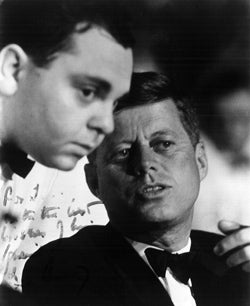
Rain was an unhelpful addition to Joe Cerrell’s assignment. It was a Friday in the spring of 1956, and the USC student had been asked to assemble an audience for a senator from Massachusetts. Students were thinking about examinations and the weekend. John F. Kennedy had come to speak. A modest crowd turned up. In Cerrell’s recollection, the visitor kept taking his glasses out of his pocket and putting them back, without actually wearing them.
It is a useful opening scene for a career spent arranging other people’s entrances. Kennedy was still working out how to become a national candidate. Cerrell was working out how to get people into a room. The second task would keep bringing him into contact with the first.
They met again at the Democratic convention in Chicago that summer. Kennedy remembered him. For a student organizer, that was something to remember in return. Cerrell’s account of those early encounters has the appealing scale of politics before the enormous traveling apparatus: a campus invitation, a few cars, people sharing rooms, arrangements made by someone who could be reached.
A senator, a student, and the weather
Joseph R. Cerrell was born in Queens on June 19, 1935, with the surname Cerrella. His father, Sal, was a New York firefighter. His mother, Marion, became a campaign worker. The family moved west, and Joe graduated from Los Angeles High School before earning his political science degree at USC in 1957.
At USC, he founded the Trojan Democratic Club. The club gave him a reason to invite politicians and gave politicians a reason to know him. Jesse Unruh brought him into Assembly campaign work; Pat Brown’s 1958 campaign for governor supplied another apprenticeship. By 1959, Cerrell was executive director of the California Democratic Party, aged 24.
The progression is striking because the responsibilities accumulated so quickly. A student organization became campaign work; campaign work became a statewide party job. There was little separation between his education and his occupation. He was learning whom to ask, where to send a visitor, and which small practical failure could make a grand political plan look rather foolish.
Kennedy’s California campaign in 1960 brought Cerrell closer to the presidential contest. There would be other candidates over the years, including Lyndon Johnson, Hubert Humphrey, Lloyd Bentsen, John Glenn, and Al Gore. Yet the rainy campus visit remains a better introduction to him than a parade of famous names. It shows him doing a job.
The calendar problem
There was an awkward detail in the emerging occupation of political consulting: elections had endings. A consultant could become exceptionally useful to a candidate and then find the candidate elected, defeated, or unavailable until the next cycle. Professional experience did not automatically produce a continuing income.
Cerrell and his wife, Lee, built the firm that became Cerrell Associates. The company dates its founding to 1966. It developed beyond campaign management into public affairs, government relations, and communications work. The calendar supplied a business problem; continuing clients supplied a way to answer it.
Looking back in 2005, Cerrell described early campaign workers with a phrase that could have belonged to a small repair shop: “We were a jack of all trades.” People arrived from other occupations, did what a campaign required, and often returned to their previous work afterward. He remembered his first Assembly contest, in 1954, as a race won on a $5,400 budget.
That figure belongs to its time. Its interest lies less in a comparison with modern spending than in the kind of work it suggests: a relatively small operation, close enough to its beginnings for one participant to remember the whole account. As campaigns accumulated money and specialists, the occupation became harder to hold in one pair of hands.
“This career did not exist.”
Joe Cerrell, recalling his early plans, 2009
There is a pleasing irony in the institution he helped create. The young organizer had entered a field without a settled professional identity. The experienced consultant watched that field subdivide into narrower trades. Success made the business more organized and its practitioners more specialized. The person once expected to handle everything became one participant in a much larger operation.
The price of a returned call
Cerrell’s practice extended well below the presidential line on the ballot. Judicial elections became an important specialty. That work required attention to contests without the built-in audience of a national campaign. A candidate could possess the qualifications for office and still need help becoming a name voters recognized.
His professional commitments also included leadership of the American Association of Political Consultants and the International Association of Political Consultants. He served on a White House business and public affairs advisory committee by appointment of Jimmy Carter. The organizer had become part of the profession’s own organization.
There was a harder question inside that success. A campaign relationship can continue after election night. The person who has helped a candidate win knows the candidate’s preferences, pressures, and circle of advisers. For a corporate client seeking an audience with government, that familiarity can be valuable.
Cerrell spoke plainly about the advantage: “I’m the one who knows him intimately.” The remark described the connection between winning elections and representing clients with unusual economy. It also exposed the tension. The same closeness that makes a consultant effective can leave the public asking how much influence a client is buying.
- Campaign workLearn the candidate
- Continuing contactKnow the officeholder
- Client representationSeek a hearing in government
A schematic of the overlap Cerrell described, rather than a measure of any particular client’s influence.
That tension belongs in his story alongside the friendships and honors. Cerrell helped build a business around knowledge of political life. Its usefulness to clients and its implications for everyone else were closely connected. A biography that keeps only the convivial photographs would miss an essential part of what his work involved.
A family business with a public life
Politics also brought Joe and Lee together. They married in 1963. Their wedding plans had already yielded to political obligations when Lyndon Johnson asked them to postpone the occasion to help staff an event. Later, on their honeymoon in Paris, they learned of Kennedy’s assassination.
The juxtaposition is severe: a marriage organized around public work, followed by private time overtaken by public history. It helps explain why the family cannot be treated as a decorative detail in Cerrell’s career. Lee was his partner in the firm as well as his wife. The business belonged inside the family story.
Cerrell’s Italian American commitments supplied another community of work. He served as president of the National Italian American Foundation from 1999 to 2005 and later as national vice chairman. His grandparents had emigrated from Calabria. His connections with Italy included recognition as honorary mayor of Rossano and a decoration from the Italian republic.
Some of that public life took place on a deliberately smaller stage. At a NIAF media gathering in Santa Monica, he introduced Italy’s consul general in Los Angeles and the evening’s journalist hosts. Guests discovered connections between the Italian towns their families had left. There were speeches, introductions, and people lingering to exchange stories.
It is an unusually revealing counterpart to the presidential photographs. Here was the same practical activity without an election attached: gathering people, establishing a connection, making an organization useful to its members. A good introduction could serve a candidate, a professional association, or a community dinner.
The next person through the door
In January 2010, Hal Dash took over the chairman and chief executive titles at Cerrell Associates. Cerrell became chairman emeritus. Dash had joined the firm in 1977 and had already spent 21 years as president. The handover placed the company’s leadership with someone who had helped develop it over decades.
Cerrell died on December 3, 2010, at 75. His family remembered his love of politics, his Italian heritage, the New York Yankees, and the USC Trojans. Those loyalties give the public biography a little household noise: a campaign, a ballgame, a university team. A life so often photographed near power still had familiar things to cheer for.
USC was a continuing obligation. Cerrell co-founded its Jesse M. Unruh Institute of Politics and taught as an adjunct professor for 15 years. His involvement gave students contact with political practice. The undergraduate who once brought politicians to campus eventually helped make that kind of encounter part of other students’ education.
The Cerrell Political Leadership Summit carries the idea into Sacramento. The annual spring program brings USC students into contact with executive and legislative leaders. It gives a concrete destination to the word legacy: a student travels to the state capital and meets someone who helps make its decisions.
The firm continued, too. Its present-day work in government affairs and communications carries the family name into a different political world. Both institutions depend on people who came after Cerrell. That is the useful test of what he built: the work can proceed without waiting for the founder to arrive.
Return, finally, to that wet Friday. The audience was modest, the visitor was nervous, and the student organizer could hardly have treated the afternoon as a finished achievement. There would be another invitation, another journey, another event to arrange. Cerrell’s career grew through that succession of practical assignments. He kept giving people a reason to meet. Decades later, students are still being offered the introduction.
Continue the conversation
- Cerrell · the firm
- Kennedy Library · oral history
- USC · life and career
- Los Angeles Business Journal · 2009 interview
- AAPC · professional biography
- NIAF · family appreciation
- Center for Public Integrity · campaigns and access
- USC · Cerrell student summit
- Cerrell on Facebook · company account
- Cerrell on X · company account