Where the code meets the customer
Peregrine sells a promise that sounds simple and turns out to be one of the hardest problems in government technology: take the dozens of incompatible systems a public safety agency runs - records here, dispatch there, evidence somewhere else entirely - and make all of it searchable from a single screen. Sequoia Capital found that promise convincing enough to lead a $190 million round in March 2025, valuing the San Francisco company at $2.5 billion.
Jerod Nelsen sits inside that promise. His title reads Office of the CEO; his work looks like forward-deployed engineering and deployment strategy - the discipline of showing up where the software actually gets used, watching it fail in ways no demo predicted, and fixing it in place. It is less glamorous than the funding headlines and more important than most of them. Someone has to turn a $2.5 billion pitch into a tool an analyst trusts at 2 a.m.
He is well cast for it. Nelsen studied Operations Research and Financial Engineering at Princeton - a major built for people who like modeling how complicated systems behave under pressure - then added a master's from the University of Pennsylvania tied to the Behavior Change for Good Initiative, where the questions run toward how humans and machines make decisions together. Fragmented data, human decisions under pressure: that is the exact seam Peregrine works, and the exact seam Nelsen trained on.
Private equity was the detour, not the destination
The straight line from a Princeton engineering degree runs through finance, and for a while Nelsen walked it. He passed through EY-Parthenon's strategy and transactions practice and did a turn in private equity at Audax - the kind of resume that usually calcifies into a career of spreadsheets and deal memos.
It did not. The pull of building over advising won out, and the master's at Penn pointed him toward decision science rather than deal flow. By 2024 he had landed at Peregrine, trading the clean abstractions of a capital stack for the messy reality of an agency's data. It is a quieter kind of ambition - choosing the room where the product breaks over the room where the term sheet gets signed.
That instinct for the point of contact is not new. It is the same one that made him a good outside hitter.
A captain who read the whole floor
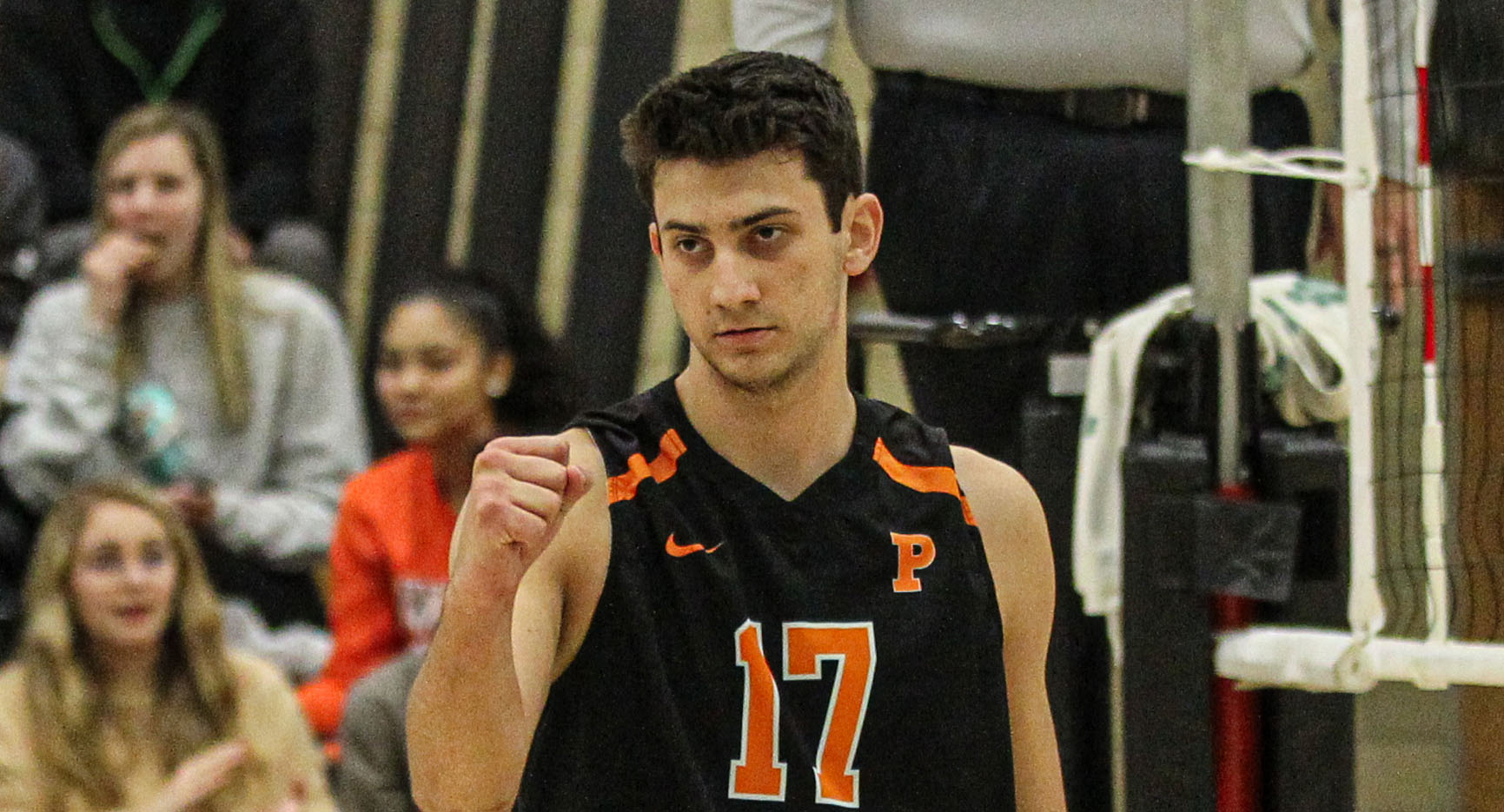
Long before he was reconciling data schemas, Nelsen was a 6'7" outside hitter for the Princeton Tigers, jersey number 17, and eventually a captain. The accolades stacked up early: a 2017 FloVolleyball and Volleyball Magazine High School All-American out of St. Francis in the Bay Area, a two-time West Catholic League Player of the Year, a spot at the 2016 USA Youth Indoor Holiday Camp.
At Princeton the recognition kept coming - AVCA National Player of the Week in February 2020, All-EIVA Second Team the same season, and back-to-back All-EIVA Academic Team selections in 2020 and 2021. He did it while finishing summa cum laude in one of the university's most demanding majors, which is its own small miracle of time management.
Volleyball rewards a specific kind of intelligence: reading the entire court in the half-second before contact, anticipating where the play goes, then committing fully. It is not a bad description of forward-deployed engineering either.
Receipts
The two worlds, measured
Bars are illustrative, scaled for comparison - one company's balance sheet next to one person's wingspan.
A family that overachieves quietly
Nelsen was born April 12, 2000, in Monte Sereno, a small town tucked in the hills above Silicon Valley. He is the son of Nels and Doreen Nelsen and the youngest of three, with two older sisters, Brenna and Kaley. Brenna was a varsity golfer at Harvard - which tells you the household standard for competing at a high level was set well before Jerod picked up a volleyball.
The details that survive the official bio are the human ones: he enjoys music, sports, and travel. He grew up a few miles from the companies whose valuations he now helps justify, and after a run through Princeton, finance, and Penn, he came back to the Bay Area to build. Full circle, more or less.