Jeremy Achin and Tom de Godoy had a peculiar plan for two people with valuable technical skills: teach software to do more of their work. They were data scientists at Travelers, building models in an industry that earns its living by putting numbers on uncertainty. Plenty of people would have treated that expertise as a moat. They treated it as a set of instructions waiting to be written down.
“How would we automate our jobs?” Achin recalled asking. The question became DataRobot, founded in 2012. It also supplies a useful way to follow his career through its subsequent turns: the competitions, the enterprise software, the acquisitions, and the later decision to build new companies while financing other founders.
There is a pleasing professional inconvenience in the premise. Become good at something difficult. Notice how many people need it. Then spend your working life trying to make the difficult part easier for everybody else. A specialist's scarcity can command a handsome price. Achin and de Godoy proposed selling relief from the scarcity.
The day job had an evening shift
Achin studied at the University of Massachusetts Lowell, with a background spanning mathematics, physics, computer science and statistics. His route there included leaving high school and later returning to education. His career offers little encouragement to anyone who believes a professional life must proceed in tidy, preapproved increments.
At Travelers, he became director of research and modeling. His work covered pricing, customer retention, conversion, claims and other problems where yesterday's observations might improve tomorrow's decisions. These were concrete commercial questions. A model had to earn its place by helping someone choose what to do.
Outside work, he and de Godoy competed on Kaggle, where data scientists tested their predictions against one another. De Godoy later recalled a contest for which they had only two weeks to prepare. They finished sixth. More competitions followed, along with top-three finishes. The scoreboard supplied an unusually direct form of professional feedback: the predictions either traveled farther up the table or they did not.
The company idea took shape during their competitions around 2011. Businesses were generating data faster than they could recruit the people needed to analyze it. Repeating the same expert steps for each new problem began to look like a business opportunity. The backlog was becoming part of the product brief.
“How would we automate our jobs?”Jeremy Achin, recalling DataRobot's founding question
Kaggle also helped assemble the people around the idea. Xavier Conort, who shared the founders' insurance background and competed successfully on the platform, connected with Achin and de Godoy there. They later invited him to become DataRobot's chief data scientist. A competition site had doubled as a meeting place for future colleagues.
A company built around the queue
DataRobot entered the Techstars Cloud program in 2013. The basic proposition was to put a greater share of predictive modeling within reach of people who could understand a business problem without having to construct every technical component themselves. Automating the workflow meant training and evaluating models, comparing results, and making deployment less laborious.
That proposition was also a recruiting challenge. To package expert practice into software, the company needed experts. In 2016, when DataRobot announced a $33 million Series B, Achin described the early spending priorities as platform development, technical hiring and helping the first customers succeed. Expansion would follow that groundwork.
The company's financing grew with its ambitions. By September 2019, a $206 million Series E led by Sapphire Ventures brought its announced cumulative funding to $431 million. The round made DataRobot a unicorn. Those numbers describe the company at that point in time; the more interesting question is what the money allowed its founder to attempt.
One answer was to reach well beyond the original modeling desk. The Philadelphia 76ers used DataRobot to improve modeling for season-ticket renewals. It is a useful example precisely because it lacks science-fiction scenery. A basketball business wanted to understand which customers would return. The problem belonged to people who sold tickets.
Another answer was geographic. In 2017, DataRobot announced an initial S$15 million investment in Singapore, intended to support its regional headquarters and research operation. The plan included hiring and an expanded technical presence. Achin's original workplace problem had become a product being carried into other markets, with local people needed to make it work.
The model needed a supporting cast
The acquisitions during Achin's tenure reveal how much work surrounds a prediction. Nutonian, acquired in 2017, brought capabilities in modeling problems including time series. Nexosis followed in 2018, adding another team and technology in automated machine learning. An apparently simple promise to users was producing an increasingly substantial engineering operation behind the screen.
Achin could be pointed about competition. When DataRobot bought Nexosis, he publicly suggested rival companies should consider firing their corporate development people for missing the opportunity. The customary acquisition announcement tends to feature a great deal of mutual delight. This one found room for a small elbow.
In February 2019 came Cursor, a data collaboration company whose tools helped users find and understand information spread across an organization. Its founders had worked at companies including LinkedIn, Salesforce and Pandora. The acquisition addressed a familiar obstacle: before people can make productive use of data, they must discover what exists and what it means.
ParallelM, acquired that June, addressed another obstacle. A model in production needs to be deployed, watched and managed. Its behavior can require attention long after the congratulatory demonstration. DataRobot subsequently announced its MLOps offering alongside the Series E financing, extending the product's remit into that continuing operational work.
Then, in December, DataRobot announced an agreement to acquire Paxata, which specialized in preparing data. Taken together, the transactions show the expanding scope of Achin's original question. Automating a data scientist's job involved a great deal more than running an algorithm. Finding usable inputs and maintaining a working system could occupy the same conversation.
Selected acquisitions announced during Achin's tenure, 2017-2019. A workflow map, not a measure of performance.
Even the future needs a photographer
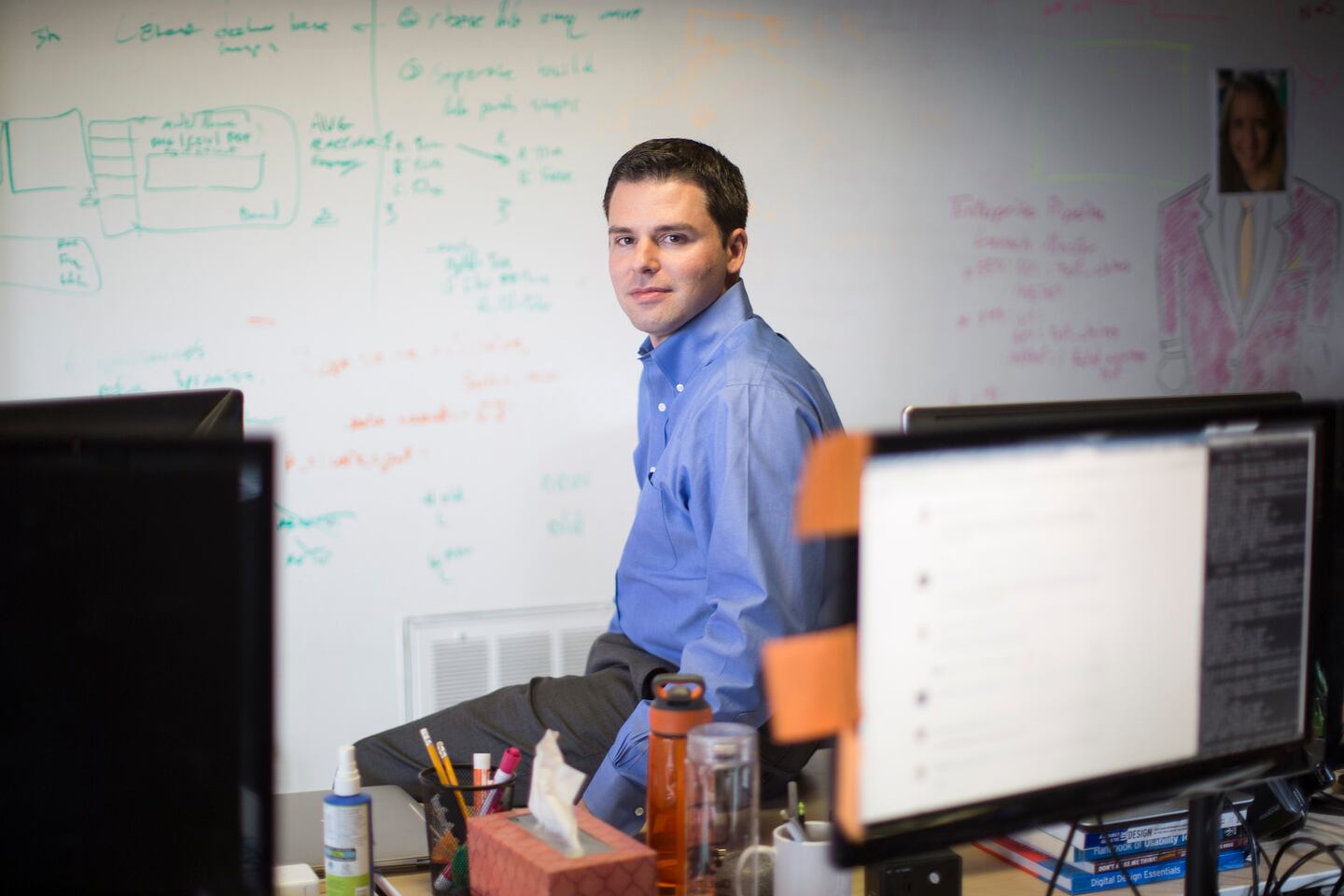
A smaller episode from 2018 offers a welcome change of scale. Posing at DataRobot's Boston headquarters with interviewer Dan Faggella, Achin asked his communications colleague whether they should smile. She jokingly suggested looking into the distance. They went with it. The future, apparently, had been positioned just outside the frame.
The conversation itself concerned a less theatrical future: AI tools that people could use without mastering their internal machinery. Achin described a direction in which users would supply an objective and relevant historical data, while software handled more of the optimization. He expected interfaces to become simpler and less dependent on programming expertise.
That was a forecast made in 2018. Its significance here lies in the continuity of his interests. The founder who had wanted to automate modeling was also thinking about how a person would communicate a goal to a machine. Removing technical steps would only help if users could still express what they wanted to achieve.
His public work widened too. In October 2020, he joined the board of advisors of the Center for a New American Security. The appointment brought his experience into a policy setting concerned with technology and national security, alongside leaders from government, academia, the military and business.
Three beginnings after DataRobot
Achin's tenure as DataRobot CEO ended in 2021, after roughly nine years. He went on to co-found hOS and Neo Cybernetica and to start Cortical Ventures with Igor Taber. The next chapter involved both running young companies and helping decide which other young companies should receive capital.
The partnerships carried earlier working relationships forward. Taber had been an investor in DataRobot at Intel Capital before joining its management team. Natalie Hogan, a former DataRobot executive, became hOS's co-founder and chief operating officer. Dmytro Zahanych became the technical co-founder alongside Achin at Neo Cybernetica.
In February 2022, Neo Cybernetica announced a $30 million seed round led by NEA. Tony Florence, who had served on DataRobot's board, joined the new venture's board. The announced purpose was to expand research and development. Achin emphasized his previous experience working closely with Zahanych when explaining the partnership.
Cortical announced its $50 million inaugural fund that same day. Its early investments included hOS, Neo Cybernetica and SeMI Technologies, the company behind the Weaviate vector database. The arrangement put Achin on several sides of company building: founder, executive and investor, with familiar collaborators appearing across the new ventures.
From insurance tables to ocean data
A later investment makes that trajectory easier to see. In July 2025, Cortical participated in Spear AI's seed financing. Spear develops maritime AI software, sensors and technical services. Its Horizon platform manages and labels acoustic data, part of the work required to make information from the maritime environment useful.
Achin had worked with Spear co-founder John McGunnigle when Achin was at DataRobot and McGunnigle was with the Navy. In discussing the investment, Achin stressed the founders' domain expertise and sense of mission. The connection joined an old working relationship to a new company dealing with a very different body of data.
Today, Cortical lists physical AI and the gap between demonstrations and production deployments among its interests. Neo Cybernetica describes its ambition in terms of robotics. hOS continues to describe its work as developing AI technologies for humans. These are stated directions, with the practical work of building still attached.
From insurance to enterprise software to maritime data, Achin keeps returning to the distance between technical possibility and something people can use. The first version of the question concerned his own job. Several companies later, it still leaves him with plenty to do.