Jennifer Jeronimo had a perfectly respectable reason to take a job interview: practice. She had spent years inside banking, liked the work and expected to stay. An interview would exercise a muscle she had scarcely used in nineteen years. Then she met the people at Gaingels, considered what they were trying to do, and found herself contemplating a rather inconvenient possibility. She might actually want the job.
She joined in 2021. Today, as CEO of Gaingels Inc. and a general partner, the New York executive helps run a venture investment community built around a proposition that sounds simple until someone has to implement it: more people should have a chance to participate in the companies shaping the economy. The practical questions begin immediately. Who can join a funding round? Who knows how to assess it? Who makes the introductions? Who gets considered for the board?
Jeronimo’s background is unusually suited to the unglamorous part of those questions. Before venture capital, there were collateral accounts, pricing processes, client records and compliance systems. If the ambition is to open a door, someone still has to make sure its hinges work.
The appeal of a difficult problem
Her banking career included Credit Suisse, Bear Stearns and JPMorgan, where she became an executive director. Her responsibilities ranged across collateral management, pricing, portfolio accounting and restricted securities, serving institutional and hedge fund clients. These are the jobs that sit behind financial transactions, where accuracy has consequences and a promising idea must survive contact with a functioning process.
At JPMorgan, she helped build a know-your-customer organization in India across the bank’s business lines and led a global rollout of transaction monitoring. Her work in compliance operations contributed to addressing a regulatory consent order. Operational improvements saved millions of dollars a year, according to her public professional biography. The common thread is practical: organize complicated work so that people can do it reliably.
A career in such departments can produce a particular kind of ambition. Success means that another person can finish a task without encountering the same obstacle again. The result may be less theatrical than a trading-floor triumph, but it has the considerable advantage of still being useful on Tuesday.
“I like operations. I like solving problems. I like efficiencies. I like saving money.”
Jennifer Jeronimo
That is a revealing list of pleasures. There is no attempt to make operations sound mysterious. She enjoys the work itself. Read her move into venture through that preference, and it becomes easier to understand: an investment community with thousands of participants also needs processes, controls and people who know what happens next.
A seat requires more than an invitation
Gaingels existed long before she arrived. David Beatty and Paul Grossinger founded it in 2014 as an LGBTQ+ angel group backing LGBTQ+ founders. Its mandate later widened to include more underrepresented people throughout the venture economy. That history matters. Jeronimo took on the leadership of an existing community, with relationships and commitments of its own, rather than creating an organization in her image.
The model is collaborative. Gaingels participates alongside other venture firms in financing rounds, across stages and sectors. Its members bring money, but also experience, introductions and potential help for portfolio companies. For Jeronimo, that makes the question of access broader than finding a founder and writing a check. Ownership and leadership are connected, and each can affect who gets the next opportunity.
Consider a capitalization table, the record of who owns a company. It can look like a dry list of names and percentages. It is also a map of who has a financial stake in what the company becomes. Changing participation there is a concrete intervention. A person can support an entrepreneur, learn the mechanics of an investment and build connections through the same transaction.
Three different entry points into the venture economy. Each needs its own machinery.
The community behind the check
In a 2025 conversation about building a venture community, Jeronimo described an organization with compliance, finance, operations, human resources and community teams. She talked about priorities and outcomes, and about consulting members with relevant expertise when evaluating a company. A cybersecurity specialist, for example, can help question whether a founder’s description captures the full problem. A network becomes more useful when somebody knows whom to ask.
There is an appealing modesty in that approach to expertise. The CEO need not be the person who understands every market. She needs a way to find the people who understand the particular one in front of her, and a process that makes their knowledge useful. At scale, remembering to ask is a management task.
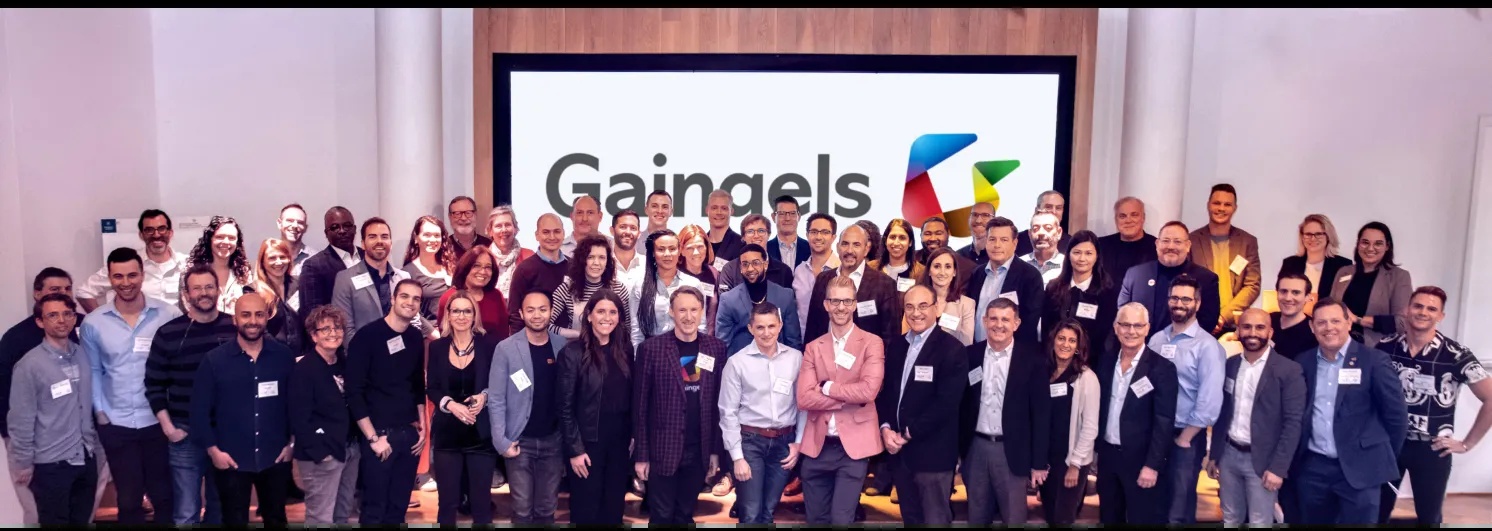
The photograph makes a useful point without a spreadsheet. A community consists of individuals whose knowledge and relationships differ. Gathering them is the beginning. Helping them contribute, keeping them informed and connecting them to opportunities is the continuing work. For a leader with Jeronimo’s experience, those details belong close to the mission.
Who gets considered for the board?
One expression of that work is Gaingels’ Board Access Program. It helps portfolio companies define what they need from independent directors, then supports the search, vetting, interviews and recruitment of candidates from underrepresented backgrounds. That sequence deserves attention. A useful introduction depends on understanding the job first. A broader candidate list must still be a relevant candidate list.
The program’s published figures record more than 300 companies helped with their board needs and more than 1,400 candidates introduced to over 200 companies. Those figures describe different activities, rather than interchangeable measures of success. An introduction creates a possibility; a placement changes who is actually present when decisions are made.
For a profile of an operations-minded executive, this is where the story becomes tangible. Inclusion acquires a workflow. Somebody identifies a requirement, looks beyond familiar circles, evaluates experience and arranges a conversation. The boardroom may have expensive chairs. The important work happens before anyone sits down.
A term sheet, a classroom, an interview
The Gaingels Letter encourages companies to consider a Diversity Term Sheet Rider. The optional language asks a company and its lead investor to make efforts to include underrepresented investors in a financing, with an allocation specified as an amount or percentage. It gives a general intention a place in the discussion where the round is being organized.
This is an operator’s kind of intervention: put the question into the document that people are already negotiating. It does not depend entirely on someone remembering the right principle at the right moment. It gives the parties something specific to consider, discuss and act on.
Education addresses another part of the problem. Jeronimo has helped develop WAVE, Women Achieving Venture Equality, a program for learning about venture investing. In her 2026 award reflection, she pointed to WAVE’s fourth cohort and the second cohort of BRIDGE, Black Rising Investors Development and Growth Education. Learning the language of an industry can make its opportunities easier to evaluate. It also makes it easier to ask a precise question when the language becomes unnecessarily grand.
Gaingels’ scholarship program supplies a different entry point. Established in 2020, it awarded 99 scholarships totaling $495,000 from 2020 through 2023. The grants support LGBTQIA+ and other underrepresented students with financial need. Mentoring and opportunities to interview with Gaingels and portfolio companies connect the educational support to possible work experience.
Tuition support with mentoring and opportunities to interview.
The difference between paying tuition and arranging an interview is worth preserving. One reduces a financial burden. The other offers a chance to practice, meet an employer and possibly enter a company. Together, they suggest how access can accumulate through several modest, concrete steps.
The space a leader has to make
Jeronimo’s own management education includes a sharp piece of advice from a former manager: she needed to change how she used her time if she wanted to grow. Fourteen-hour days left little capacity for the next responsibility. She learned to delegate, improve the information available for decisions and choose what to release. An overflowing calendar can be an impressive-looking way to stop moving.
“You must create space for yourself to grow.”
Jennifer Jeronimo
She has described herself as resilient and values mentors who notice blind spots. These preferences fit a leader willing to learn an unfamiliar industry while bringing useful experience from another. A trusted person who challenges an assumption can be more valuable than one who admires a title. There is room for encouragement, of course. There should also be room for correction.
Her advice about taking on unfamiliar responsibility is to act even when afraid. That thought belongs beside the earlier story of the practice interview. A long career can make competence feel settled. Accepting a new role asks a person to keep the competence while surrendering some of the certainty.
A milestone, and more work to organize
In March 2026, the National Venture Capital Association and Venture Forward named Gaingels the recipient of their Inclusion Impact Award. The announcement reported a community of more than 5,000 members, including 4,500 accredited investors. It also recorded that Gaingels had passed $1 billion in total investment in 2025 across more than 2,600 portfolio companies. Those are community and organization milestones, achieved with many people’s work.
milestone reached in 2025
Cumulative investment and participation figures, not a measure of realized investment returns.
Jeronimo’s public conversations continue. In September 2026, she joined Kristian Marquez on The Innovators & Investors Podcast to discuss co-investment, representation in ownership and support after a company raises money. The subjects are consistent with the job she accepted: connect an intention to the decisions and routines that might make it happen.
Her story leaves a practical question hanging over every discussion of opportunity. After someone has been invited, what enables them to participate? A clearer document, a useful introduction, a better search, a class, an interview: none is especially theatrical. Jeronimo’s career gives those details their due. Making room is a generous ambition. Keeping the room usable is a considerable job.