Every CFO can tell you, to the dollar, what the sales team produced last quarter. Ask the same about engineering - the single most expensive function in most software companies - and you get a shrug, a Jira board, and a hopeful smile. Jellyfish exists to end the shrug.
Walk into a 2026 engineering org and you will find more dashboards than developers. Git history. Sprint velocity. Incident counts. Now, a fresh layer of AI coding assistants quietly rewriting how the work gets done. The data is everywhere. The meaning is nowhere. Jellyfish, headquartered on Franklin Street in Boston, sells the missing translation: it ingests the exhaust of engineering tools and hands leaders a sentence a board member can actually understand.
The Problem They Saw
A black box with a payroll
Here is the uncomfortable truth Jellyfish was built on. Sales got Salesforce. Marketing got HubSpot. Finance got a wall of systems with three-letter names. Engineering got... standups. The function that builds the product, burns the largest budget, and decides whether the company ships on time has historically been managed with gut feel and a backlog.
That worked when engineering was a cost center nobody looked at too closely. It stopped working the moment software became the business. Leaders needed to answer simple, brutal questions: What are we actually building? Is it the thing we promised investors? How much of this quarter went to keeping the lights on versus moving the company forward? The questions were reasonable. The tools to answer them did not exist.
The deeper problem was a language gap. Engineers speak in commits, pull requests, story points, and cycle time. Boards speak in initiatives, margins, and quarters. Between those two dialects sat the engineering leader, expected to translate on the fly, usually in a slide assembled the night before the meeting. Every other department had already automated this translation. Engineering, the function literally responsible for automation, had somehow not automated its own reporting. The irony was not lost on anyone who had to live it.
The Founders' Bet
The Endeca alumni reunion
Andrew Lau, Phil Braden, and David Gourley were not strangers to this pain - they had lived it. The three came out of Endeca, the search company Oracle bought for roughly a billion dollars in 2011. Lau famously joined Endeca as an intern and left as VP of Engineering, which is either a great career arc or a cautionary tale about never leaving the building.
In 2017 they made a specific bet: that "engineering management" could be a software category, not just a personality trait. Most people thought you measured engineers the way you measured assembly lines - by counting things. Jellyfish bet the opposite. The point was never to surveil developers. It was to give their leaders a vocabulary, so engineering could stop being the department that gets talked about and start being the one in the room.
The Product
From raw signal to a straight answer
Mechanically, Jellyfish is a data company wearing a dashboard. It plugs into the systems engineers already use - Jira, GitHub, GitLab, Bitbucket, CI/CD pipelines - and normalizes the mess into a single model the company patented. On top of that model sit the products people actually buy.
Business Alignment
Maps engineering time to strategic initiatives. Finally, a chart that says where the money went.
Operational Effectiveness
Metrics, benchmarks, and bottleneck-spotting - the engine-check light for delivery.
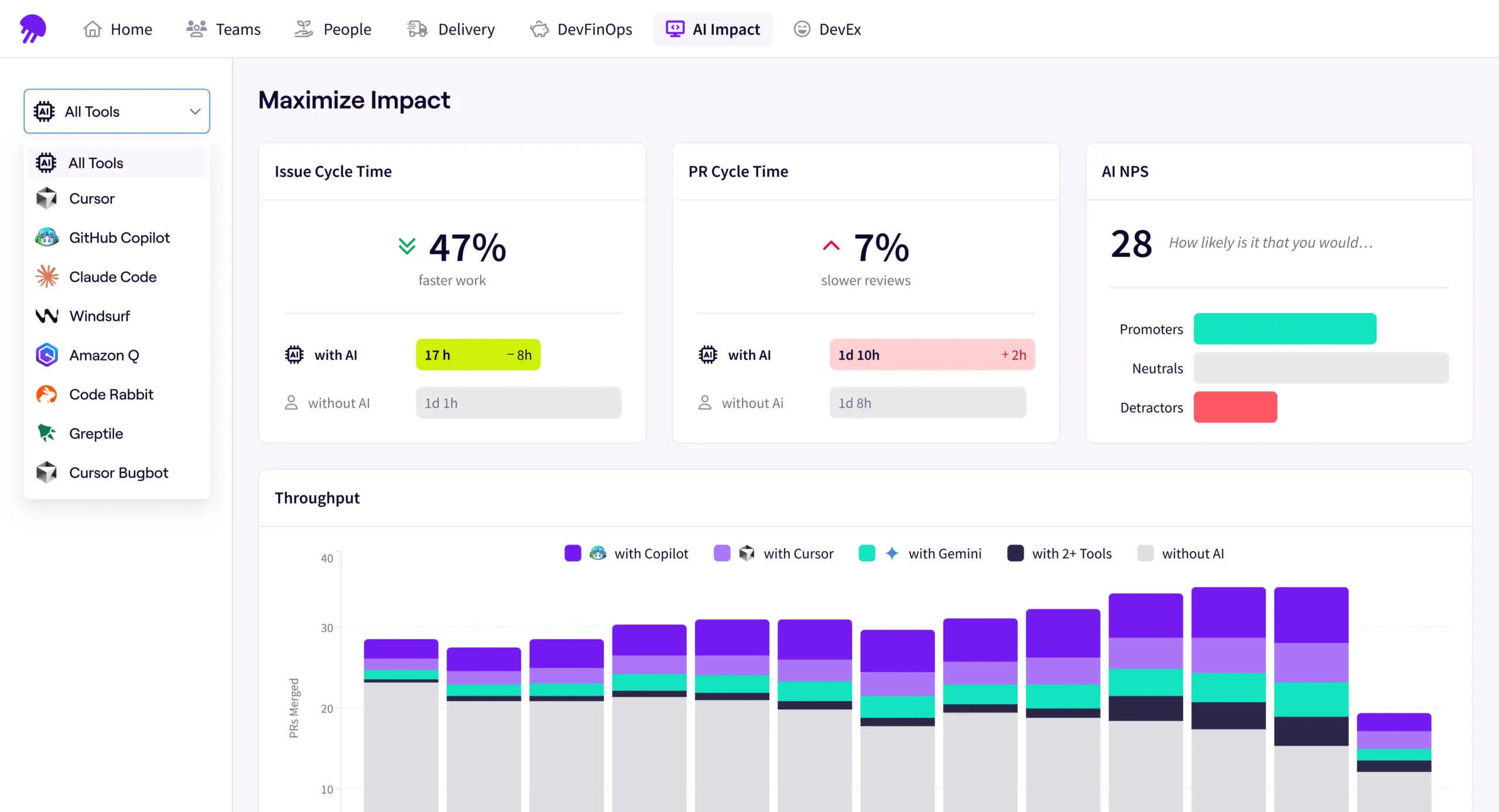
AI Impact
Adoption, spend, and ROI for every coding assistant and agent in the org.
DevFinOps
Automated software capitalization and audit-ready R&D reports. The chore nobody volunteers for.
DevEx
Developer surveys and sentiment, merged with the system data so the vibes get a number.
Jellyfish Assistant
Ask questions in plain English; get answers from your own engineering data.
The most quietly clever piece is DevFinOps. Buried in tax law is the right to capitalize software development costs and claim R&D credits - real money most companies leave on the table because tracing it by hand is miserable. Jellyfish does the tracing automatically. It is not the flashiest feature in the deck. It is frequently the one that pays for the contract.
What ties the suite together is a deliberate refusal to play the surveillance game. Jellyfish does not rank developers on a leaderboard or count lines of code as if more were always better. The unit of analysis is the team and the initiative, not the individual keystroke. That choice is partly ethical and partly practical: leaders who deploy a tool their engineers experience as a productivity tracker tend to find that the engineers, being clever people, quickly learn to game it. By aiming at allocation and outcomes instead, Jellyfish keeps the data honest and the room calm.
The Jellyfish Drift
The Proof
Numbers that survived the room
Skepticism is the correct default for any company promising to "measure engineering." So here is what is checkable. Jellyfish raised about $117M across its rounds. It grew revenue 5x in 2020 and 3x in 2021. It went from roughly 20 employees to 125 by its Series C, and sits near 270 today. Its customer list - Mastercard, Priceline, PagerDuty, Box, ZoomInfo, nCino - is not a list of companies that buy software on a whim.
Funding, round by round
The investors are the supporting cast worth naming: Accel, Insight Partners, Tiger Global, and Wing Venture Capital. When the same firms keep writing checks across three rounds, they are not buying a pitch - they are buying renewal rates they have already seen. Accel and Wing came in early and doubled down. Insight, a firm that specializes in software companies with sticky enterprise contracts, led the Series B and returned for the C. That kind of repeat behavior is the closest thing private markets have to a customer review.
The competitive set tells its own story about how real the category became. LinearB, Swarmia, Pluralsight Flow, Uplevel, and DX all chase versions of the same insight. A market with that many credible players is not a fad; it is a category that arrived. Jellyfish's particular wager is that the winner will be the platform that connects engineering data to the business and finance side of the house, not the one with the prettiest velocity chart. The DevFinOps and Business Alignment products are bets placed squarely on that thesis.
The Mission
From executors to influencers
Jellyfish frames its purpose in a phrase that sounds like a HR poster but actually means something: move engineering leaders "from executors to influencers of business strategy." Translated, that means the VP of Engineering should walk into the planning meeting with the same data fluency as the VP of Sales - not as the person explaining why the thing is late, but as the person shaping what the thing should be.
Why It Matters Tomorrow
The AI bill comes due
There is a new reason the shrug is no longer affordable. AI coding assistants are now everywhere, each with a subscription line and a promise of productivity. Boards want to know whether the spend is working. "It feels faster" is not an answer a CFO accepts twice. Jellyfish's AI Impact product is a direct play at this question - adoption, cost, and measurable output, in one view. The company that spent years learning to measure human engineering effort is well positioned to measure the machine kind.
Which brings us back to that opening shrug. The CFO who once had no answer about engineering now has a dashboard - one that ties code to strategy, flags where the quarter actually went, files the R&D credit, and tells her whether the AI tools earned their keep. The shrug has become a sentence. For a company whose whole thesis is that engineering deserves to be understood, that is the entire point.