Jeff Atwood spent four years helping programmers get to the point. A question needed an answer. A useful answer needed to be found. The conversation that wandered off into everyone’s opinions could kindly take itself elsewhere. Then he helped start a company whose purpose was to give that conversation somewhere to go.
The change makes sense once you look past the software. Stack Overflow, the programming question-and-answer site he co-founded with Joel Spolsky in 2008, and Discourse, the discussion platform he launched with Robin Ward and Sam Saffron in 2013, both depend on a surprisingly ordinary act: somebody taking the trouble to help somebody else. Atwood keeps returning to that act, whether the setting is a browser window or a rural American county.
These days, the question has become expensive. In February 2026, he reported about $21 million in immediate family giving and a separate $50 million pledge for longer-term work. He calls the Rural Guaranteed Minimum Income Initiative his third and final startup. It is a considerable distance from a programming blog. The useful stranger has accompanied him all the way.
The blog with a warning label
Atwood’s first microcomputer was a Texas Instruments TI-99/4A. He learned through implementations of Microsoft BASIC in the 1980s, then worked with Visual Basic and Delphi in the following decade. His education took a less obvious route: he entered the University of Virginia in 1988 and graduated in 1992 with an environmental science degree and a computer science minor.
Coding Horror arrived in 2004. The name came from a warning illustration in Steve McConnell’s Code Complete, a book Atwood admired enough to borrow its alarmed expression. He asked McConnell’s permission first. Naming a programming blog after bad code leaves the author pleasantly little room for self-importance.
His stated method was straightforward. Research something interesting. Write it down in public. Find it again when needed. Other people could use it too, and comments could turn a post into a conversation. Even his technical autobiography pointed toward people: the highest-level language he preferred was ordinary written language. A computer was fascinating partly because of what it revealed about its users.
An answer deserves to be found
By April 2008, that public writing habit had become the starting point for a business. Atwood and Spolsky announced Stack Overflow with a problem already in view: useful programming knowledge was trapped in forums, scattered through help pages or tucked into books. They wanted participation to be easy and the resulting knowledge easy to discover.
Their partnership also contained disagreement. Atwood had criticized Spolsky in earlier writing and cheerfully acknowledged this when announcing their company. Agreement was hardly the admission price. He wanted his assumptions questioned. Two bloggers bringing their audiences together could also bring their differences, which is more interesting than two founders completing each other’s promotional sentences.
“I distrust people who agree with me all the time.”
Jeff Atwood, announcing Stack Overflow, 2008
The format imposed discipline. Voting moved answers into a useful order. Comments had limits. Discussion was restrained because the page had a job to do for the next visitor as well as the original questioner. These choices could feel severe, but they followed a specific ambition: build a dependable collection of questions and answers.
There were other people in the work, too. Geoff Dalgas and Jarrod Dixon belonged to the founding team alongside Atwood and Spolsky. Contributors supplied knowledge, edits and judgment. The site became the seed of the wider Stack Exchange network. Its growing reference library depended on people who were willing to spend time on someone else’s problem.
Write it down.
Find the answer.
Keep talking.
Fund the chance.
The hours a startup cannot give back
In February 2012, Atwood announced he would leave Stack Exchange’s daily operations on March 1. His family had welcomed two more children. Running a startup and being present for several small children demanded more time than he could keep supplying to both.
His farewell was unusually direct about the bargain. Work could fill evenings and weekends, then occupy a person’s attention even when the person had physically gone home. He refused to accept that bargain for his children. The decision belongs in his career story because it changed the shape of the career.
He also wrote that a founder should not need to remain forever at the center of a community designed to govern itself. He could become a citizen again. That is an appealingly demanding test of a community builder: whether the room continues to function when its organizer steps outside.
Room for a longer conversation
Leaving Stack Exchange gave Atwood another look at forums. He had investigated them during Stack Overflow’s early planning and returned to find software that, in his judgment, had barely moved forward. Yet the communities themselves still held useful, wonderfully particular knowledge. His examples included Lego collections, stunt kites and powerful squirt guns. The internet’s back rooms were doing quite a lot of the work.
A Q&A site could not provide everything those groups needed. Conversations sometimes have to unfold before anyone knows precisely what the question is. Discourse, announced on February 5, 2013, offered open-source discussion software with moderation and governance built into its ambitions. Its corporate name, Civilized Discourse Construction Kit, was almost a set of assembly instructions.
The team emerged through the kinds of connections the product was meant to support. Atwood asked about forums in established online communities, including Something Awful. Robin Ward contacted him with experience building Forumwarz and its attached forum. Atwood offered to fund his work for at least a year. Sam Saffron, whom Atwood had hired at Stack Exchange, joined as a co-founder.
Even an adviser came through a game. Atwood had met Shawn Holmes after joining his Quake clan in 1996. The professional network included a place where people shot virtual rockets at one another. In 2023, Atwood moved from Discourse CEO to executive chairman, with Sarah Hawk and Saffron taking the CEO responsibilities. Once again, building the room included making space for other people to lead.
A rather particular keyboard
The year Discourse launched, Atwood also introduced a mechanical keyboard. He had used at least six expensive ones and remained dissatisfied with the available details: backlighting, appearance, media keys. Some people respond to imperfect equipment by writing a review. Atwood contacted Weyman Kwong of WASD Keyboards and proposed working together.
The CODE keyboard was a small, physical expression of an old interest. Someone has to type the words that make a community useful. A tool handled every day deserves attention. Kwong wondered over lunch whether Atwood was a kind of geek humanitarian. The description was funny in 2013. A decade later, it would acquire a rather larger budget.
There is affection for the machinery in Atwood’s work, but also impatience with machinery that gets in the way. His GitHub projects include an effort to update the classic Basic Computer Games book in modern languages. The old enthusiasm remains available to new readers, with the code laid out for people to examine and improve.
Enough money, and a deadline
Stack Overflow’s sale to Prosus in 2021 changed Atwood’s finances. The transaction was valued at $1.8 billion; that figure belonged to the company sale, rather than his personal bank balance. What mattered to him was the resulting question of how much was enough.
His parents had come from poor rural backgrounds in North Carolina and West Virginia. College had involved family savings, a Pell Grant and work at Safeway and a painting business. That history gave the later windfall a particular context. He had benefited from a path that required help as well as effort.
A high-school production of The Outsiders helped give his response its name: “Stay Gold, America.” In January 2025, his family began with eight gifts of $1 million. PEN America, Team Rubicon, Global Refuge and First Generation Investors were among the recipients. Their wider commitment came with a five-year timetable. A promise to give eventually had become a schedule.
Amounts shown on the same scale. The pledge is not a claim that all the money has been distributed.
The longer-term work became RGMII. It funds studies in Mercer County, West Virginia; Beaufort County, North Carolina; and Warren County, Mississippi. Participating families receive $1,500 a month for 16 months. They decide how to spend it. The initiative works with GiveDirectly and draws on OpenResearch’s earlier work, with an intention to share research openly.
Atwood’s ambition is to reach rural counties in all 50 states over time. That is an aspiration, while the first three funded studies are the current work. The approach has a recognizable resemblance to his software projects: support participation, learn from what happens, and make the knowledge available beyond the original group.
What an answer cannot carry
The technical conversation has continued alongside the giving. In June 2026, Atwood announced Off By One, a monthly TWiT show with Leo Laporte. Computing history, the open web and yo-yos all fit inside its brief. A programmer’s naming joke leaves enough room for a little disorder.
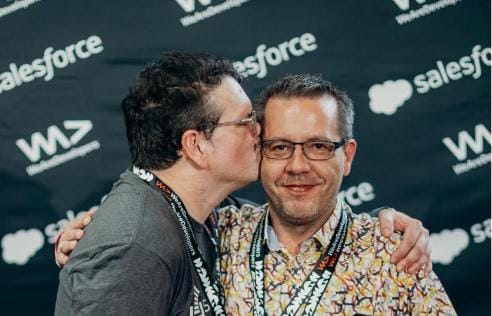
In July, he presented in Berlin with Ben Dumke-von der Ehe, an early Stack Overflow colleague. Atwood had made Ben’s participation a condition of accepting the invitation. Their relationship was part of the subject: a community could change the lives of people who helped build it.
His August essay welcomed language models’ ability to connect differently worded questions with existing answers. He also asked what happens to shared knowledge when everyone moves into private exchanges with a machine. The convenience is real. So is the question of who will keep contributing to the commons from which such systems learn.
In September, he published a reader’s letter about help received from Stack Overflow strangers while studying during military service. The writer remembered that somebody had given them time. Atwood’s next question followed naturally: what do people become if they stop helping each other? After blogs, companies, keyboards and cash commitments, he is still looking at the person on the other side.
Keep the conversation going
Read Coding Horror, visit Discourse and explore the rural income initiative. Find Atwood on Mastodon, LinkedIn, GitHub and his X profile.
- Watch the 2026 Berlin talk with Ben Dumke-von der Ehe ↗
- Watch Off By One: From Stack Overflow to Stay Gold, America ↗
- The 2008 introduction to Stack Overflow ↗
- Listen to Stack Overflow’s founding team ↗
- Atwood’s farewell to Stack Exchange ↗
- How the Discourse team came together ↗
- The CODE keyboard story ↗
- Stay Gold, America ↗
- The rural initiative’s launch and giving update ↗
- UVA Today’s interview about his education and giving ↗
- A reader’s letter about help from strangers ↗