On September 12, 2024, Jared Isaacman opened the hatch of a Dragon spacecraft and rose into a view that no restaurant customer had ever requested with the check. Earth curved below him. His spacesuit was being tested outside a spacecraft for the first time. Somewhere far beneath that scene were the bars, hotels and shops whose card transactions had helped make his journey possible.
The distance between those places is the interesting part. Isaacman’s wealth came from payments, a business that asks its customers to think about it as little as possible. His other career has involved machines that demand attention: fighter jets, rockets, spacesuits. The quiet transaction financed the conspicuous departure.
By December 2025, he had become NASA’s fifteenth administrator. That appointment gave his biography another turn. A teenager who had once left school to work in payments was now responsible for the American civil space agency. It is a pleasingly improbable route, though each stop becomes less mysterious when you look at the work between them.
A teenager at the other end of the transaction
Born in Summit, New Jersey, in 1983, Isaacman grew up as the youngest of four children. His early commercial education included a job at CompUSA and building websites for business owners. One of those customers worked in payment processing and offered him a full-time information technology job. The industry supplied something more useful than a glamorous origin story: a problem he could see up close.
Accepting a card required a merchant to navigate equipment, applications and service. Isaacman thought the process could be simpler. In 1999, at sixteen, he started United Bank Card in his parents’ basement. His parents had a condition for leaving high school: he had to obtain a GED. He did. The family bargain put a credential beside the experiment.
There was also the delicate matter of being sixteen while asking adults to trust you with their income. His father, Donald, an experienced salesman, became the outward face of the young company. The arrangement is a useful corrective to the solitary-founder picture. Isaacman had an idea and technical experience; his father could enter the conversation with a merchant without first having to explain his age.
That early division of labor mattered. A restaurant owner needs the payment to go through on Saturday night. Youthful confidence is an entertaining quality in a founder, but a poor substitute for an answer when the terminal stops working.
The machine that paid its way later
The business eventually gathered around Harbortouch, its point-of-sale offering. In an interview about the company’s development, Isaacman described a deliberate move toward combining the merchant’s software, equipment and payments. “Our goal was to become a one-stop-shop for POS and payments.” The proposition was concrete enough to fit on a restaurant counter.
Harbortouch’s no-upfront-cost POS program extended that argument. Supply the hardware and software, handle installation and training, and support the merchant afterward. The initial equipment bill became less of an obstacle to signing up. The company would earn through the continuing commercial relationship, including payment processing. Free was an opening offer with an economic life beyond the opening day.
- 01Get installedEquipment, software
and setup - 02Take paymentsTransactions run
through the system - 03Stay in serviceAn ongoing merchant
relationship
The upfront price was only one part of the business.
That model also placed obligations on the supplier. A box on a counter had to keep functioning. Software, provisioning and support became part of the product. The merchant was buying a way to operate, and a failure in any one piece could make the whole arrangement feel expensive.
United Bank Card adopted the Harbortouch name in 2012. The later corporate history needs a little untangling. Lighthouse Network, which included Harbortouch and other POS businesses, acquired the original Shift4 gateway company in late 2017. The combined organization took the Shift4 name. There was an acquisition inside the name change, with another company’s technology and history attached.
Shift4 went public in 2020. A payments business begun in a basement had reached the New York Stock Exchange. The ticker symbol was FOUR. The customers still needed the same basic thing: a dependable way to finish the sale.
A hobby with seven jet engines too many
Flying offered Isaacman a different set of problems. He took lessons, pursued qualifications and attempted a record around the world. The first try taught him about airspace restrictions, airport slots and the time lost while refueling. Speed depended on arrangements made on the ground as well as the aircraft’s performance in the air.
In 2009, he circled the globe in a Cessna Citation CJ2 in 61 hours, 51 minutes and 15 seconds. He later completed his aeronautics degree at Embry-Riddle’s Worldwide Campus in 2011. Leaving high school had not ended his education. It had produced a rather irregular timetable.
A light-jet record in a Cessna Citation CJ2.
Then there was the Black Diamond Jet Team. Its fleet grew to five L-39s and two MiG-17s in matching paint schemes. Isaacman flew the right-wing position. Anyone who has discovered that a hobby needs another accessory can recognize the mechanism, although most accessories do not require their own runway.
Operating the aircraft cost more than sponsorship could cover. The team’s experience helped lead to Draken International, which provided aircraft and adversary training for military pilots. Former military jets could simulate the opponents those pilots might encounter. A costly enthusiasm had found a contracted purpose.
Isaacman sold a majority stake in Draken to Blackstone in 2019. His flying continued. By the time NASA published his administrator biography, he had accumulated more than 8,000 flight hours and flown in over 100 airshows. The aviation chapter explains why his eventual spaceflight involved a commander’s seat rather than simply a window.
Four seats, then an open hatch
Inspiration4 launched on September 15, 2021, carrying Isaacman, Sian Proctor, Hayley Arceneaux and Chris Sembroski. It was the first all-civilian mission to orbit Earth. The distinction matters: a brief trip above the atmosphere and a spacecraft circling the planet are different undertakings. This crew spent three days in orbit before splashing down in the Atlantic.
Isaacman financed the flight and served as commander. Those roles gave the mission its unusual shape. The customer was also a trained participant, with responsibilities to three other people in the capsule. Private money had purchased access to a system built and operated by a much larger team.
Polaris Dawn followed in September 2024. Scott Poteet, Sarah Gillis and Anna Menon joined Isaacman. Poteet had worked at both Draken and Shift4; Gillis brought experience training astronauts at SpaceX. The crew’s biographies connected the businesses and technical work that had preceded the launch.
The mission reached a peak altitude of 1,408.1 kilometers, farther from Earth than humans had traveled since Apollo at that time. Isaacman and Gillis performed the first commercial spacewalk, testing SpaceX’s extravehicular suits. The famous image captures one person at a hatch. The operation depended on the others inside and on the ground.
The five-day flight also tested Starlink laser communications. Gillis played violin from orbit. There is something welcome about an engineering test that leaves room for music: bandwidth, once established, can carry something besides a status report.
The quiet transaction financed the conspicuous departure.
A different kind of command
The path to NASA contained a delay that no faster aircraft could solve. President Donald Trump’s initial selection of Isaacman was withdrawn in May 2025. He was nominated again in November, confirmed by the Senate on December 17 and sworn in the following day. The vote was 67 to 30. The appointment required a political process as well as a résumé.
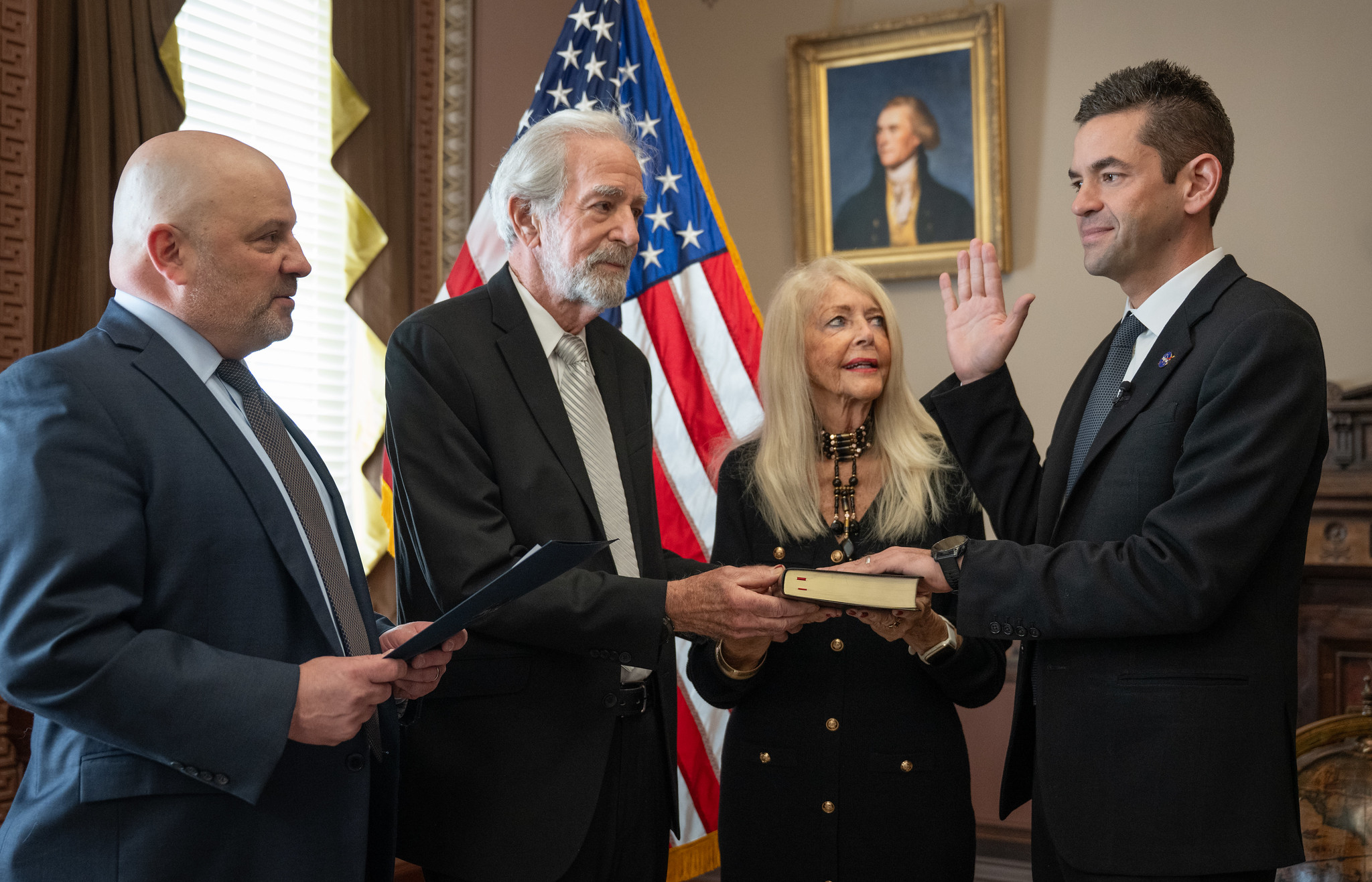
He had already left Shift4’s CEO position in June, when Taylor Lauber succeeded him. Following his confirmation, he also resigned his executive chairmanship and board seat. The founder’s next job belonged to a different institution, with a different set of owners: the public.
At NASA, he has described ambitions for a lasting lunar presence and eventual human exploration of Mars. Artemis II launched on April 1, 2026, sending four astronauts toward a lunar flyby. In an October 23 update, he said Artemis III remained planned for an Earth-orbit docking test in summer 2027, with Artemis IV targeting a lunar landing in 2028. Those dates describe plans still to be carried out.
In May 2026, he returned to Huntsville for the opening of Space Camp’s Innovation4 Skills Training Center. He had attended Space Camp as a child. By then, he was supporting it with donations and his NASA salary. The visit brought the story back to a place where young people encounter the machinery of flight before they can afford to operate any of it themselves. It was a quieter scene than the spacecraft hatch, with an audience that still had its own departures to arrange.
A founder can choose a customer and change an offer. An administrator works through budgets, elected officials, national commitments and an organization whose knowledge extends far beyond one office. His background gives him experience with equipment, service and demanding operations. How that experience translates is now a matter of public consequence.
Back at the restaurant counter, the promise was straightforward: make the complicated machinery work so someone else could get on with the evening. The scale has changed considerably. The obligation to deliver a functioning system is familiar. Isaacman has spent much of his life buying the means to go higher. His current job asks him to help an institution take other people along.
Follow the flight path
Continue with the official biographies, conversations and mission films.