Before James LaLonde made a business out of crossing borders, he learned to listen for what changed on the other side of one. He grew up on a ranch in South Austin, a sixth-generation Texan with a surname that sounded French and an attention already drifting east. At the University of Texas at Austin, he studied economics and Japanese. The combination was prophetic: systems and language, numbers and nuance. One explains how markets move. The other explains why people inside those markets do not always move as expected.
That distinction became his career. LaLonde joined Microsoft in 1990 and worked on its early efforts in Japan. Later came executive roles at McAfee and Brocade, and years lived and worked across Tokyo, Hong Kong and Beijing. Technology companies like to believe their products are universal. The world has an impolite habit of disagreeing. Menus need translation; business models need surgery. A product that feels obvious in California can arrive in China wearing the commercial equivalent of somebody else's shoes.
LaLonde learned Japanese to a native or bilingual level, built professional fluency in Mandarin and also studied Spanish. His useful subject was never vocabulary alone. It was context: who is speaking, what the room expects, and which assumption has quietly expired.
His own biography became an argument for patient immersion. He did not approach Asia as a short assignment or a single expansion plan. He stayed through changing jobs, technologies and cities. That matters because markets have memories. Relationships accumulate slowly, and yesterday's tidy lesson can become tomorrow's misleading shortcut. Fluency, in this sense, is less a certificate than a willingness to remain corrigible.
“Most first time founders feel that getting funding is the main objective in the startup. It is not. First you need to validate your idea and product.”James LaLonde, The Tao of Startups
A small room with a very large market outside
In 2011, LaLonde and Henry Fong founded Yodo1 in a small room inside a Beijing incubator. Mobile gaming was still a modest slice of the games business, and China was a magnificent headache for outside developers. The audience was enormous. So were the practical complications: regulation, distribution, local stores, cultural references, player habits and payment systems.
Yodo1's original proposition was a bridge. Independent studios could keep making games; Yodo1 would help those games become intelligible, available and commercially viable in China. It localized, published and monetized titles including Ski Safari, Rodeo Stampede and Crossy Road. The task was not to repaint a button and declare victory. It was to understand what a particular game was trying to do, then preserve that pleasure while changing whatever the market demanded.
The bridge kept widening. Yodo1 expanded from China publishing into global publishing, monetization, user acquisition, live operations and collaborations between games and familiar entertainment properties. The company says it has now helped more than 6,000 developers and engaged more than 3.5 billion players. Its team works from more than 30 countries. The incubator room has become a network.
A revealing turn came in 2025. Yodo1 completed the transfer of global publishing and development rights for Transformers: Earth Wars under license from Hasbro, bringing over code, assets and members of the original team. Yodo1 had already operated the title in China. Now the market translator was responsible for the whole conversation.
The eight-minute book
LaLonde is an operator who likes a portable phrase. His best-known book began as one. On March 23, 2018, he gave an eight-minute talk at a China Accelerator event in Beijing. He called it “The Tao of Startups,” a brisk journey through the startup cycle and the matters founders routinely confuse with progress. The talk landed. He expanded it into a book published later that year, then into a university course. A Mandarin Chinese edition followed in 2020.
The advice has little patience for startup pageantry. Validate the idea before worshipping the financing. Choose co-founders carefully. Divide equity once and treat the agreement as if carved in stone. Work on the parts of a business model that can kill the company early. LaLonde calls his shortcut an “inverted T,” a way to force attention onto the problem, the customer and the proposed value before polishing the rest of the canvas.
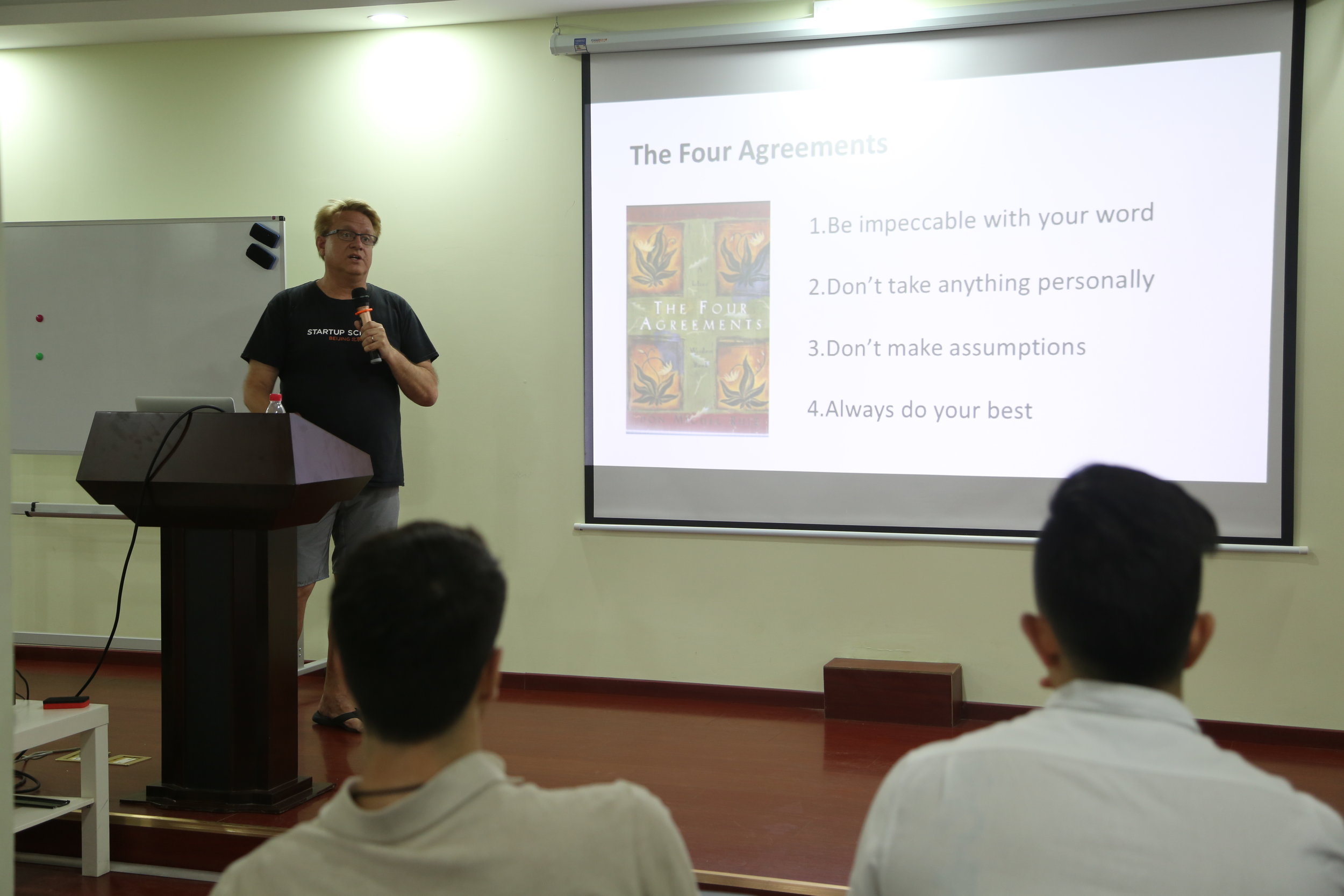
In 2019, he made the room itself into a recurring institution. Beijing Pitch Club met on Wednesday nights in the city's central business district. Anyone could present, in any language. Pitchers received audience feedback, a recording and a T-shirt. Pizza and water were free. Before the pandemic pushed it online, the club hosted hundreds of pitches with roughly 40 people attending an average session.
It is a very LaLonde arrangement: generous, practical and mildly theatrical. The T-shirt gives the evening a bit of ceremony. The feedback prevents the ceremony from becoming self-regard. A founder cannot hide for long when ten people a week stand up and test whether their idea survives contact with sentences.
The trust battery
The small-room founder now helps run a company designed to have no single room. Yodo1 is work-from-anywhere, a policy LaLonde describes in personal terms. His father was an entrepreneur, and as a boy LaLonde saw him only on Sundays. Remote work, he has said, allows him to spend time with his own son every day. The freedom is not an office perk pasted onto the company. In his telling, it repairs something.
Distributed work creates its own hard problem: trust among people who may never meet. LaLonde and Yodo1 talk about a “trust battery” that colleagues charge with clear, reliable behavior and drain with the opposite. The metaphor is cheerfully plain. It also admits that trust is neither magic nor permanent. It is stored energy, built interaction by interaction, and remote teams spend it whenever ambiguity arrives.
The company pairs that idea with other compact mantras: assume positive intent, stay in the sunshine, do not make assumptions. The most persistent may be WDSLL, or “What Does Success Look Like?” The question goes at the start of a project. Describe the outcome first; only then decide what work belongs between here and there.
“When I was a boy, I only saw my entrepreneur dad on Sundays. With Work From Anywhere, I spend quality time with my son every single day.”James LaLonde on Yodo1's remote culture
A new language for the same old problem
Lately, LaLonde has applied his appetite for translation to artificial intelligence. Yodo1 began hiring AI developers in 2018. More recently it built an internal assistant called MIA with access to years of company meetings, chats, notes and plans. LaLonde describes it as a communications partner for a far-flung organization, a system that remembers what distance and time zones encourage people to forget.
He also wrote and published a book on Amazon in 24 hours using AI, partly as a demonstration for his team. The stunt has a showman's neatness, but its premise fits the older method. Begin with what success looks like. Use the available tools. Produce something concrete enough to criticize.
There is a straight line here, though it passes through several countries and industries. At Microsoft in Japan, the question was how software enters a culture. At Yodo1, it became how games find players across markets. At Pitch Club, it was how an idea enters another person's mind. With a distributed team and an internal AI assistant, the question is how understanding survives the journey from one colleague to the next.
LaLonde returned to Austin, but his work did not return to a smaller map. Yodo1's current business stretches across publishing, live games, monetization and collaborations with global entertainment brands. In 2026, its licensing work included a Transformers event in Lords Mobile with IGG and Hasbro. The company is no longer merely opening China's door for outsiders. It is operating games and arranging introductions across the world.
The games business sells escape, but its operations are stubbornly earthly. Somebody must understand the regulation, the revenue model, the joke that does not travel, the player who feels ignored and the colleague twelve time zones away. LaLonde's career suggests that scale begins there, in details small enough to be missed. Learn the language. Define the result. Keep the trust charged. Then, perhaps, the enormous market outside the room becomes a collection of people who can hear you.
Continue the conversation