A used excavator has a second career waiting somewhere. So does a truck, a rental fleet or a vehicle that has reached the end of its first owner’s plans. Finding that next owner takes a price, a buyer and a surprising amount of organization. James Kessler has built much of his working life around the organization part.
Known professionally as Jim, Kessler became chief executive of RB Global in August 2023. The job put him over a business bringing together Ritchie Bros., the equipment auction company, and IAA, the vehicle marketplace. Behind the grand corporate language lay a familiar assignment for him: help businesses with different histories operate together, while customers still expect the machinery to keep moving.
His route there runs through Pep Boys, a sports retailer, commuter vans and collision repair. It makes an unusually practical curriculum for a marketplace chief. Along the way, he has held finance jobs and operating jobs, sometimes in the same company. A spreadsheet can tell you that a process is expensive. An operating role gives you the pleasure of finding out why.
An education in the things between departments
Kessler earned an undergraduate degree and an MBA at Saint Joseph’s University. His undergraduate qualification was a B.S. in financial management; his MBA concentration was finance. His career would keep returning to the relationship between the numbers and the work that produced them.
At Pep Boys, his responsibilities included finance, operations and the merchandise supply chain. He spent 16 years with the automotive retailer. These are adjoining territories inside a company, although they can feel like separate countries when something goes wrong. A purchase decision becomes inventory; inventory needs movement; movement costs money; customers have their own timetable.
He also served as executive vice president, chief financial officer and chief operating officer at City Sports. The change of merchandise mattered less than the breadth of the assignment. Finance and operations were both on his desk. That combination is a useful way to read his later career: commercial decisions and their consequences kept arriving together.
From 2013 to 2016, he held CFO and COO roles at vRide, the vanpooling business. In November 2016, Merchants Fleet Management announced him as president of its Alamo Leasing division. Cars and vans remained a thread, but the business problems changed around them: retailing, shared commuting, fleet services. He was accumulating experience across several ways of making vehicles useful.
The merger after the announcement
At ABRA Auto Body and Glass, where he was chief operating officer from 2017 to 2019, Kessler oversaw operations, procurement and growth initiatives. His responsibilities included integration work around the ABRA and Caliber Collision merger. He then served as Caliber’s president of emerging business from 2019 to 2020, evaluating and scaling businesses that complemented collision repair.
A merger has a ceremonial moment, when the deal closes, and a considerably longer working life afterward. People still need to know who decides what. Purchasing needs a process. Customers need a service that feels coherent. Kessler’s documented responsibilities placed him inside that less photogenic part of the transaction, where an announced combination has to acquire everyday habits.
That experience became relevant again when Ritchie Bros. bought IAA. By the time Kessler became CEO, he had participated in the acquisition’s due diligence and was leading related cost-saving and revenue-growth work. The connection between the two chapters is direct: collision repair had given him experience bringing automotive businesses together before he faced the combined equipment and vehicle marketplace.
- 2020Chief Operating Officer
Ritchie Bros. - 2021President & COO
Ritchie Bros. - 2023Chief Executive Officer
RB Global
Three titles, one expanding assignment
Ritchie Bros. announced Kessler’s appointment as chief operating officer in May 2020. His remit included day-to-day operations and collaboration across the leadership team. Ann Fandozzi, then CEO, had also led vRide earlier in his career. Their paths had crossed before the auction business brought them together again.
In September 2021, he added the presidency. Revenue, services, operations and critical support functions came under his leadership. The promotion broadened the job from running operations to connecting more of the commercial system. Selling a service and delivering it would have a more integrated chain of responsibility.
The CEO appointment followed in August 2023, alongside a seat on RB Global’s board. He succeeded Fandozzi. Ritchie Bros. and IAA were now part of the same group, and Kessler’s operational experience had become central to the company’s next phase. His advancement had taken three years, but the work behind it drew on a much longer career.
There is a useful distinction between running an auction and running everything that makes an auction possible. RB Global’s brands span equipment sales, vehicle transactions, valuation information, parts procurement and transport services. Bringing those activities together creates opportunities for customers, along with a management problem: each additional connection has to earn its place in the customer’s day.
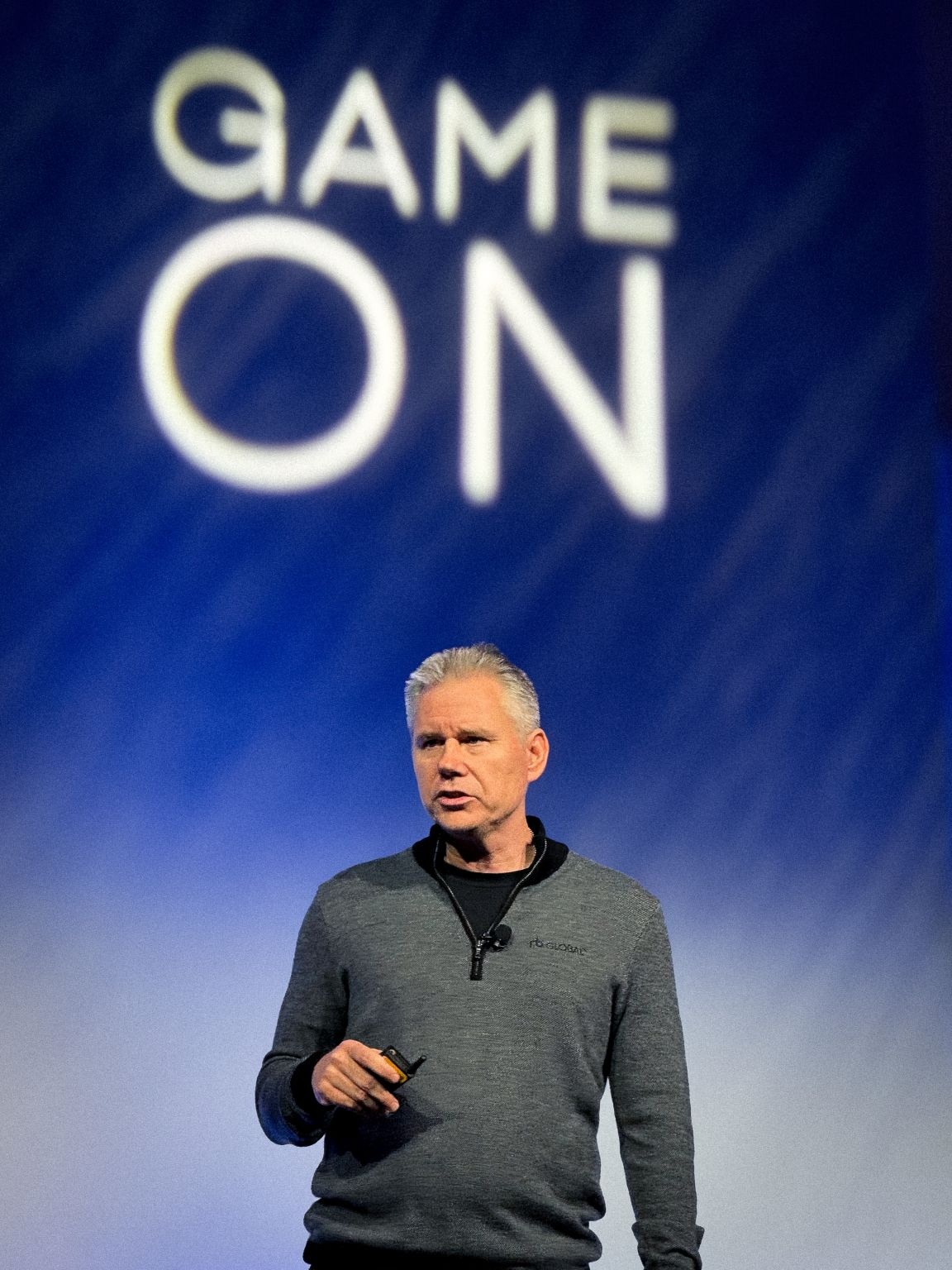
“Game on” meets the working day
In the photograph from RB Global’s 2025 North America sales kickoff, Kessler stands beneath the words “GAME ON,” holding a presentation remote. The stage supplies the drama. The company’s account of his closing remarks supplies something more workmanlike: supporting partners, delivering useful solutions and building relationships through trust, transparency and collaboration.
That pairing suits the business. An auction can be a performance, but repeat business depends on what happens around it. In an August 2026 earnings discussion, Kessler returned to yard operations, service standards and the value delivered to partners. His answer connected the automotive side with industrial, construction, heavy equipment and transportation customers.
It would be easy to describe every business in the group as a technology platform and stop there. Kessler’s public remarks keep pulling the conversation back toward execution. At a March 2026 investor conference, he described artificial intelligence as an enabler, discussing uses involving data, reserve-setting and images. Technology enters the story through a job it can help perform.
The same perspective makes the company’s size easier to understand. RB Global sold more than 2.7 million assets in 2024. That figure describes company activity, rather than a personal accomplishment. For its CEO, it also describes the scale at which individual transactions have to be made dependable. Even a small inconvenience becomes a substantial management subject when it repeats often enough.
Thirty years, and a reason to turn up
In June 2025, Kessler attended Ritchie Bros.’ celebration of 30 years in Australia. The anniversary auction in Geelong brought back a live theatre format last held there in 2019, with Canadian auctioneers joining the event. A business expanding through digital channels still found a reason to assemble people in a room.
The anniversary gathering at Kardinia Park brought together more than 400 customers, partners and employees. For Kessler, the visit connected a global executive role to a local commercial history. The Australian operation began in 1995; those relationships predated his arrival at the company by a quarter-century.
“We’ve spent 30 years building trust, relationships, and opportunities here,” he said. The pronoun does some work. A CEO inherits relationships made by other people and becomes responsible for what happens to them next. An anniversary is pleasant; keeping the customers for the following year is the less decorative assignment.
“We’ve spent 30 years building trust, relationships, and opportunities here.”
Jim Kessler · Australia, 2025
The next generation needs a place to work
Kessler’s industry involvement includes service on the Associated Equipment Distributors board. At the January 2026 AED Summit in Dallas, RB Global exhibited its services and sponsored the foundation’s fundraising gala and live auction. The event supported efforts to develop skilled technicians and future industry leaders.
His comments about that partnership connected company growth with jobs and careers for the next generation. “We are proud to partner with AED to build a bright future,” he said. In this setting, the aspiration had a specific subject: technician education and readiness for work in the equipment industry.
It is a revealing extension of the marketplace story. Equipment can change owners online, but it continues to need people who understand it. A parts system, a valuation tool and a sales channel all sit inside an industry with practical skills to replenish. Kessler’s support for the initiative puts the people who keep assets useful alongside the people who buy and sell them.
A fresh organization chart, a familiar question
CarMax announced in April 2026 that it intended to add Kessler and William Cobb to its board in connection with its annual meeting. The announcement followed engagement with Starboard Value, which agreed to withdraw its director nominations. For Kessler, the invitation brought his automotive and integration experience into another company’s boardroom.
Back at RB Global, October 8, 2026 brought a fresh set of leadership appointments. Steve Steinberg became CFO, Shiv Dutt took the new chief digital and strategy role, and Jake Lawson and Sam Wyant assumed newly created business presidencies. The announcement also said CFO Eric Guerin and COO Steve Lewis would depart.
Kessler described an organization intended to move faster and put clearer responsibility around business performance. One phrase from his explanation stands out: “clear owners of business unit performance.” It carries an echo of his earlier assignments. Revenue, operations, finance and technology can be arranged many ways; somebody still has to be answerable for what the customer experiences.
His career offers a way to follow that question across different settings. At Pep Boys it ran through retail and supply chains. At vRide it involved shared transportation. At ABRA and Caliber it involved combining repair businesses. At RB Global, the same question stretches across equipment, vehicles, services and borders. The inventory has grown heavier. The obligation remains wonderfully concrete: make the next transaction work.