A payment has a destination. A large organization has departments. Trouble begins when the payment has to negotiate with all of them. Jacob Aruldhas, founder and CEO of ECS Fin, has made the distance between those two facts his working territory. He talks about messaging, processing and accountability: the machinery behind a transfer that the customer would prefer never to think about.
In a 2021 interview, he put the problem in four words: “Payment processing is scattered.” There is considerable office life packed into that sentence. A transaction passes through several applications. A piece of information disappears. The omission becomes apparent later, when someone tries to reconcile the results. By then, the original handoff has acquired the useful camouflage of being somebody else’s business.
Aruldhas’s response is to follow the transaction across those boundaries. The proposition is easy to understand from the receiving end. If you are waiting to be paid, the internal elegance of each department offers limited consolation. You would like the money, and preferably an answer that does not require assembling a committee.
A payment has no interest in your org chart
His argument has a specific target: systems designed around separate departmental needs. At Sibos in Frankfurt in 2025, he advocated a transaction-centric approach, bringing accountability and visibility to the underlying transaction rather than treating each department’s application as the center of the universe.
Consider the difference in viewpoint. A department can report that it finished its step. A customer wants to know whether the entire instruction succeeded. Those statements may coexist perfectly well while leaving a rather important question unanswered. The transaction supplies a continuous thread through an organization that has divided the work into pieces.
“Payment processing is scattered.”
Jacob Aruldhas, 2021
At Sibos in 2022, his discussion of payments had already centered on fragmented environments and data accountability. Three years later, the emphasis remained recognizable. The vocabulary of financial technology moves quickly. His chosen problem has proved more durable: how to keep sight of an instruction as it travels through the machinery built to carry it.
The engineer before the executive
Aruldhas earned a PhD in Engineering at the University of Florida, where his public education record lists 1991 to 1994. His publication list includes work on highway geometry and the analysis of New York City intersections. Before the payments discussion, there were other complicated systems to examine.
That background makes an interesting companion to the founder title. Engineering asks what a system does under actual conditions. The attractive diagram must eventually survive contact with the thing it describes. In financial operations, the equivalent test arrives when a real instruction meets a real exception and someone has to decide what happens next.
He has also taught research methods as visiting faculty at Columbia University. That subject sits a step before the answer: how do you frame a question, investigate it and decide what the results support? It is a useful discipline to bring into a room full of proposed solutions. Before choosing a tool, somebody has to work out which problem deserves attention. In Aruldhas’s public payments discussions, the question repeatedly concerns the behavior of the whole system, including the gaps between its parts.
ECS began as a consulting firm in 1999. Its first software application arrived in 2009. The decade between those dates gives the business a different shape from the familiar product-launch story. Advice came first; a product followed. The company’s history describes the difficulties customers encountered with multiple vendors, integrations and extended implementations.
It is tempting to hurry past consulting on the way to software. Here, it belongs in the middle of the story. The business moved from advising institutions to supplying applications for their work. The distinction matters because an integration problem often sits between products, where a product brochure has little incentive to linger.
An unexpected stop in the food aisle
Then the bibliography takes a turn. Aruldhas coauthored Responsible Innovation in the Food Sector with Beatrice Godard, an entry in the Encyclopedia of Food and Agricultural Ethics. The entry appeared online in 2014. Among the subjects are corporate responsibility, ethical evaluation and the effects businesses have on the people around them.
A payments executive in a food ethics encyclopedia is a useful interruption to a tidy career summary. It puts a broader question beside the technical one: what should a company take responsibility for when it introduces something new? Profitability is part of the discussion. So are the people who share the space in which the business operates.
The publication does not turn every software decision into a philosophical declaration. It does establish that Aruldhas’s published interests extend beyond processing instructions. His academic work and his commercial work both give him reasons to think about consequences that spread beyond the immediate task. The connection is worth considering without making a whole personality out of a book entry.
His conversations have also put him alongside people approaching payments from different positions. A 2021 cross-border payments webinar brought him together with Fabiola Herrera of the Central Bank of the Dominican Republic and Kunbi Oguneye, CEO of remittance company N2Xpress. Roxe’s Thomas Trepanier moderated. A central bank, a remittance business and an infrastructure provider bring different responsibilities to the table. The shared subject was making international payments faster, cheaper and more reliable. That setting places Aruldhas among the participants working on the connections between institutions, where improving one part still leaves the problem of joining it to another.
A route you can actually follow
One concrete example arrived in June 2024. Zenus Bank integrated Visa B2B Connect through ECS Fin’s IMS Payments. The integration gave the bank another way to handle business payments across borders. Aruldhas highlighted the wider coverage and routing choices it offered.
The operational details make the example useful. Payment information could be checked before initiation. Status updates could remain visible through the transaction lifecycle. Rejects and recalls could be managed through APIs within IMS Payments. The announcement also described checking messages against country-specific requirements before a transaction proceeded.
Read those functions as verbs: check, route, follow, respond. They describe work that somebody must do even when the customer sees only a transfer. Bringing the verbs together gives a more tangible account of the company than an abstract promise to modernize banking. It also illustrates why Aruldhas keeps returning to the entire journey.
- 01CheckValidate the instruction
- 02RouteSelect the payment path
- 03FollowKeep status visible
- 04RespondManage exceptions
When the clock gets shorter
The same concern appears in securities settlement, where moving money can be linked to moving securities. In April 2024, Aruldhas was listed alongside Swift and ECS Fin colleagues for a webinar on Securities View, transaction identifiers and T+1. The agenda addressed a practical difficulty: tighter settlement windows leave less time to correct a problem.
The proposed response involved seeing trade status early enough to intervene. A transaction identifier could help connect information across the settlement chain. Operations teams could examine exceptions before the deadline turned a manageable problem into a failed settlement. The appeal is easy to grasp: a warning becomes useful when it arrives while there is still something to do.
ECS Fin’s 2026 interview with Swift returned to an operational dashboard that consolidates transaction status across systems and counterparties. Its description emphasizes immediate visibility and proactive exception management. That is the working environment Aruldhas is addressing: people responsible for an outcome that depends on information held in several places.
His listed Sibos 2026 topic in Miami drew a further distinction between trades requiring intervention and payments requiring control. The company’s recap explained the timing: payment instructions need scrutiny before release, while trade instructions can involve matching and exception handling before settlement. Speed means different things depending on what remains possible after the instruction leaves.
A ribbon, a new office, a shorter commute
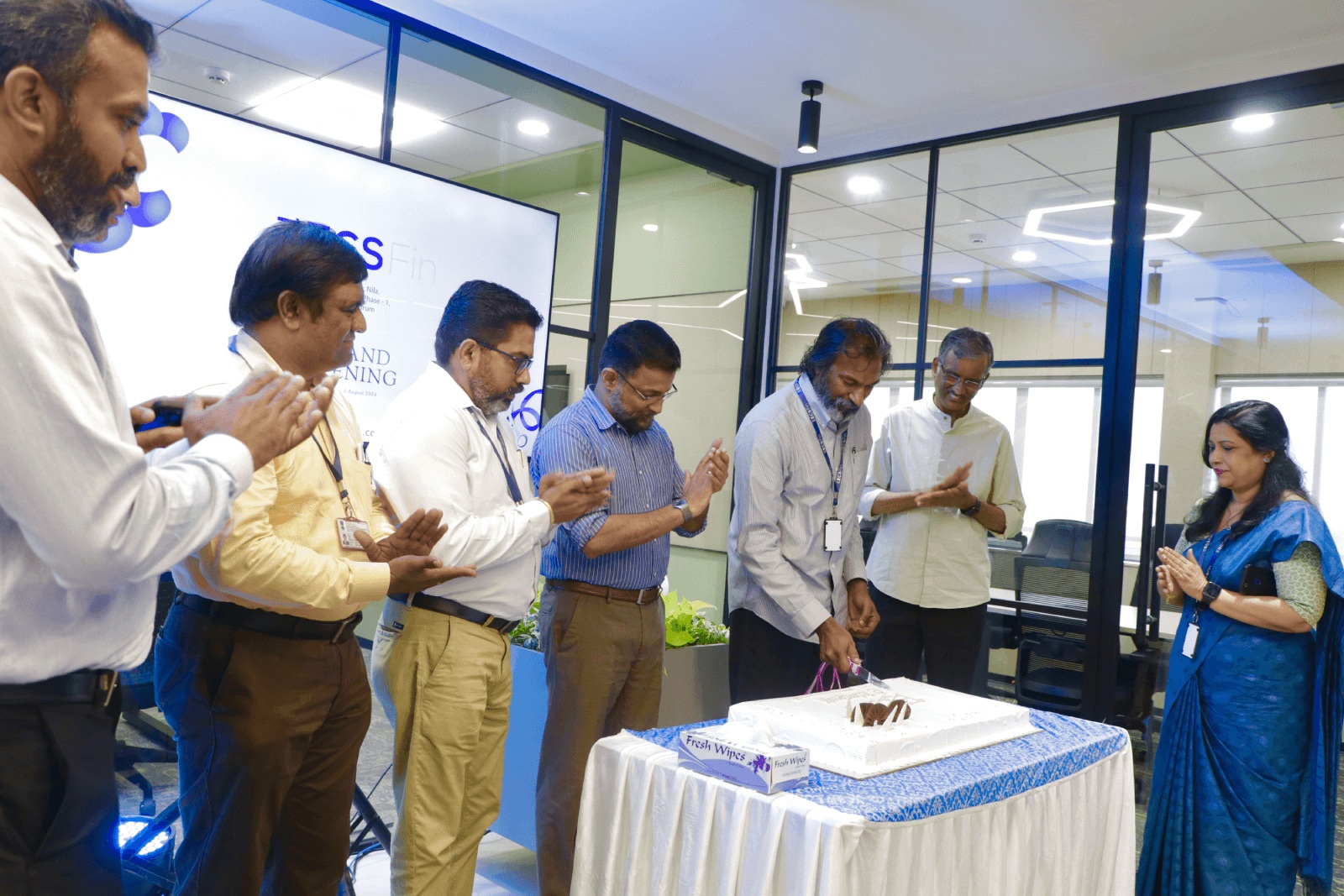
At the Nila building in Thiruvananthapuram’s Technopark, a different sort of instruction awaited his attention: cut the ribbon. In the office-opening photographs, Aruldhas stands beneath a cluster of pale balloons, scissors in hand, with colleagues gathered around. Financial infrastructure rarely supplies its own party decorations. An office opening is a welcome exception.

His explanation for the new office included a thoroughly human detail: accommodating employees who commuted from the north. He also spoke about using the firm’s engineering abilities to improve enterprises and create resources for communities, families and individuals. Geography, in that account, includes the journey to work as well as the location of customers.
The company philosophy published under his name gives employees an unusually plain sentence: “Employees are adults, mutual respect is a must.” It also describes leadership through mentoring, guidance and service. These are stated principles, with the everyday test any workplace principle faces: whether people experience them when there is work to finish.
The same argument, a different city
Aruldhas is based in White Plains, New York, but the work takes place across a wider map. The 2026 calendar listed him with Arul Santhosh and Fazil Semain for a payment-modernization event in Kuala Lumpur. Its agenda covered API connectivity, richer payment data and readiness for continuous operations. Later came the Miami program.
Those appearances place him in a continuing conversation about how institutions adapt. The names of networks and standards change. His recurring contribution is to ask how the work holds together across them: who can follow an instruction, who can act on a problem, and how the organization keeps the outcome in view.
There is a modest pleasure in a founder story whose central object is so ordinary. Someone needs to pay someone else. Around that need grow applications, departments, standards, contracts and conference programs. Aruldhas keeps asking the people building the machinery to remember the instruction traveling through it. At the far end, somebody is still waiting.