The morning after Ivan Herrera arrived in Florida, he put on the same clothes he had traveled in and went to a construction site. There was no ceremony, only work. Seven members of his family, plus a dog, had left Alquízar, a small town south of Havana, and crowded into a two-bedroom home. Herrera was 23. His wife, Ania, was 22. The biology degree he had earned at the University of Havana was real, but in Miami it did not yet open a door.
So he started with the doors that did open. He cleared rubble. He welded and worked around mechanics. He drove for a mobile-phone company. Before dawn, he filed accounts and checks in a bank archive. He studied English at Miami Dade College while jobs accumulated around him. At one point he held three of them. His father had been a physician in Cuba; in Florida, father and son hauled trash together. Herrera would later describe the bargain plainly: freedom had a price, and the family was prepared to pay it in work.
There is a particular temptation in founder profiles to find the first flash of genius. Herrera's story offers something more practical: apprenticeship by necessity. Every unglamorous job taught him how a new country moved. The bank revealed money's paperwork. Construction made fatigue ordinary. English class taught him to persist while sounding less polished than he felt. Then a Honda dealership showed him the force that connected all of it.
The accent finds its market
Herrera wanted a sales job but was repeatedly told he lacked experience. At Braman Honda, he asked for three months to prove himself. He became a leading salesperson. The shift was not cosmetic. In a corporate setting, he felt his accent had been treated as a weakness. On a showroom floor full of Miami customers, it could signal familiarity. He understood the anxiety of a complicated purchase and knew that credibility could travel farther than flawless grammar.
Cars led to real estate. Real estate led to an office of his own. The sequence was less a collection of career changes than a chain of relationships. Someone who trusted him with a car might later trust him with a home. The family buying a home would need protection for it. Reputation, Herrera discovered, was portable.
The money was good, but the hours were not. By then he had children and rarely saw them. He trained for insurance, earning a Florida license in 2008, and began selling life policies door to door. He could make a living that way, yet a frightening moment in a rough neighborhood clarified the risk. He took off his watch, put it in his pocket and ran back to his car. A business that depended entirely on his feet would always demand their presence.
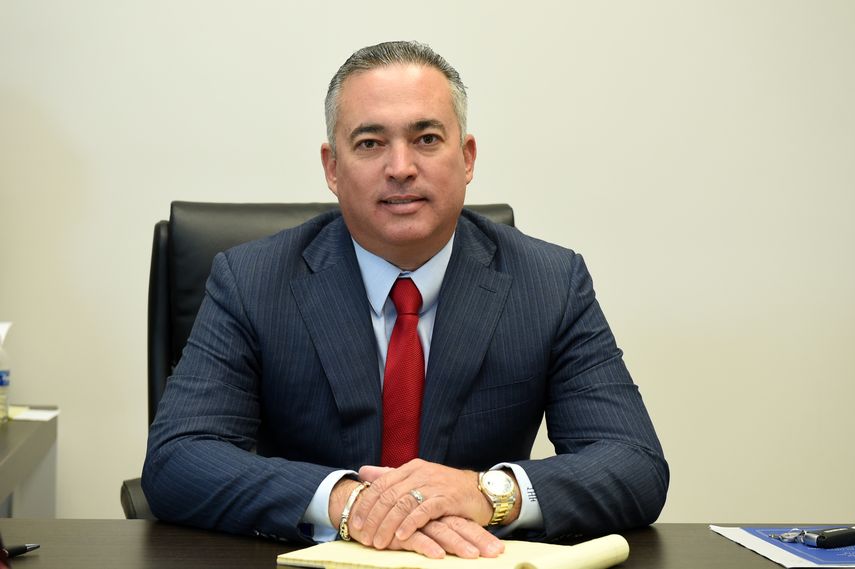
The family buys a name
Ania wanted a business of her own. The couple considered a daycare and a hair salon. Herrera preferred a place where they could sell a product they understood, to people they knew. In 2009, amid a financial crisis, they paid $40,000 for the UniVista name. The name was part of the attraction: it sounded the same in English and Spanish. The business attached to it was failing. It came with essentially no customers and few useful contracts.
The family mortgaged its home and other property, spent its savings and watched the new company lose money for two years. Herrera had three children by then. Risk is often romantic only in hindsight. In the moment, it means a credit-card bill, a payroll date and the knowledge that the people eating breakfast beside you are exposed to the same bet.
What the Herreras did during those losing years explains more than the risk itself. They built departments. Training. Programming. Accounting. Human resources. Internal auditing. Customer retention. Claims assistance. These are the nouns people omit when telling a start-up story because they lack sparkle. They are also the machinery that lets a company survive its own growth.
Even the brand carried an operating choice. UniVista could be pronounced without adjustment in either of the two languages its customers moved between every day. That small symmetry mattered. A name on a storefront can either remind a newcomer that a system was designed elsewhere or quietly suggest that there is room inside. Herrera did not confuse recognition with trust, but he understood it as an invitation. The harder work began once someone walked through the door: explain the terms, check the details and remain available after the signature.
“When you sell a policy, you are selling a promise.”Ivan Herrera
Herrera had learned to sell. Now he was learning to design a seller's guardrails. Agents trained every day. Auditors reviewed the work. Reports showed what was happening by the day, hour and minute. Quality mattered alongside volume. Complaints were meant to be resolved quickly, and Herrera said he sometimes answered calls himself. The policy had been sold, but the obligation was still alive.
This was also a form of scale that did not require Herrera to become less present. A founder cannot answer every phone forever, but a process can preserve what the founder listens for. Training passes judgment forward. Audits catch the error before it becomes a broken promise. Retention reveals whether a customer felt served after the first transaction. The company's infrastructure was, in that sense, a memory system for its original values.
A category becomes a neighbor
UniVista's opportunity sat in plain sight around Hialeah and other immigrant neighborhoods. Large insurers often described parts of this market as unusual or nonstandard. New arrivals could have limited credit records. Some were unfamiliar with the American financial system. Language made an already dense product more intimidating. From a distant spreadsheet, the customers could look complicated.
Herrera did not have the luxury of distance. These were people whose lives resembled his own: families rebuilding, working hard and trying to protect what they had assembled. He believed the market was not inherently untrustworthy. It was poorly understood. UniVista could explain it to carriers, negotiate products for local needs and explain the policies back to customers in language they used at home.
That is the central business insight in Herrera's career. Cultural fluency was not decoration added to an insurance agency. It was distribution, risk knowledge and customer service at once. Empathy became useful because it was translated into operations. The company could gather better information, train agents against mistakes and keep calling after the first sale.
By 2016, Herrera described UniVista as an 80-office Florida company with 500 employees. A later Miami business profile reported more than 120 Florida offices, early California locations and hundreds of thousands of customers. The network has since grown through franchises and a presence in several states. The signs multiplied, but the original proposition remained local: sit close enough to the customer to notice what a national category conceals.
The useful part of the dream
Herrera speaks in the vocabulary of an immigrant entrepreneur: sacrifice, faith, family, discipline, the refusal to accept a no. Yet his most revealing lines concern service. A policy, he says, is an investment in peace of mind. An agency is buying a future problem that it must be prepared to solve when the customer calls. The sale creates a duty.
That view makes the founder less a conquering hero than a custodian of promises. It explains the auditors, the retention department and the attention to complaints. It also explains why he has urged entrepreneurs to sell honestly and follow up. A clever pitch can produce a transaction. A kept promise produces a company.
In June 2025, EY named Herrera one of its Florida Entrepreneur Of The Year award winners. The recognition arrived sixteen years after the $40,000 purchase and nearly three decades after the construction site. By then, the early résumé that might once have looked scattered had acquired a clear logic. Biology taught him to observe. Manual work taught stamina. Sales taught persuasion. Real estate taught networks. Immigration taught him which customers the market misunderstood.
“The person who adapts to change adapts to life.”Ivan Herrera
Herrera has said he wants UniVista to reach Hispanic communities across the United States. Expansion is a familiar corporate ambition. In his case, it carries a personal shape: the customer on the other side may also be holding a credential that no employer recognizes, studying English after a long shift or discovering that an accent changes meaning depending on the room.
The lesson worth borrowing is not simply to take a large risk. Plenty of large risks end as large regrets. It is to pair conviction with infrastructure, and biography with a business model. Herrera knew an overlooked customer because he had been one. Then he did the slower work of turning that knowledge into training, data, quality control and follow-up.
The first morning in Miami, there was rubble to clear. Years later, there were systems to build. The work changed clothes. The habit did not.