The revealing thing about Intertop is that its most important product may no longer be a shoe. It may be the path that shoe takes: discovered on a phone, checked against inventory, tried in a Kyiv store, bought with loyalty points and delivered from a network that knows where the box is. The Ukrainian company has spent 32 years turning a familiar retail ritual into a connected system. Its storefront still says fashion. The machinery behind it says platform.
That distinction matters in a market where price, authenticity and availability pull in different directions. A shopper can find a bargain on a cross-border app, hunt through a general marketplace or walk into a brand boutique. Intertop’s proposition is less theatrical: put official international labels and a growing roster of Ukrainian names in one dependable place, then let customers choose how to browse, pay, collect, return and try things on. The company removes the small frictions that make buying clothes online feel like clerical work.
A shoe store learns new tricks
Intertop’s origin sits inside MTI, a Ukrainian group founded in 1991 by Volodymyr Tsoi, Serhii Bashlakov and Borys Belianskyi. MTI began in technology. In 1994 it opened the first Intertop store, a footwear concept that grew into one of the country’s best-known retail networks. The technological ancestry now looks less like trivia than foreshadowing. Today Intertop describes itself as an omnichannel fashion company, and it talks about terminals, warehouses, suppliers and accounting systems with the same seriousness that fashion houses reserve for fabrics.
The assortment followed customers outward. Shoes led to clothing, sport and accessories; cosmetics arrived; a HOME category appeared in 2024. Intertop’s LinkedIn profile says the platform carries about 140,000 products, including brands such as Timberland, Skechers, Marc O’Polo, Napapijri, Emporio Armani, The North Face, Vans and Kiko Milano. A 2025 interview put more than 150 Ukrainian brands on the marketplace. This is no longer a rack with an internet address. It is a department store whose aisles can expand without asking a landlord.
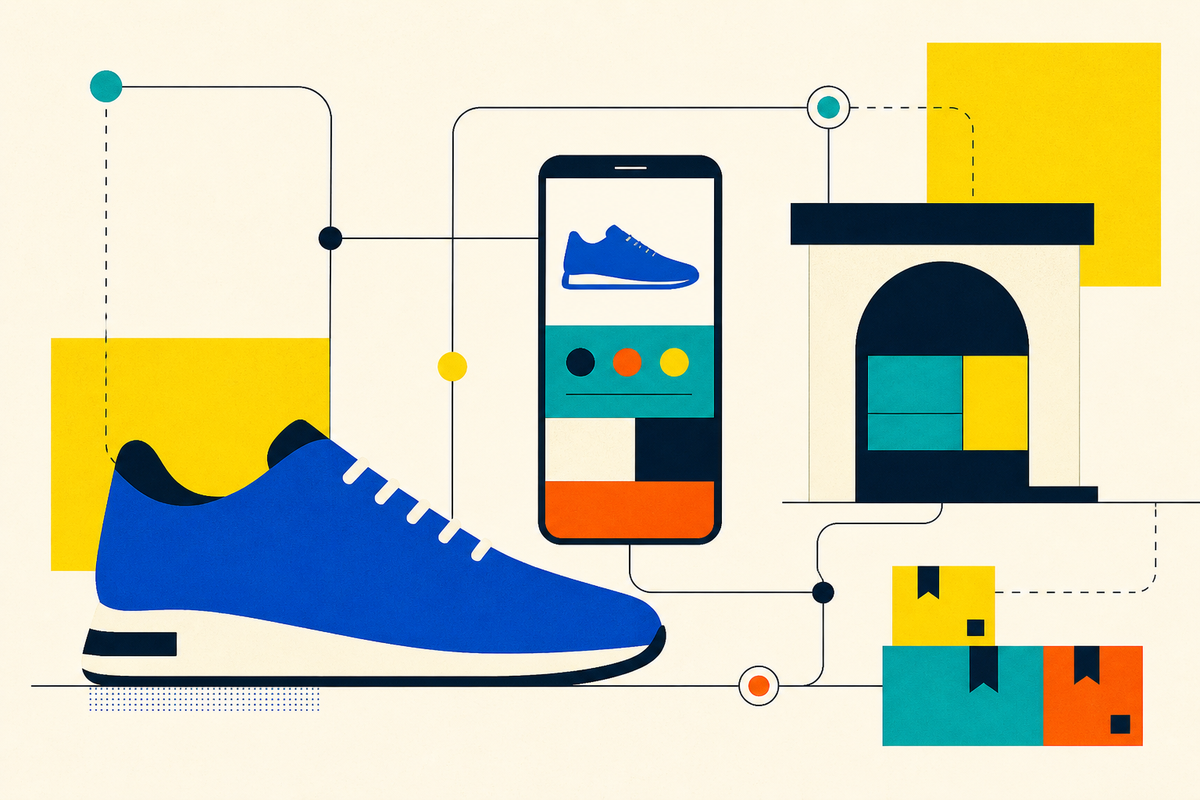
Its customers are ordinary shoppers - women, men and families looking for fashion, beauty and practical outdoor gear - but there is a second constituency behind the screen. Marketplace sellers need traffic, fulfillment and credibility. International brands need a local operator that understands leases, customs, merchandising, service and Ukrainian consumer behavior. Intertop serves both sides. That is why “marketplace” alone understates the model.
The fitting room is part of the software
Fashion has a stubborn physical layer. A size chart cannot tell you whether a heel slips. A product page cannot reproduce the weight of a winter coat. Intertop’s stores solve that problem while doing several other jobs: they are pickup counters, return points, local inventory nodes and evidence that a brand is not a vanishing online seller. Click-and-collect turns this expensive estate into infrastructure for digital commerce.
The company has worked toward a single view across its site, app, stores, terminals, warehouses, suppliers and records. During the 2020 app rebuild, mobile accounted for more than 70 percent of intertop.ua traffic. A marketing case study later reported that targeted app work lifted revenue by 12 percent over four months. Another multi-year redesign program reported a 55.4 percent conversion increase in its first year, followed by further gains. Those numbers come from agency case studies, but the direction is plain: Intertop treats interface details as store economics.
INTERTOP Plus keeps that loop turning. The current program has four levels, with cashback rising from 3 percent to 6 percent on eligible full-price purchases, plus personalized offers and marketplace rewards. It lives in the app, where the bonus balance becomes another reason to return. The delayed activation and redemption rules are not romantic, but they reveal how carefully the company manages returns, margin and repeat visits across channels.
The business behind the basket
Intertop earns retail margins when it buys and resells stock. Its marketplace adds commissions and services without requiring the company to own every item. Exclusive distribution adds another layer: Intertop can launch, localize and operate brands across dedicated shops and digital channels. Kiko Milano is the cleanest recent example. Intertop has been its exclusive official distributor in Ukraine since 2021; by April 2026 the cosmetics brand had 21 physical stores and a dedicated Ukrainian online shop with nationwide delivery.
Then there is the capability hiding in marketing. INTERTOP Agency offers branding, performance media, retention, content production and physical-store services. In an interview, the marketing operation was described as a full-service studio staffed for photography, video, makeup and styling. This is a useful piece of vertical integration: the retailer builds creative muscle to feed its own enormous catalog, then packages that muscle for partners. The store window becomes a media channel. The product shoot becomes a service business.
Public company data recorded UAH 4.54 billion in 2025 revenue and about 1,230 employees. More than 120 Intertop and related brand stores operated in Ukraine in 2026, with 15 more in Kazakhstan. These figures move as formats open, close and reorganize, but they put Intertop in a distinctive middle ground: larger and more physical than a fashion marketplace, more digitally integrated than a conventional chain, and more specialized than a generalist such as Rozetka.
Trust is the unfashionable moat
Competition comes from every direction. Kasta and Rozetka aggregate categories. Answear and MD Fashion court online and premium shoppers. Sportmaster and Megasport own familiar territory in activewear. Makeup is formidable in beauty. Inditex, LPP and LC Waikiki operate powerful store networks, while SHEIN pushes price and endless choice from outside the country. Intertop cannot be cheapest, most exclusive and broadest at once. Its defensible position is the combination: authorized product, local service, broad selection and somewhere nearby to try it on.
CEO Serhiy Badriddinov has made authenticity explicit, saying the platform does not carry counterfeit or fake goods. For a brand, this discipline protects presentation and pricing. For a shopper, it shortens the anxiety between “add to cart” and opening the box. Intertop’s decades of supplier relationships are hard to copy quickly; so are store leases, trained staff, loyalty data and integrated inventory. None is a spectacular moat alone. Together they form a practical one.
Operating when the map changes
The full-scale Russian invasion turned retail infrastructure into a daily improvisation. Intertop reopened stores city by city where conditions allowed, shifted online orders to prepayment when supply and delivery became uncertain, and used social media as a customer-service desk while its call center was unavailable. In the early months, people displaced from home needed ordinary clothes and shoes with unusual urgency. Stores and Nova Poshta branches became the practical endpoints.
The company also sent more than UAH 3.5 million in clothing and technical gear to defenders during the first two weeks, according to its wartime case account. Later collaborations gave that support a consumer form. An Intertop collection with UNITED24 directed all profits to defense and demining and raised UAH 500,000 for naval drones. Other projects involved Ukrposhta, the Ukrainian animated film Mavka, the Come Back Alive foundation and Superhumans Center. The commercial and civic roles overlap: a sweatshirt can be inventory, cultural signal and donation mechanism at the same time.
This period also corrected an easy assumption about digital retail. During the wartime recovery described by the company, roughly 70 percent of purchases happened offline because shoppers wanted speed and fitting. The “old” channel proved useful precisely because it was connected to the new one. Omnichannel is not a race in which the app defeats the shop. It is the ability to reroute demand when circumstances change.
The next border
Intertop is preparing another test of that operating system. In March 2026, co-owner Volodymyr Tsoi said the company was heading toward the European Union and looking at Uzbekistan and Kyrgyzstan, after entering another market in 2025. International expansion is notoriously good at exposing false economies: a format that works at home can buckle under new leases, logistics, regulations and tastes.
Yet Intertop has something more portable than its old shoe-chain identity. It knows how to represent multiple global labels, build local demand, operate branded stores and join those stores to a marketplace. Its expansion product is not merely the green Intertop sign. It is a bundle of retail competencies that other brands would rather rent than reconstruct country by country.
The constraint will be focus. A platform spanning footwear, fashion, sport, beauty, home, media services and new markets can become more useful with every connection, or simply more complicated. The task is to keep the customer’s side plain: real products, sensible discovery, a nearby fitting room and no mystery when something must go back. If Intertop can preserve that simplicity while the machinery grows, its three-decade journey will look less like a retailer chasing e-commerce and more like a technology company finally revealing itself.