The concrete boxes were already installed. Andy Harris, then a drone pilot and former highway designer at the Cherokee Nation Department of Transportation, had intended to photograph the work. Nobody had told him it was finished. In Infotech’s account of the episode, a missed update helped send the agency looking for better construction software. The road had moved forward. The information had stayed behind.
- Infotech connects civil construction bidding, inspection, contracts, and payments.
- Its roots are in statistical investigations of bid rigging.
- The practical prize: fewer repeated tasks and records people can actually find.
The statistician at the bid opening
Infotech’s founding story starts well before cloud subscriptions. Jim McClave established Info Tech in 1977. Tom Rothrock, whose economics research concerned sealed bid markets, became an early collaborator and officially joined in 1981. They brought statistics to a stubborn question: were public buyers seeing real competition?
McClave’s biography credits his analysis in a 1981 Florida highway bid-rigging case with helping recover $30 million for taxpayers. Software followed. An early system for Kansas DOT organized historical construction information. In 1985, AASHTO bought Infotech’s software, beginning the relationship through which Infotech still develops and supports AASHTOWare Project.
That history gives the business an unusual perspective. A bid is both an offer to build something and a record someone may later need to examine. The company learned to care about the second part early.
A record that travels with the road
The product family follows the paperwork. Bid Express accepts sealed electronic submissions and checks for omissions. Appia handles construction administration: quantities, daily reports, change orders, funding, and pay estimates. Doc Express routes documents for signatures and approvals. Signet records and verifies subcontractor payments.
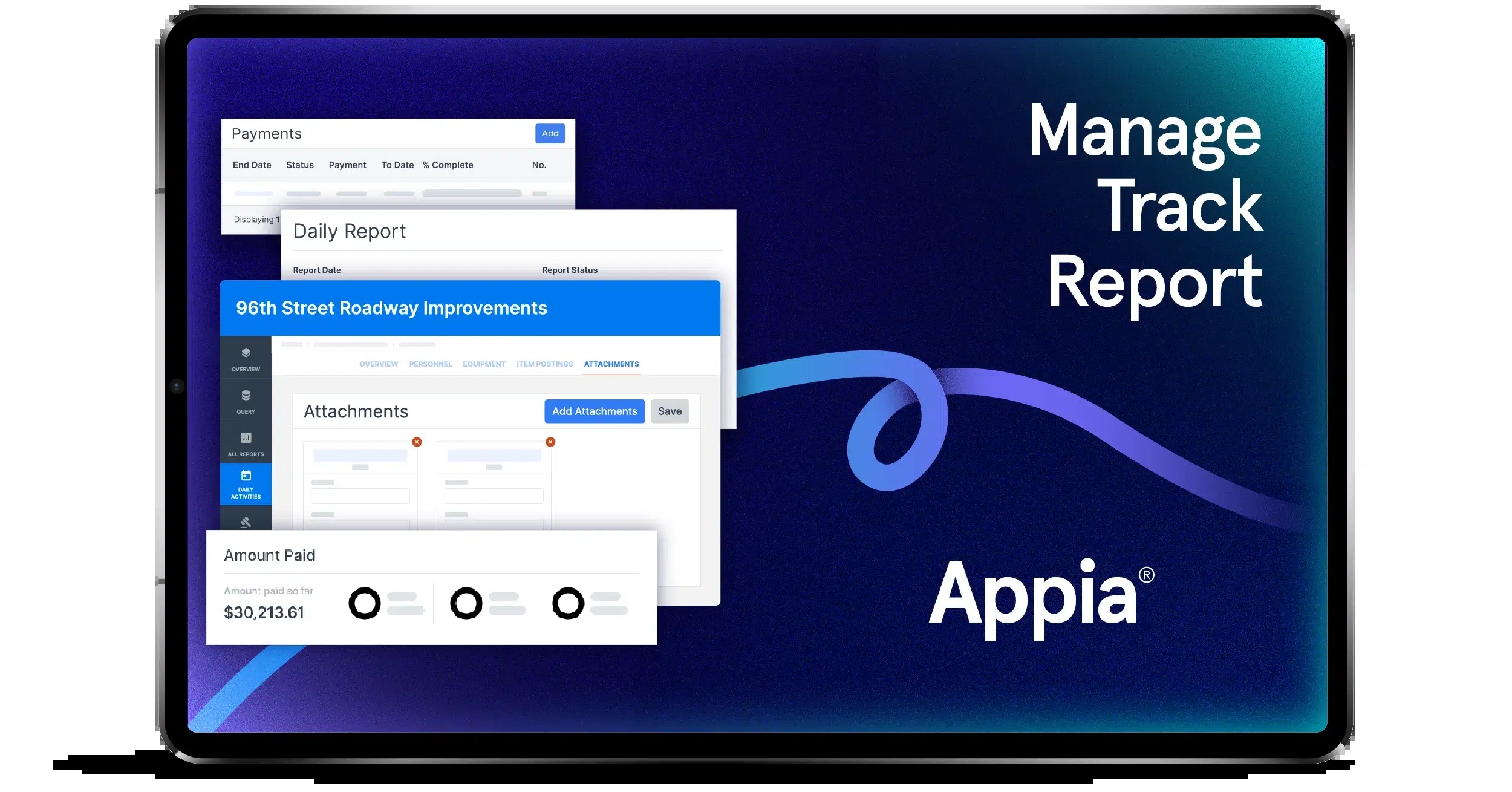
An awarded bid can become the starting data for an Appia project. Inspectors add field records; managers review them; documents move through approval. Esri integration adds location through ArcGIS Field Maps. The interesting engineering happens between those steps, where a person might otherwise retype the same information.
- 01 / BIDSubmitBid Express
- 02 / BUILDRecordAppia
- 03 / APPROVESignDoc Express
- 04 / PAYVerifySignet
Simplified product roles. Configuration and integrations vary.
This is specialist territory: transportation departments, local and tribal agencies, engineering consultants, and the contractors serving them. Infotech’s advantage is its familiarity with civil infrastructure administration. The alternative often includes field books, spreadsheets, separate signing tools, or construction software built around a different kind of project.
At engineering firm RS&H, David Elliott described finding information in roughly five minutes that previously required eight to ten hours of file research. That is one customer’s account, rather than a promise for every project. But it makes the value legible: a well-kept record becomes useful precisely when somebody challenges what happened.
“8-10 hours of researching files the old way, I did in about 5 minutes.”David Elliott / RS&H, in an Infotech case study
The $20 newspaper notice
Huntington, West Virginia, supplies a pleasantly unglamorous example. Purchasing director Kim Bailey inherited eleven filing cabinets and a basement of old bids. “I was swimming in paper,” she told Infotech. After adopting Bid Express, newspaper notices could direct bidders online rather than carry the full information. The reported advertising cost fell from $400 to $20 per bid.
Bailey also reused solicitation templates. The lesson travels well beyond procurement: standardize the repeatable parts before asking people to work faster. A form that already contains the right requirements can save more effort than another reminder to be efficient.
Two websites, two price tags
Infotech makes money through software subscriptions, transaction fees, agency licensing, and services such as implementation, training, and hosting. Appia’s published standard license is $2,475 per user annually, before applicable state tax. Doc Express and Mobile Inspector are included with the Appia subscription.
For vendors using Bidexpress.com, the published choices are $50 per solicitation or $60 a month, plus applicable tax. Agency sponsorship can remove the vendor submission charge. Agencies choose between cost-sharing and sponsored models, with annual and implementation fees.
Bidx.com, the service used with AASHTOWare Project Bids, has a separate schedule. Its Core tier lists $100 a month; other features and authorizations affect the bill. Treating the two sites as interchangeable would produce a misleading budget.
The buying decision therefore starts with a workflow: who submits, who checks, who signs, and how often? Count the time spent preparing records and recovering them later, alongside the license expense.
Getting people across the bridge
Adoption takes work. Huntington’s contractors initially resisted the change; Bailey said the first few months were a struggle. Cherokee Nation DOT had evaluated products oriented toward commercial buildings and other disciplines before finding a closer fit. These are useful warnings against buying from a feature checklist alone.
My reading of those cases: test a real solicitation or inspection, assign responsibility for entering records, and train the people outside your office too. Offline field capture still needs synchronization before colleagues see updates. A searchable database depends on somebody putting usable information into it.

Inside the company, hackathons give employees room to experiment. Its people philosophy is called Treating People Right. In June 2026, Infotech announced its third consecutive Great Place To Work certification. Culture has a practical audience here: customers depending on support when a submission deadline approaches.
From receiving bids to choosing them
Diversis Capital acquired Infotech in 2024, with Will McClave remaining CEO. The company acquired Workflow Manager in October 2025; now called PlanX, it extends the portfolio into transportation planning and project management.
January 2026 brought Bid Intelligence: tools that recommend opportunities, tag proposals, and summarize documents. September release notes show more everyday work on navigation and access to data. Infotech calls its connected approach Unified Civil Intelligence. The practical test remains the one suggested by those installed concrete boxes: does the next person know what happened?