BREAKING  Bezos names Walder-Biesanz a 2025 Courage & Civility laureate — $5,000,000 NATIONAL MATH STARS  1,300 applications. 60 spots. 98% retention. THE MODEL  Find them at 7. Stay for a decade. $100,000+ per child. RESUME  Olin · Gates Cambridge · Fulbright · Stanford MBA · opera critic BREAKING  Bezos names Walder-Biesanz a 2025 Courage & Civility laureate — $5,000,000 NATIONAL MATH STARS  1,300 applications. 60 spots. 98% retention. THE MODEL  Find them at 7. Stay for a decade. $100,000+ per child. RESUME  Olin · Gates Cambridge · Fulbright · Stanford MBA · opera critic
The Profile · Talent & Education

Ilana Walder-
Biesanz

She finds the one-in-a-thousand math child in second grade, then refuses to let go for the next ten years.

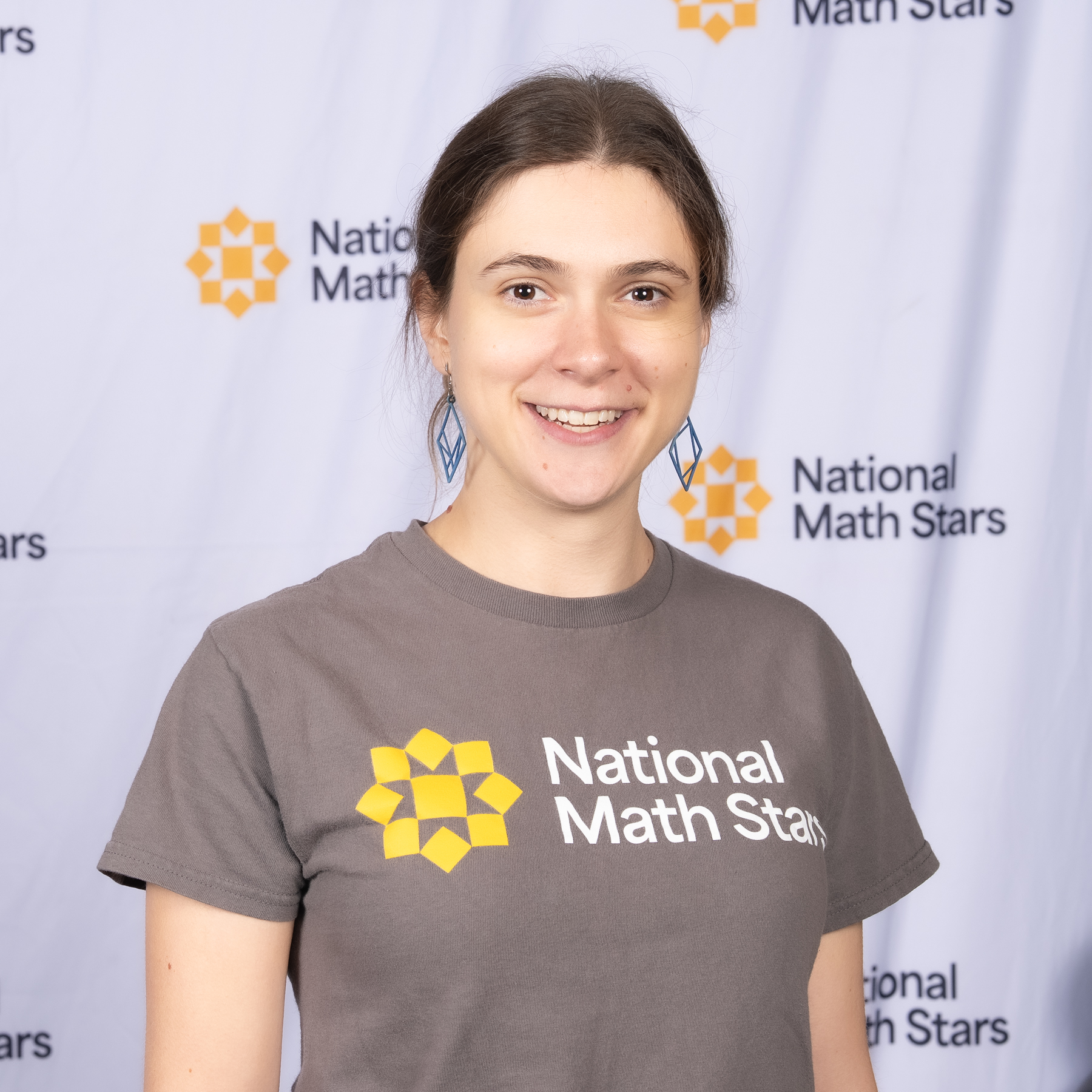
Ilana Walder-Biesanz, founder and CEO of National Math Stars
She wears the logo. The kids wear the future.
The Big Idea

A decade-long bet on second-graders

Most education charities run a program. A summer camp, a Saturday class, a six-week intensive. Ilana Walder-Biesanz looked at that menu and decided the whole thing was built wrong. National Math Stars, the nonprofit she founded in 2023, does not run a program. It runs a relationship - one that starts when a child is seven or eight and is supposed to last until they finish high school.

The mechanics are precise, which figures for a systems engineer. National Math Stars looks for children scoring in the top 2% on math assessments in second and third grade, then narrows with reasoning tests to the roughly one-in-a-thousand. Those children become Stars. Each one receives a personal advisor, mentorship from working mathematicians, family advising, and a budget for the things gifted kids usually have to find on their own - competition fees, online courses, robotics kits, a chess coach.

The price tag is deliberately large: more than $100,000 and up to ten years per child. That is not a typo, and it is the entire point. The premise is that talent is distributed everywhere and opportunity is not, and that the gap between them is not a single missing class but a decade of small, well-timed nudges.

"We wanted to focus on early talent identification and offering long-term, holistic support that goes beyond occasional summer camps," she has said. The organization does not try to out-teach the institutions that already teach math well. It connects its Stars to places like Art of Problem Solving and Johns Hopkins' Center for Talented Youth, then supplies the part those places assume a family already has: the guidance and the money.

That restraint is its own kind of strategy. After the first year, Walder-Biesanz concluded the organization should "focus on what's missing: the guidance, mentorship, funding, and encouragement needed to connect talented kids to existing opportunities." It is an unusually humble thing for a founder to say - that the best move is often to point, not to build.

The early numbers suggest people believe her. The pilot started with 12 children, nicknamed Protostars. The second cohort drew 1,300 applications for about 60 places. Retention in that cohort hit 98%, which in the world of youth programs is close to unheard of. By 2025 the organization was naming Stars well beyond its Texas home, in states including Iowa.

Then, in December 2025, the validation arrived with a famous signature attached. Jeff Bezos and Lauren Sanchez Bezos named Walder-Biesanz one of five recipients of a Courage & Civility Award - $5 million, no strings, to spend on growth, a new pilot, and the unglamorous infrastructure a young nonprofit needs to scale without breaking. It joined roughly $16.5 million in philanthropic commitments the organization had already lined up through 2027.

The selection process is where her convictions show. National Math Stars does not just rank children by raw score. It weighs socioeconomic status, parental education, geography, race, gender, and learning differences - because a one-in-a-thousand mind in a household that already knows how to navigate gifted programs needs less help than the same mind three zip codes over. The goal is a pipeline that looks like the country, not like the existing list of who already shows up to math competitions.

None of this is theoretical for her. She spent years at Bain & Company in Houston advising both companies and nonprofits across education, climate, and manufacturing, learning how organizations actually scale and where they quietly fall apart. Before Bain she was a product manager at Yahoo, where rising from associate to senior PM taught her to build things people actually use. National Math Stars is, in a sense, the product she always wanted to ship.
What She Learned

The lessons of a 12-child pilot

The first cohort was small on purpose. Twelve children, the Protostars, were less a program than an experiment in what these families actually needed. The findings reshaped everything that came after.

Lesson one: the mentoring had to be about problem-solving, not tutoring. These kids did not need someone to re-explain the homework. They needed someone to hand them harder, stranger, more beautiful problems and sit with them while they wrestled. The mentors are working mathematicians for a reason.

Lesson two was quieter and more revealing about how she thinks. Open-ended "ask us for whatever you need" funding sounds generous, but it rewards the families already fluent in asking. So National Math Stars replaced it with structured budgets - a defined envelope every family could see and use - specifically to shrink the inequities that informal generosity tends to hide. It is the move of someone who has read enough about good intentions to distrust them.

Roughly three in four Protostars stayed into year two. The next, larger cohort kept 98%. The bet that depth beats breadth is, so far, paying out.

The Belief

Why this, why her

She arrived at the work through Carina Initiatives, joining in July 2023 as an entrepreneur in residence with a single brief: find America's most exceptional young mathematicians and figure out how to keep them. By the end of that summer, National Math Stars existed.

The conviction underneath it is simple and stubborn. Mathematical talent shows up everywhere; the support to develop it does not. Close that gap early, stay long enough to matter, and the country gets scientists and engineers it would otherwise have quietly lost in the third grade.

$5M
Bezos Courage
& Civility Award
$100K+
invested
per Star
10 yrs
of support
per child
98%
cohort
retention
"Every one of our Stars has the potential to make valuable contributions in science, engineering, and technology."
// Ilana Walder-Biesanz
Origin

The prodigy who built the on-ramp she never had

She learned to read in Japanese before she learned to read in English. That is the kind of sentence that tells you everything about the rest of the story.

Walder-Biesanz grew up at a school that let children move at their own pace regardless of age, so she was usually the youngest in the room. When she switched to public school she was still years ahead, especially in math and languages. Unsatisfied with the ceiling, she started taking mathematics and Spanish courses at Lewis & Clark College at 13, while she was still in secondary school.

She finished her undergraduate engineering degree at Olin at 19 and her first master's at 20. She knows exactly what it feels like to be a gifted kid running out of road - which is why she spends her days finding other kids before they hit the same wall, and making sure the road keeps going.

National Math Stars, in other words, is autobiography disguised as a nonprofit.

The Path

From Yahoo to Stars

  • 2013B.S. in Systems Engineering from Olin College, at 19. Named a Gates Cambridge Scholar.
  • CAMBRIDGEM.Phil. in European Literature - thesis on Mozart's La clemenza di Tito.
  • FULBRIGHTA year in Munich researching how Germany stages classic opera and theater.
  • TECHProduct manager at Yahoo, rising to senior PM.
  • 2020MBA from Stanford GSB. Siebel Scholar. Then Bain & Company in Houston.
  • 2023Entrepreneur in Residence at Carina Initiatives - founds National Math Stars.
  • 2025$5M Bezos Courage & Civility Award.
The Plot Twist

The engineer who reviews operas

You could tell her story as a straight line of math credentials. You would be missing the better half. Walder-Biesanz is a working opera critic with a romantic streak she makes no apology for.

The critic

She has reviewed opera and theater for San Francisco Classical Voice, Bachtrack, Parterre Box, and Opera Online. During her Fulbright year alone she filed roughly 35 reviews - more than 26,000 words on other people's stagecraft.

The board member

She sits on the board of Ars Minerva, a small San Francisco company that resurrects forgotten Baroque operas. Two performing-arts boards, in fact - the day job is math, the heart has subplots.

The polyglot

Six languages at intermediate level or above. A perfect 100/100 on a graduate optimization final in a class of 140-plus. Opera singing, ballroom dancing, and - yes - fencing on the hobby list.

"I belong in the nineteenth century and take every possible opportunity to pretend I'm actually there," she once wrote on her opera blog. The woman building a 21st-century talent pipeline would, given the option, time-travel to the era of grand opera.

In Her Words

Quotable

"Focus on what's missing: the guidance, mentorship, funding, and encouragement needed to connect talented kids to existing opportunities."
"We wanted to focus on early talent identification and offering long-term, holistic support that goes beyond occasional summer camps."
"The only secret to the 'what matters most to me and why' essay is honesty and passion."
"I belong in the nineteenth century and take every possible opportunity to pretend I'm actually there."
The Margins

Facts that don't fit the resume

01

Learned to read in Japanese before English.

02

Took college math at 13. Finished undergrad at 19, first master's at 20.

03

Speaks six languages at intermediate level or above.

04

Kept a blog, "My German Season," chronicling ten months of opera in Munich.

05

In her spare time: theater, novels, puzzles, and petting her two cats.

06

Perfect score on a graduate optimization exam taken by 140+ students.

Pass It On

Share this profile

in  LinkedIn X / Twitter Facebook Instagram

Profile compiled from public sources · Facts verified where possible · Last updated June 2026