A business owner wants a logo. That sounds like a small request, until the questions begin. How many designs? What should they cost? Who makes them? And how much time will disappear before there is anything worth putting on a business card? Huffwork's archived logo page approached this tangle with a remarkably concrete opening: prices from $50, with five to fifteen logo options depending on the package. Here was a creative purchase presented as something a person could actually begin.
- The offer: a marketplace connecting business owners with digital service professionals.
- The entry point: logo design advertised from $50, plus a $20 credit toward a first project.
- The interesting wrinkle: its buying guides also directed readers to Fiverr and do-it-yourself tools.
Those details belong to Huffwork's 2023 website, rather than a current price list. Together, they reveal a business concerned with the awkward distance between having an idea and commissioning the work. Its subject was digital services. Its practical territory was the buyer's hesitation.
The purchase before the purchase
Before someone hires a designer, they have to decide what they are buying. A basic business website, an online shop and a custom web application can all be called a website. They require different skills, different budgets and different conversations. Confusing them makes the first quote feel arbitrary, even when the person preparing it has understood the job perfectly.
Huffwork's website-design guide separated these possibilities. It discussed blogs, online stores and more elaborate applications, then laid out routes through agencies, freelancers and website builders. Squarespace, Wix, Weebly and Webflow appeared alongside the option of hiring a professional. Shopify had its own guide. So did mobile app development.
The useful service here was translation. Instead of assuming that a business owner already knew the right procurement vocabulary, the articles described the choices. A reader could arrive asking for a website and leave with a more useful question: which kind of website, built by whom, with which responsibilities left to me?
Supply your own time.
Write a clear brief.
Define the wider scope.
A marketplace that pointed next door
Then comes the detail that makes Huffwork more interesting than another catalogue of freelance skills. Its archived website-design guide recommended Fiverr. The Shopify and Wix guides did too. A company described as a marketplace was also helping readers navigate another marketplace.
That makes sense if you read the articles as buying guidance. Their organizing question was how to get something made. Sometimes the answer involved a freelancer elsewhere; sometimes it involved building the thing yourself. Huffwork occupied the space where service discovery, educational publishing and a marketplace proposition met.
For a reader, the distinction matters. An article comparing routes to a finished website performs a different job from a project workspace. One helps you choose; the other helps you transact. Huffwork's public pages presented both kinds of ambition. The guides offer particularly clear evidence of the first.
“We help you to easily hire digital service professionals”Huffwork's archived About Us page, 2023
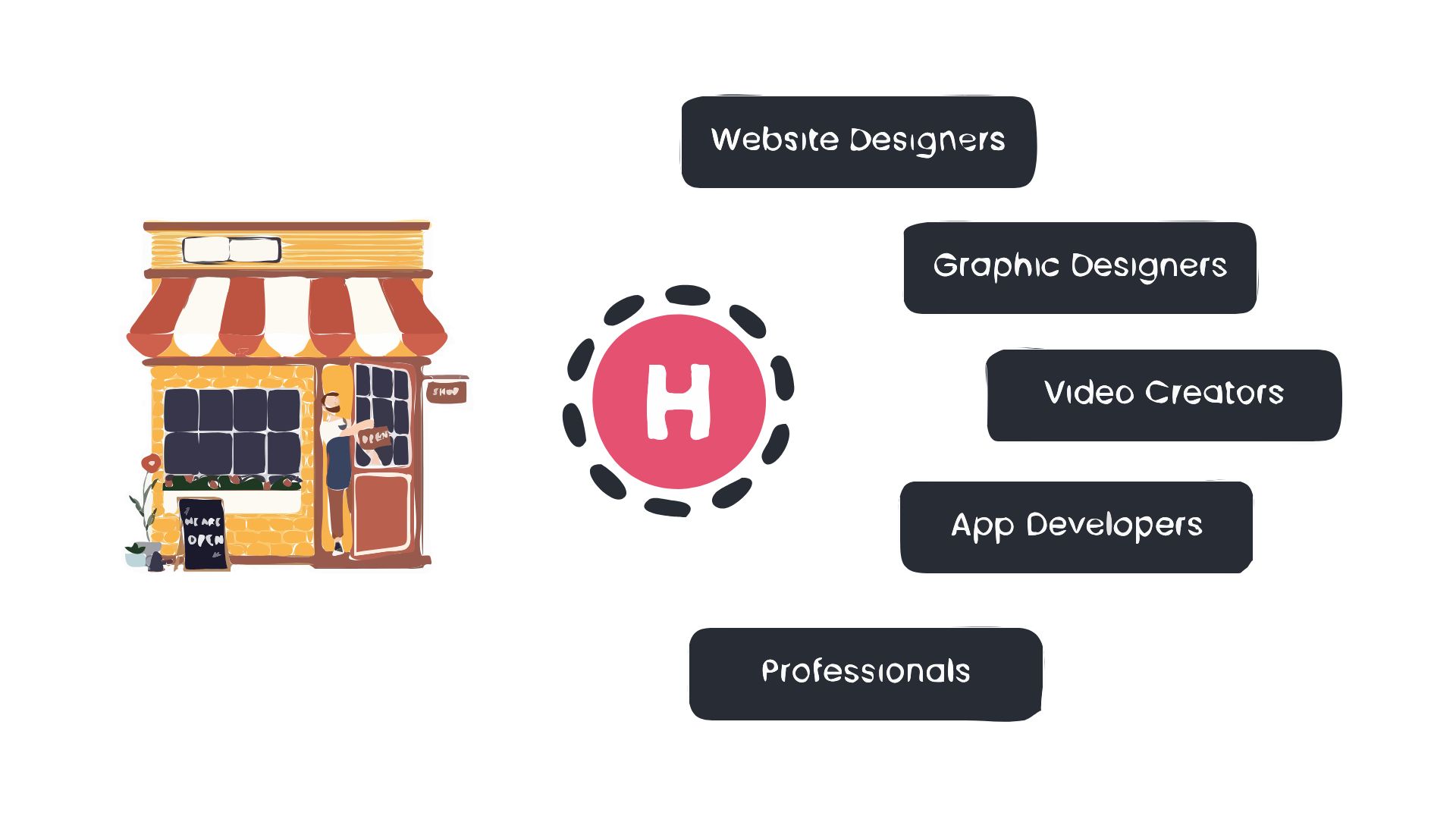
Its range of advertised services followed the needs of a small business rather than one technical discipline. The December About Us page listed website design, programming, translation, business plans, voice-over work, video editing and virtual assistance. There were restaurant menus and business cards, too. These are the unglamorous, necessary objects through which a business introduces itself to the world.
Fifty dollars makes a different conversation
The logo offer gave this broad proposition a specific shape. “Pricing from $50” was a starting price, while the promised five to fifteen options depended on the package. The same page advertised a $20 credit for a first project. Neither figure should be read as a universal cost for design work.
The attraction is easy to understand. A named starting price gives a buyer something to compare with the budget already in their head. A defined number of options makes an abstract creative service feel more tangible. The credit provides an additional reason to try a first project. These are observations about the offer's design, rather than evidence of how many customers accepted it.
Five to fifteen logo options, depending on package. A starting offer, rather than a quote for every brief.
What can another business copy? Put the deliverable beside the price. If a customer must decode the package before understanding what arrives, the sales page has handed them another task. Huffwork's logo page paired the two in a few lines. The approach is most useful when a service can be bounded clearly enough for buyers and providers to share the same expectations.
The customer who brings the next customer
Huffwork also published an affiliate proposition. Its December 2023 page promised participants 10% of every sale for life, along with an affiliate dashboard and weekly payouts. That was the program's advertised promise. It gives the profile a second concrete commercial mechanism beyond the first-project credit.
The two offers addressed different moments. A credit encouraged a new buyer to begin. A recurring referral reward encouraged someone else to keep introducing buyers. Read together, they suggest an attempt to make acquisition part of the product's surrounding economics. They do not, by themselves, establish the platform's margins or its growth.
The company's June terms described fees for introductions, listing upgrades and memberships, while distinguishing the platform from the contracts between buyers and sellers. That is the familiar marketplace bargain: the platform organizes access; the specialist supplies the work. Its success depends on the quality of the match and the clarity of the job.
That last condition is where the opening logo request returns. A tidy package can help someone take the first step. It becomes less useful when the brief contains unresolved strategy, an open-ended application or a continuing need for judgment. Those projects demand more conversation. Huffwork's most transferable idea is the modest one visible in its archived pages: give the customer enough detail to begin that conversation intelligently.
EXPLORE HUFFWORK