A doctor who charges a monthly fee instead of filing insurance claims has escaped one set of paperwork. She has acquired another. Someone must know which patients belong to which plan, whose card failed on Tuesday, what the employer promised to pay, and which clinician should receive the money. If she works alone, a spreadsheet might last for a while. If she wants to treat the employees of a company spread across seven states, the spreadsheet has met its natural enemy: geography.
Hint Health built a business in that gap. Founded in San Francisco in 2013 by Zak Holdsworth and Graham Melcher, it first made the membership and billing machinery for direct primary care, or DPC. In that model, patients or employers pay a recurring fee for access to primary care. The doctor can spend less time submitting routine visits to an insurer; the practice still needs a reliable way to enroll people, charge them and keep records straight.
- Hint Core handles the membership ledger, recurring billing and employer accounts.
- Hint Clinical adds an electronic medical record, scheduling and patient communication.
- Hint Connect links independent doctors to employers whose workers live in different places.
01 / ORIGINThe boring problem was the right one
The founders describe asking, in 2013, what it would take to redesign American healthcare from first principles. It is a lofty question. The answer they shipped was more useful than lofty: software to manage direct care memberships. HintOS, later renamed Hint Core, tracks enrollment, recurring payments, plan rules, employer contracts and reporting. It integrates with clinical systems so that a membership change need not become an out-of-date chart somewhere else.
That is Hint's distinction in a crowded health software market. A general medical record starts with a visit. Hint started with the relationship that makes the visit possible: who is a member, under what terms, and who pays. The company later added its own clinical record, but the membership ledger remains the center of gravity. One Hint Core customer, Proactive MD's John Collier, says it can keep 50 employers with different plans in one place. The remark is less glamorous than a claim about artificial intelligence, and more revealing.

02 / THE PRODUCTSFrom the ledger to the exam room
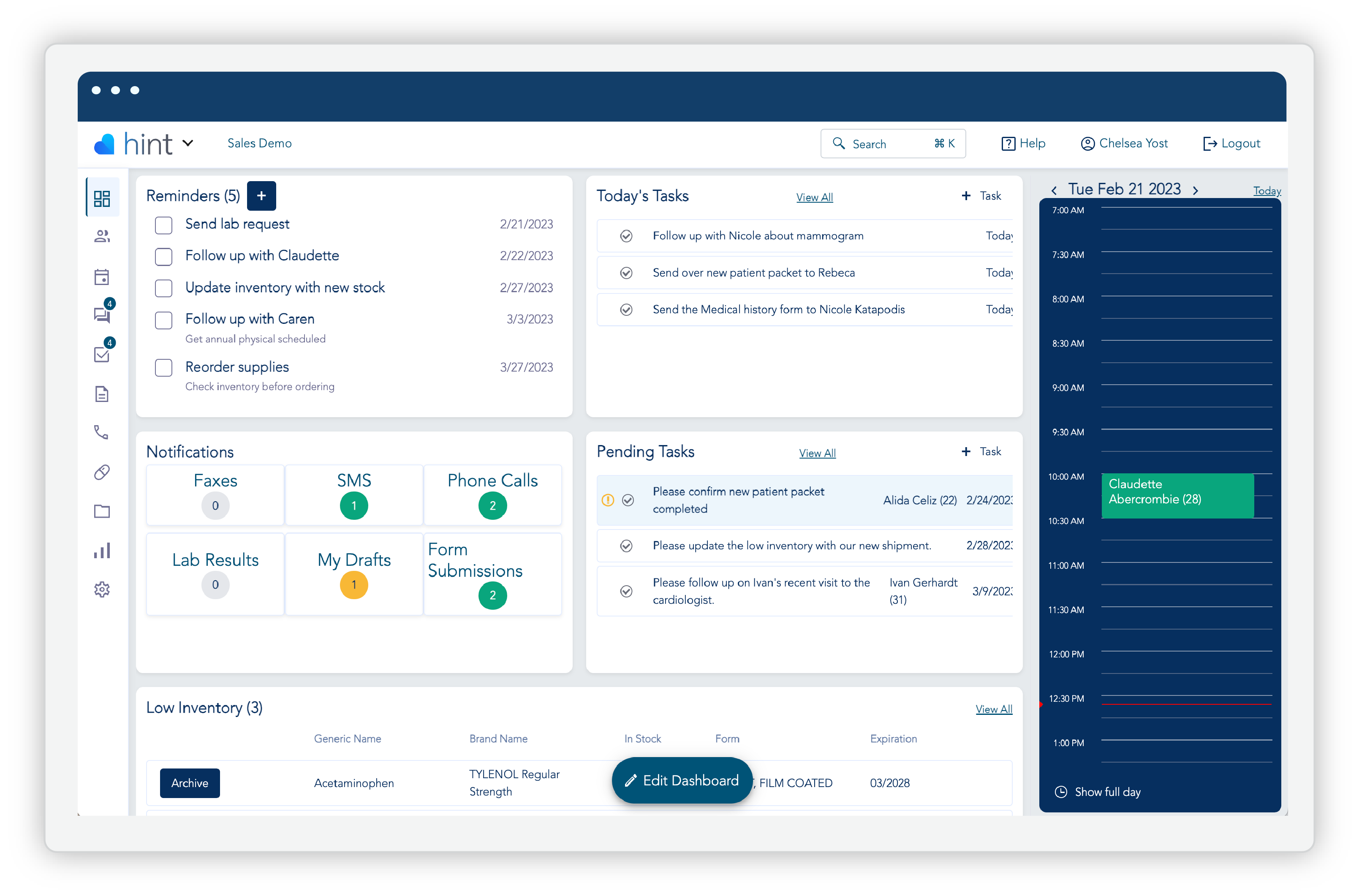
Hint Core is the business layer. It can enroll patients, collect recurring fees, bill employers, track deposits and show results by plan, clinic or location. Hint Clinical is the care layer: charts, tasks, scheduling, prescriptions and messages in a product built for direct care. The company has also added tools for AI-assisted documentation. A clinician can use the combined system to see a patient, record the visit and keep the subscription current without jumping between unrelated products.
The third layer is Hint Connect. It is a curated network of independent DPC practices sold to employers, benefit advisors and health plans that want a DPC benefit. A company with workers in one town can arrange care with a nearby practice. A company with workers across several states needs a map, common benefit terms, enrollment rules and one contracting process. Hint Connect supplies that coordination. Independent practices can join the network without adopting Hint Core, an important detail for doctors who already have a software stack they like.
03 / PROOF OF WORKSeven weeks, fifteen clinics
A published case study gives the network idea an address book. Antioch Med, Candid Health Advisors and E-Powered Benefits needed a direct care option for an employer whose people were spread across seven states and eighteen locales. Hint Connect used a geographic analysis to identify fifteen independent practices. Ten were already in its network; five were added. Hint says the group assembled the network in seven weeks, then used Core for eligibility, enrollment, plan management and billing.
The sequence matters. Software alone could not put a clinician near each employee. A list of clinicians alone could not make fifteen practices behave like one benefit. Hint's pitch is the combination of the two. It also explains why the company sits between several markets: SaaS for doctors, benefit infrastructure for employers, and network operations for independent clinics.
“Before Hint Connect, we would literally have to make 23 phone calls, have 23 different conversations, 23 different contracts, 23 different payment levels.”David Contorno, E-Powered Benefits, describing a multi-office client
04 / THE BILLWhat the switchboard costs
Hint publishes starting prices, a useful courtesy in healthcare software. Core Growth starts at $110 a month and includes 100 members. Each additional block of 50 members adds $45 a month. Electronic payments have separate fees: the published Growth rate is 2.75% plus 30 cents for cards, with an added American Express surcharge, and 0.75% plus 25 cents for ACH, capped at $5 per transaction. Larger Core plans and the combined clinical packages cost more. A growing clinic should calculate the full bill from its membership count and payment mix, not merely admire the starting price.
Includes 100 members. Added members and payment processing are extra. Pricing is a snapshot of Hint's public schedule, not a quote for a particular practice.
The 2022 $45 million Series B, led by Banneker Partners and Frist Cressey Ventures, financed a wider platform and customer support. Hint does not publicly break out revenue from subscriptions, transaction fees and network arrangements in enough detail to price the whole enterprise. The software economics, however, are visible to a clinic shopping for it.
05 / THE MARKETGrowth makes the map harder
Hint's 2026 DPC trends report analyzes data from more than 2,700 clinicians and 1.4 million members. It reports that DPC membership per capita grew 837% between 2017 and 2025 in its data, while clinician growth per capita rose 555%. Those are measurements of the data Hint assembled, not a census of every American practice. They still describe why a company that once handled subscription payments now sells network tools and a marketplace of integrations: more members mean more coordination.
In 2025, Hint says it shipped 25 major features and added 267 locations to Hint Connect. It also reported eighteen new employer groups through the network. The company hosts Hint Summit and training programs for practices starting out. That community work has a practical side: doctors who learn how to launch a DPC clinic may later need a billing system, a clinical record or an employer contract.
There are clear limits to the model. Direct primary care is primary care, not a replacement for hospital or specialist coverage. The employer network is only as useful as its local clinicians, and a doctor cannot promise convenient access if the panel fills faster than capacity grows. A solo clinic with a small local patient base may need little beyond membership software; a national employer needs far more than an app. Hint's wager is that enough practices and employers will meet in the difficult middle.
The reader can copy the sequence even outside healthcare: solve the recurring transaction first, connect it to the daily workflow, then build the network only when both sides have a reason to use it. The order is less romantic than “disrupting” an industry. It is also a better account of how infrastructure earns its place. A subscription needed a ledger. A national benefit needed a switchboard.