A radio wave has no respect for architecture. It does not admire the lobby, appreciate the poured concrete, or care that a building passed every visible inspection. It weakens in stairwells. It disappears behind steel. It can arrive at a basement as a whisper, precisely where the person holding the radio needs a clear answer. Hilmi Turan has spent his working life with this invisible problem.
His business card says president and CEO of Sema Wireless. His public posts sound more like those of an engineer who has just returned from the field and is still turning over one troublesome measurement. Turan designs and installs Emergency Responder Communications Enhancement Systems, usually shortened to ERCES or ERRC, along with cellular distributed antenna systems. The names are a thicket of initials. The purpose is simple: make radios work inside buildings that would otherwise swallow their signals.
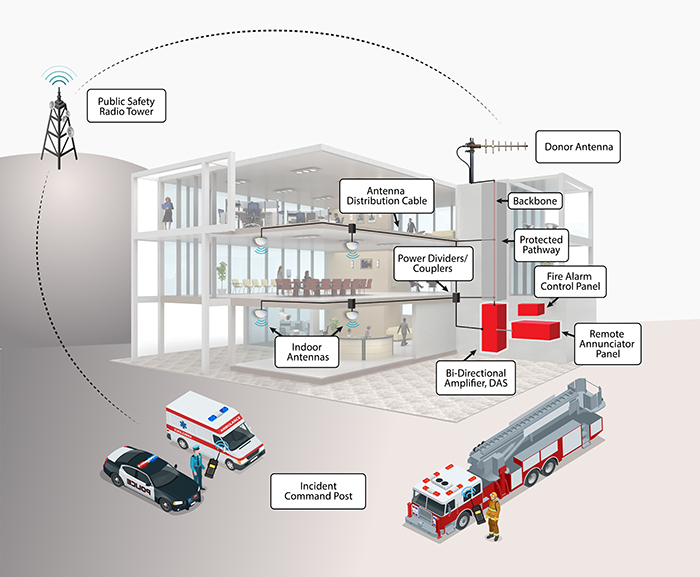
It is infrastructure with an unusual publicity problem. When it performs, nobody notices. A rooftop donor antenna receives the public-safety network. A bi-directional amplifier strengthens the signal. Cable, splitters and indoor antennas carry it across floors and into rooms. The system waits behind walls and above ceilings for a bad day. Success looks like an ordinary conversation.
The engineer before the company
Turan was born in Istanbul on February 9, 1976. He completed a bachelor’s degree in electrical engineering at Istanbul Technical University in 1998, then went directly into wireless. A public career history places his first post at Motorola that September. Ericsson followed from 2004 to 2008, then CTS from 2008 until the spring of 2013. In his own biography, Turan also names CommScope and AT&T among the companies where he worked as a senior or principal RF design engineer.
The sequence matters because Sema Wireless did not begin as a speculative leap into a fashionable market. By the time Turan started the company in April 2013, he had worked in indoor and outdoor distributed antenna systems for a decade. He knew the corporate side of wireless, the calculations, the hardware and the stubbornness of real buildings. Entrepreneurship arrived after the apprenticeship.
Graduates from Istanbul Technical University and begins a career in wireless engineering.
Moves into indoor and outdoor distributed antenna systems.
Starts Sema Wireless, focused on public-safety and cellular DAS.
Marks the company’s first Houston public-safety project completed from permit to final approval.
Adds NICET certification and publicly introduces his ownership of component supplier Armut, LLC.
Sema calls itself a turnkey integrator. In practice, that means the company stays with a system from radio-frequency design through permitting, installation, integration, testing and approval. Turan leads engineers and technicians. A Texas school-district evaluation identified him as the technical lead for Sema’s proposal and credited him with 26 years in wireless. The same document puts project managers Ben Dzubu and Bob Manara beside him, a useful glimpse of the team structure behind the founder’s title.
Why a finished building can still be unfinished
Mobile coverage has trained people to think of signal as weather: strong here, weak there, vaguely beyond anyone’s control. Inside a large building, however, coverage is partly an architectural fact. Concrete absorbs and reflects radio energy. Metal-coated glass, elevator shafts and below-grade rooms complicate the path. A handheld radio can work outside the front door and become unreliable several floors in. The walls have not malfunctioned. They are doing exactly what dense walls do.
A distributed antenna system answers by building a deliberate route around those obstacles. The rooftop donor antenna communicates with the public-safety network outside. An amplifier and a protected backbone carry that connection into the structure. Smaller indoor antennas distribute coverage where responders may need it. The fire alarm control panel and remote annunciator monitor the system, while backup power is intended to keep it available when normal electricity is not.
Every stage gives Turan’s team another question to settle. Where is the strongest donor signal? Which spaces fall below the required coverage? How should cable run without creating a vulnerable single point? What does the local authority require, and how will the finished system be tested? The answer is not one powerful antenna. It is a chain whose ordinary-looking pieces have to cooperate.
That chain also explains why Sema’s work stretches from permit to final approval. Radio engineering is only part of an ERCES project. The system belongs to a building, answers to local fire-code enforcement and ultimately serves people arriving under pressure. Design drawings, equipment, installation and inspection are not separate stories. They are successive versions of the same promise.
A few inches, and a different answer
Turan’s most revealing technical story is not about a giant installation. It concerns the distance between a person’s hip and ear. During a recent delivered-audio-quality test, he wrote, an inspector held a speaker microphone while the radio itself sat on his hip. The test failed. Turan asked him to move the radio to ear level without the speaker mic. It passed.
“A few inches in height changed the outcome.”Hilmi Turan, on a radio-coverage test
Turan did not treat the pass as the end of the matter. His point was that firefighters in an emergency may have both hands occupied. A system tested with a radio in the position most likely to produce a good result may satisfy a procedure while missing the circumstances of actual use. He called for authorities and engineers to test systems the way they will be used.
This is the engineer’s argument in its natural habitat: not a grand theory, but a small variable with large consequences. Inches become evidence. Body position becomes part of system design. The person carrying the radio belongs inside the technical model.
Maintenance is the second design
Installation earns the ribbon-cutting. Maintenance earns fewer photographs. Turan has been blunt about the imbalance. Fire departments, he says, are getting better at reviewing ERCES designs and performing final inspections, while enforcement of annual inspections still needs attention. Building owners may skip them to save money. Five or six years can pass before somebody discovers trouble in a bi-directional amplifier, battery backup unit, donor antenna or another critical component.
The logic is almost comically familiar. A quiet system appears healthy because it is quiet. Deferred inspection saves a modest sum until repair becomes expensive. But the joke ends where public safety begins. Turan frames preventive maintenance as both a reliability measure and a financial one. His company sends reminders, though he argues that reminders alone cannot replace enforcement.
That concern also explains his involvement with the Safer Buildings Coalition. When he ran as a candidate for coalition vice president, Turan said the organization was the first subject he raised in meetings with municipal building and fire departments. Membership, in his telling, was not a badge for a website. It helped officials feel more confident that integrators and manufacturers were keeping pace with fire code and technology. He promised to spend more time bringing jurisdictions into that network.
“Let’s test the way it will actually be used.”Hilmi Turan
The parts behind the promise
In 2026, Turan disclosed another business hiding in plain sight. He also owns Armut, LLC, a supplier of the passive components that Sema uses in its own projects: plenum coaxial cable, jumper assemblies, splitters, tappers, connectors, indoor antennas and outdoor donor antennas. Armut supplies other ERCES and cellular DAS integrators as well, with inventory in three Dallas-Fort Worth-area warehouses and files meant to simplify design in iBwave software.
It is a founder’s expansion that makes sense from the workbench outward. Install enough systems and the parts catalog stops being a shopping list. Availability affects schedules. Documentation affects design. A connector is small until a crew is missing one. Turan’s second company turns lessons from integration into a supply business, while keeping him in the same narrow and technically demanding world.
His humor stays there too. After working on more than 500 ERRC systems, Turan finally took the NICET certification exam for emergency-responder radio coverage. He did not know it was open book. He passed, then wrote that apparently his memory was still there. The line is funny because it refuses ceremony. The credential came after the field experience, not before it.
An older post is even shorter. When Sema completed its first public-safety DAS project in Houston from permit through final approval, Turan wrote: “I love my job!” No corporate paragraph followed. There are worse summaries of a career.
What reliability looks like
Turan’s public record does not offer a mythology of disruption. It offers continuity. Electrical engineering in Istanbul. Wireless design at large companies. A decade learning distributed antenna systems. A company started in Texas. Hundreds of installations. Then certification, maintenance arguments and a component business built beside the original one.
The connective tissue is attention. Attention to where a radio is carried. Attention to the inspection that did not happen. Attention to the cable in stock, the permit in motion, the official who needs to understand the code. None is especially cinematic. Together they determine whether a message crosses a room when concrete would prefer that it did not.
Invisible infrastructure asks for a peculiar kind of ambition. The better it works, the less applause it receives. Turan seems comfortable with that bargain. His measure is not whether the system attracts notice. It is whether a voice gets through.