Before Henrique Braun became chief executive of Coca-Cola, he was a student who kept choosing another spell of education. An exchange at the University of Georgia brought him to Athens. A summer internship took him to Coca-Cola in 1993. There was an opportunity to join the business, but first he finished his undergraduate degree. Then a scholarship took him to Michigan State. Coca-Cola found him again at a university career fair. In 1996, he joined its global corporate engineering group in Atlanta. The route to the corner office had included a considerable amount of homework.
Thirty years later, on March 31, 2026, Braun succeeded James Quincey as CEO. His remit now reaches across a company whose drinks are sold in more than 200 countries and territories. The early engineering job has become a useful opening chapter for a career that has passed through laboratories, bottling operations, marketing and regional leadership. The common thread is the work behind the label: how to turn a consumer's preference into something a business can make, distribute and sell.
California, Brazil, and a different kind of fieldwork
Braun was born in California while his father, Walter Braun, was pursuing a doctorate. Walter was a professor in the soils department at the Federal Rural University of Rio de Janeiro. The family returned to Brazil, where Henrique grew up. He would graduate from that university in agricultural engineering. The connection places his education in a particular family and institution, rather than in the vague territory usually described as an international background.
His later qualifications added two American universities: a Master of Science from Michigan State and an MBA from Georgia State. He completed those degrees in 1996 and 1999 respectively. In other words, the formal education continued into his early Coca-Cola years. The subjects on his résumé stretch from agricultural engineering to business administration; his professional assignments would eventually stretch just as far. He holds citizenship in both Brazil and the United States.
The Brussels chapter
One of the places Braun has called home is Brussels. In a public reflection on his career, he recalled accepting a role at Coca-Cola's research and development facility there roughly a quarter of a century earlier. He described that period as the beginning of his enthusiasm for innovation: paying attention to consumers, trying ideas and expanding the ones that work. For a future chief executive, the laboratory offered an education that would sit alongside the business degree.
When he returned to Brussels in 2025, his attention was on the teams working with flavor trends, changing preferences and packaging. He thanked technical, innovation and supply-chain colleagues together. Those are separate specialisms, but they meet in the same product. A promising flavor still needs a workable package and a route to the customer. His account of the visit kept all three in view, treating innovation as a shared piece of work with several departments attached.
A career with more than one map
Braun's assignments covered North America, Europe, Latin America and Asia. His responsibilities also changed in kind: supply chain, new business development, innovation, marketing, general management and bottling operations. Staying with one employer did not mean staying in one profession. The range is central to understanding his promotion. Coca-Cola chose an executive who had already worked across several of the functions and markets he would be asked to oversee.
From 2013 to 2016, he led Greater China and South Korea. He then ran Brazil from 2016 to 2020, followed by Latin America from 2020 to 2022. The progression moved from a business spanning Asian markets to his country of upbringing and then a wider region. Each title increased or altered the territory under his care. Taken together, they make a more revealing career portrait than the familiar phrase about climbing a corporate ladder. This ladder had an unusually ambitious travel itinerary.
- 1996AtlantaGlobal engineering
- 2013Greater China & South KoreaPresident
- 2016BrazilPresident
- 2020Latin AmericaPresident
- 2025Worldwide operationsChief operating officer
- 2026Atlanta, worldwide remitChief executive officer · March 31
The bottle has a business case
As Latin America president, Braun spoke about refillable packaging in a November 2021 business update. He put affordability alongside the way people buy and drink beverages. Returnable bottles, in his account, offered growth opportunities, including single servings consumed away from home. He linked the eventual mix of packaging to consumer demand. It was a practical discussion of formats, occasions and price, rather than a bottle presented as a decorative symbol.
That discussion also connected packaging to a circular economy. The useful detail is how many decisions were joined together: which drink, which format, which occasion, which customer. Braun had worked in supply chain and bottling, and here he was describing packaging through both commercial and environmental considerations. The bottle on a table carries a succession of business choices that usually remain out of sight. In this part of his public record, he took those choices out for examination.
Seven operating units, then all of them
His next role, president of international development, brought seven operating units into his portfolio. The territories included Latin America, Africa, India and Southwest Asia, Greater China and Mongolia, Japan and South Korea, ASEAN and South Pacific, and Eurasia and the Middle East. The list illustrates the breadth without requiring a flattering adjective. These were different markets grouped under a single executive responsibility.
When Coca-Cola named him chief operating officer, effective January 1, 2025, North America and Europe joined that remit. He now oversaw all the company's operating units and reported to Quincey. The announcement emphasized his work developing talent as well as delivering business results. Braun's own response centered on working with the leadership team, bottling partners and employees. His language was collective, appropriate to a role whose organization chart extended well beyond any single office.
That same emphasis appeared in his reflection at the end of 2025. He described visits to teams and partners around the world, conversations over a Coke and gratitude to the people who had welcomed him. He thanked bottling partners alongside company teams. He also acknowledged the board's and Quincey's confidence in choosing him for the CEO position. The post offered a modest picture of the transition: a year of encounters, followed by a larger responsibility.
A digital appointment with an operating brief
Before Braun's first day as CEO, Coca-Cola announced changes to its leadership structure. A new chief digital officer role went to Sedef Salingan Sahin, reporting to him, with a brief connecting digital work, data and operational excellence. Digital strategy responsibilities would move from president and chief financial officer John Murphy to Sahin. Murphy would remain president and CFO. The appointments made the new leadership arrangement concrete before the handover.
The company also created two market groupings led by Sanket Ray and Claudia Lorenzo. Braun described the changes in terms of understanding consumers and responding faster across markets. There is a recognizable connection to his Brussels account: better information, joined-up functions and execution. Here it appeared in reporting lines and job descriptions. The early decisions give the reader something tangible to watch as his tenure develops, beyond the promises that accompany almost every executive appointment.
The shop floor still gets a visit
During Coca-Cola's 2026 Market Activation Recruitment Week, known as MARK, Braun joined colleagues in Atlanta stores. Teams worked alongside bottlers to support customers and improve execution. That year's program also prepared stores for the FIFA World Cup, including point-of-sale materials intended to connect with football supporters. Braun described MARK as a local initiative that had become an established tradition.
The store visit supplies a useful counterweight to the sweep of his international résumé. A discussion about worldwide operations can become remote very quickly. Here the activity was specific: colleagues, bottlers, customers and materials inside stores. The work connects directly to the commercial system he had been overseeing as COO. Football supplied the occasion; the task was to help a customer sell a drink. A global event still needed someone to get the display into place.
The people who were there on the tough days
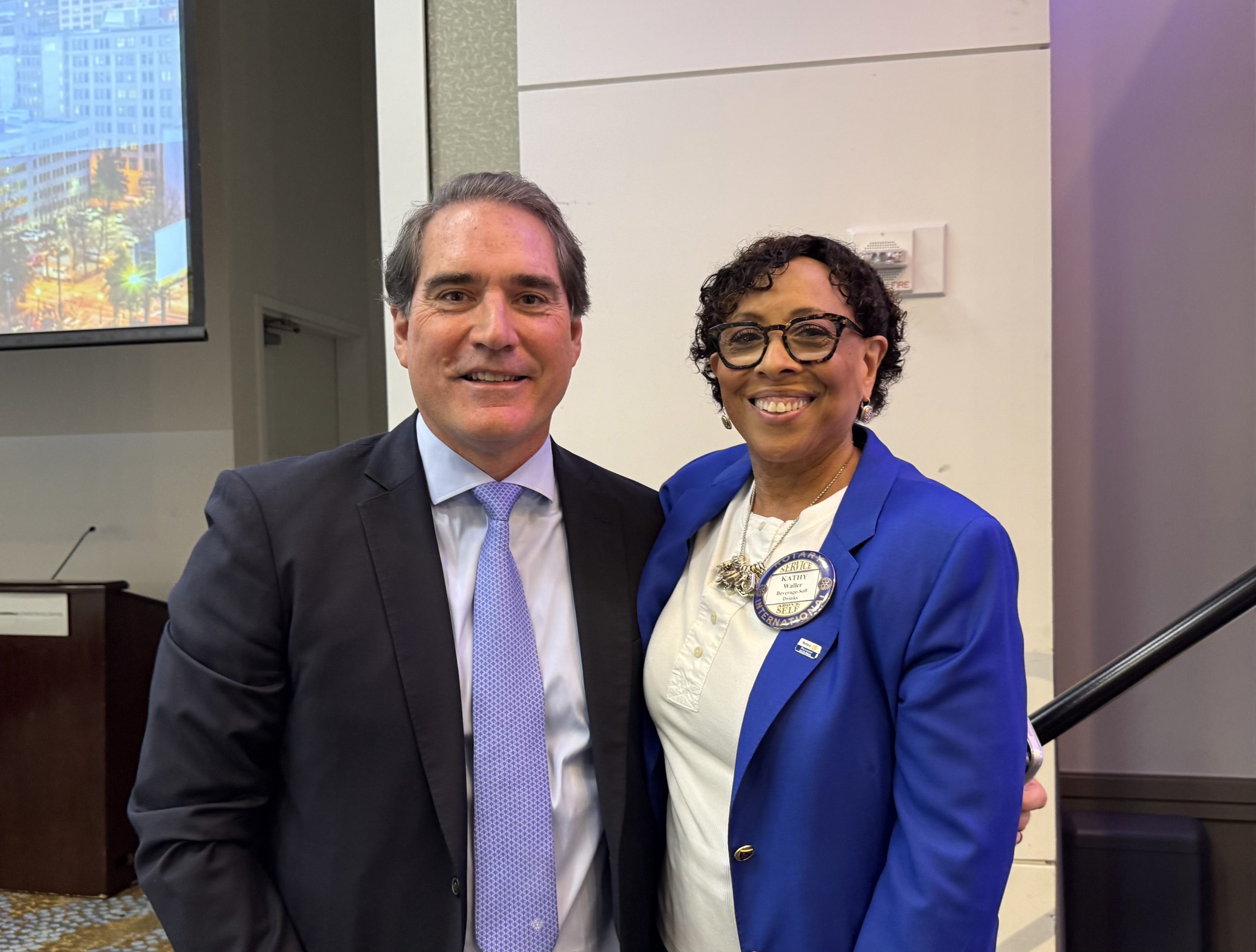
At Atlanta Rotary in June 2026, Braun thanked two mentors: former Coca-Cola Enterprises CEO Brian Dyson and former Coca-Cola CFO Kathy Waller. He acknowledged Waller's support on difficult days. Dyson had advised him before his first meeting with the Coca-Cola board to be himself and smile. It is an agreeably short preparation course for a room that could justify a much longer one.
The photograph of Braun with Waller gives those thanks a human scale. He had arrived at the top job with people to acknowledge, including people who had seen the less comfortable parts of the journey. His remarks allowed that history into a public appearance. The advice he remembered concerned how to enter the room as himself. After three decades of changing responsibilities, it was still worth repeating.
“Be yourself, and smile. We like smiles.”
Brian Dyson’s advice, recalled by Henrique Braun
Atlanta, with the world attached
There are other glimpses of the colleague behind the titles. In a 2020 post about Coca-Cola Brazil's June festivities, Braun described preparing his moustache and goatee for the celebration. Families joined the dancing, with children and even dogs making appearances. He remembered the company's traditional parking-lot party. The detail is small, funny and specific: an executive taking the office festivities seriously enough to prepare his facial hair.
His connections also extend beyond Coca-Cola. The Atlantic Council lists him on the advisory council of its Adrienne Arsht Latin America Center. That association sits alongside his years leading the company's Brazil and Latin America businesses. Across the career, the same places keep returning in different capacities: a country where he grew up, markets he managed, a region where he participates in a wider business conversation.
As CEO, Braun has set out priorities around growth opportunities, closer attention to consumers and technology that helps the business perform. He has also emphasized partnership with bottlers. Those ambitions now have the weight of the chief executive's job behind them. Atlanta is his base once again, and the company he joined in 1996 is his responsibility. His career has supplied a long itinerary of places to learn. The next chapter asks what he will do with the education.