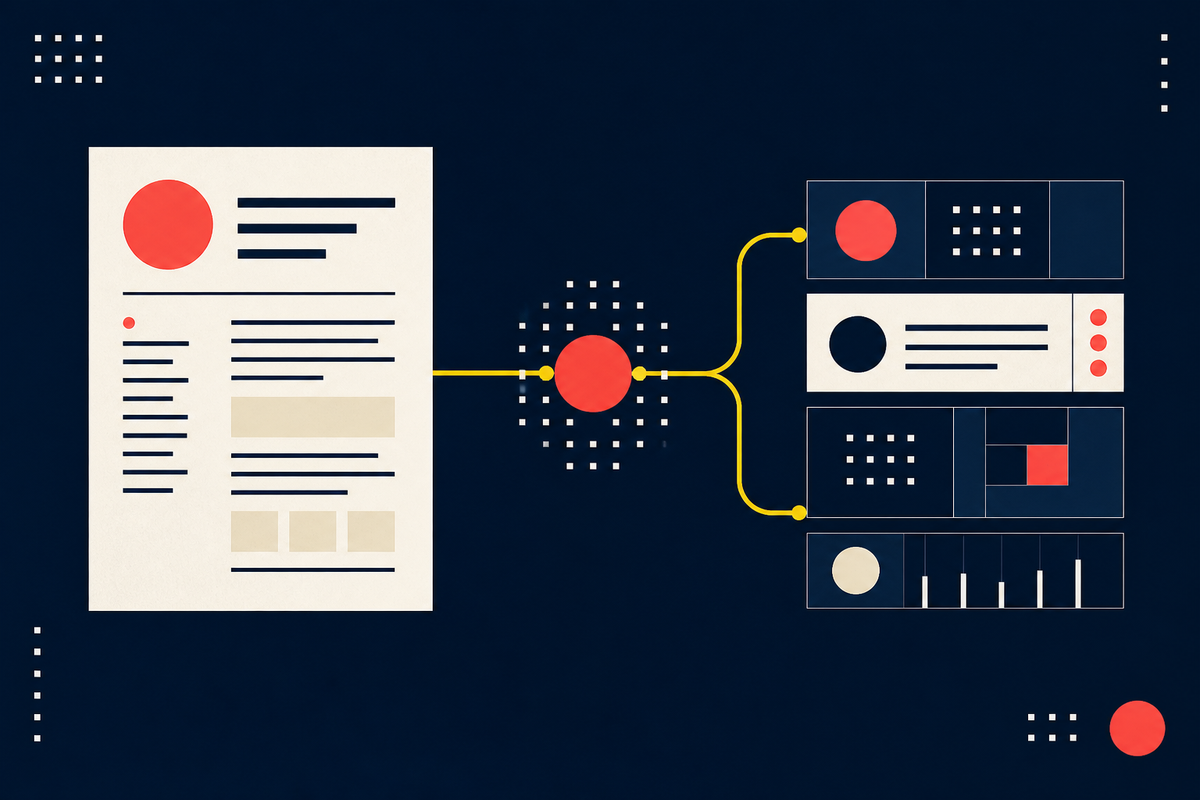
The expensive part of an unanswered question is rarely the question itself. It is the interruption that follows. A customer opens a ticket. A support agent repeats an explanation. A salesperson leaves a live opportunity, searches three folders, asks a colleague in Slack, then returns with an answer that may already be stale. HelpDocs and Spekit both promise to make company knowledge useful, but they enter this scene through different doors. HelpDocs is built around publishing a dependable place customers can visit. Spekit is built around putting approved guidance into the tools where revenue teams are already acting.
That distinction makes a HelpDocs vs Spekit comparison more useful than it first sounds. Buyers often group knowledge bases, wikis, digital adoption systems, and enablement platforms into one large category. Their feature lists encourage the confusion: editors, search, AI, analytics, permissions, integrations, and browser access appear on both sides. Yet software architecture follows the moment it is designed to serve. The important question is not whether each product can hold an article. It is whether the article should become a public support surface or arrive as a prompt, answer, asset, or next action inside someone else's workflow.
HelpDocs makes documentation a product surface
HelpDocs begins with the reader outside your company. A team can publish a branded help center on a custom domain, structure articles, make them searchable, translate them, control access, and watch what visitors look for. Its Lighthouse widget can carry that self-service experience into an application, while its Chrome extension lets support staff find and paste articles from other tabs. The center of gravity remains a body of customer documentation that can be read, indexed, linked, and maintained as part of the product experience.
The company itself is unusually legible for a SaaS vendor. HelpDocs says it was founded in 2016, remains bootstrapped and fully remote, and is kept small by design. Founders Taylor Sloane and River Sloane describe a product-focused operation that serves more than 500 teams and millions of pages per month. Its pricing page is public. As of August 2026, monthly plans begin at $129 for Sprout, move to $299 for Bloom, and reach $499 for Harvest, with lower effective prices on annual billing. A 14-day trial requires no credit card.
Those details point to a specific buying motion. A support, customer success, or product team can evaluate HelpDocs without building an enterprise committee first. The questions are concrete: Can we import our material? Does search handle the words customers actually use? Can the site look like us? Can editors manage translations and permissions? Does the contact form prevent a ticket before it is sent? The output is visible, which makes quality easier to judge.
The strongest HelpDocs case is a question that should become reusable public infrastructure instead of another private reply.YesPress analysis
AI supports that publishing job. HelpDocs lists tools for drafting, rewriting, metadata, alt descriptions, style enforcement, translation, and Ask AI search grounded in the knowledge base. Its 2026 Improve with AI release analyzes an article, gives it a score, and offers specific suggestions a writer can preview and apply. River Sloane's account of the feature is revealing: they wanted to avoid a blank prompt that leaves the user wondering what to ask. The result is opinionated assistance inside a defined editorial task.
Spekit treats knowledge as part of execution
Spekit starts with a different reader: a seller, enablement manager, product marketer, or revenue operator inside the company. Its basic content object, the “Spek,” is deliberately bite-sized and can carry definitions, videos, images, tables, slides, PDFs, and other documents. People can reach Speks in the web app, through a browser extension, or embedded across workplace tools. That last route is the important one. Spekit is designed to surface the approved answer while a rep is writing an email, updating a CRM record, preparing for a call, or sharing material with a buyer.
The platform has expanded far beyond tooltip-style training. Spekit describes a system spanning a governed GTM knowledge engine, AI Sidekick coaching, unified deal context, content creation, buyer-facing deal rooms, learning paths, analytics, and integrations. Its examples are tied to action: explain how to position against a competitor, tell a rep which fields are needed to advance an opportunity, recommend content from the context of a deal, or create a follow-up based on call and CRM signals. The intended payoff is less searching and more consistent execution.
Spekit was founded in 2018 by Melanie Fellay and Zari Zahra. The company says it has raised more than $60 million and is used by more than 500 revenue teams. Unlike HelpDocs, it does not publish a simple per-plan price card. Its own comparison material says pricing is configured around teams, functionality, and use cases. That normally means a sales-led evaluation, more stakeholders, and an implementation shaped around a company's revenue stack. It also reflects the broader job Spekit is trying to own.
Its June 2026 GTM Knowledge Engine 2.0 release added more than 30 features across AI content creation, analytics, governance, and MCP tools. Spekit says its MCP server can connect governed company knowledge to systems such as ChatGPT, Claude, Copilot, and Glean, then push approved output back into Spekit. The claim buyers should test is operational: can one governed source keep both humans and AI agents aligned as product messaging, process, and deal context change?
The feature grid matters after the workflow map
| Decision | HelpDocs | Spekit |
|---|---|---|
| Primary audience | Customers and support readers | Revenue teams and GTM operators |
| Core surface | Branded help center and in-app help | CRM, inbox, browser, content hub, and deal workflow |
| Desired action | Understand, self-serve, avoid or resolve a ticket | Learn, follow process, personalize, share, advance a deal |
| Governance focus | Published article quality, access, language, and search | Approved GTM content, freshness, context, and rep adoption |
| Buying motion | Public plans and self-serve trial | Configured pricing and demo-led evaluation |
A disciplined evaluation begins before either demo. Collect ten recent questions that created measurable friction. Include customer tickets, internal Slack threads, sales call follow-ups, onboarding questions, and content requests. For each, record the asker, the moment, the current source, the owner of the answer, and the next action. Then score the cost of delay. A customer asking how billing works may need an indexed, linkable article. A rep asking how to handle a competitor during a call may need a short, approved response tied to the opportunity.
This exercise prevents an easy mistake: buying a large system for a small publishing problem, or buying a tidy documentation site for a complex behavior-change problem. It also exposes requirements that vendor pages cannot answer. If your content owners will not review stale material, an AI search layer only accelerates access to old facts. If reps refuse to open another destination, a perfectly organized portal still adds a trip. If customers use Google to begin every support journey, public structure and search visibility matter more than an internal recommendation engine.
Using both requires an editorial treaty
Some companies genuinely need both categories. HelpDocs can own customer-facing procedures and explanations while Spekit owns sales plays, competitive guidance, launch messaging, coaching, and buyer collateral. The risk is duplication. Pricing rules, security descriptions, product capabilities, and implementation steps can drift when copied into separate systems. A sensible joint setup assigns a canonical owner and source for every shared fact, defines which material may be transformed for each audience, and sets a review trigger when the source changes.
The systems can then play complementary roles. A HelpDocs article might remain the definitive public explanation that a rep shares. Spekit can tell the rep when that article is relevant, pair it with private coaching, and track the buyer interaction. Internal objection handling should stay out of the public help center. Public technical instructions should not be rewritten from memory in a private battle card. Boundaries create trust because readers know which system owns which kind of truth.
The final choice is refreshingly ordinary. Choose HelpDocs when your highest-cost unanswered questions belong to customers and should become polished, searchable, branded documentation. Choose Spekit when those questions belong to revenue teams and the answer must arrive with context, coaching, content, or an action inside the flow of a deal. Choose both when the two audiences are large enough to justify separate delivery systems and your team is prepared to govern the seam between them.
A feature matrix can confirm the decision. It should not make it. Start with where work happens, because knowledge only earns its keep at the moment someone can use it.
Frequently asked questions
What is the main difference between HelpDocs and Spekit?
HelpDocs primarily publishes customer-facing knowledge bases. Spekit primarily delivers governed revenue guidance, content, coaching, and deal context inside the tools used by go-to-market teams.
Which is better for a public help center?
HelpDocs is the direct fit. Its product centers on branded documentation, search, multilingual publishing, permissions, analytics, and contextual customer self-service.
Which is better for sales enablement?
Spekit is built for sales and revenue enablement, including governed GTM knowledge, contextual coaching, content recommendations, deal rooms, and workflow analytics.
Do both platforms use AI?
Yes. HelpDocs applies AI to support-content creation, improvement, translation, and retrieval. Spekit applies AI to GTM content governance, recommendations, coaching, deal intelligence, and workflow actions.
Can a company use both?
Yes. Use clear ownership rules: customer documentation can live in HelpDocs, while private revenue guidance and activation live in Spekit. Shared facts need one canonical source and a review process.