Heather Hartnett grew up with a question waiting at the end of college: what company was she going to build? In an entrepreneurial family, this apparently counted as ordinary parental conversation. Many graduates are asked about a job. Hartnett was being asked to produce an enterprise. It was a generous vote of confidence, with the small inconvenience of requiring an answer.
The answer took time. Her career would pass through technology, philanthropy and investing before she co-founded Human Ventures in New York in 2015. By then, she had found a question she preferred asking other people: what would you need to build a company with us? A team, perhaps. A useful introduction. Someone to help turn a promising idea into an experiment that could survive contact with customers.
That question puts an unusual emphasis on the investor’s contribution. A founder has to persuade somebody to believe. Hartnett’s proposition asks what the believer intends to do afterward. The resulting firm combines a startup studio with early-stage investing. Its name is Human Ventures, an admirably direct reminder of who will be responsible when the spreadsheet encounters real life.
A family question with a long half-life
Her parents had encouraged entrepreneurial thinking well before graduation. As a child, she was prompted to consider what people wanted and how a business might serve them. She later described learning to tolerate risk as part of that upbringing. The expectation could be daunting, but it also made creating something feel like an available course of action.
Hartnett studied economics and business management at Maharishi University of Management, now Maharishi International University. She later earned a certificate in fundraising and development at New York University. The pairing looks useful in retrospect: one course of study concerns how resources move; the other concerns persuading people to move them.
Her early professional life had a less tidy shape than a venture-capital biography might suggest. An old personal blog, called Behind the Scenes, introduces a writer, producer and digital-media marketer working as communications director for David Lynch Foundation Television. Her interviews there included Ringo Starr, Mike Love, Ben Harper and Moby. She was learning how to bring people into a project and how to communicate what it was trying to accomplish.
Work with the David Lynch Foundation also brought her into the world of philanthropic families. She became interested in entrepreneurs whose businesses could create change alongside a financial return, and worked at City Light Capital. Venture investing offered a way to identify those people early and put resources behind them. Across those jobs, the recurring subject was what somebody could build if the right support arrived in time.
“Doubt the doubt.”
Heather Hartnett
A studio with a casting problem
When Human Ventures launched, Joe Marchese announced that Hartnett would lead it as CEO. The March 2015 announcement described a plan to identify challenges, assemble teams and develop products. Reserve was an early investment. The venture business Hartnett and Marchese were constructing would have to make its own case while helping other companies make theirs.
By 2017, Hartnett was describing the studio’s ambition in the language of co-founding. It would help people enter the startup world and give them practical help at the beginning. New York mattered because of the industries already there. An experienced person from one of those industries might understand a problem beautifully while still needing help with the mechanics of starting a company.
The studio analogy makes this easier to picture. A film requires a cast, producers and people who understand the work behind the camera. A young company has its own unglamorous dependencies. There are people to recruit, products to design, accounts to keep and decisions that cannot wait until everybody has acquired the relevant expertise. A shared team can make those capabilities available earlier.
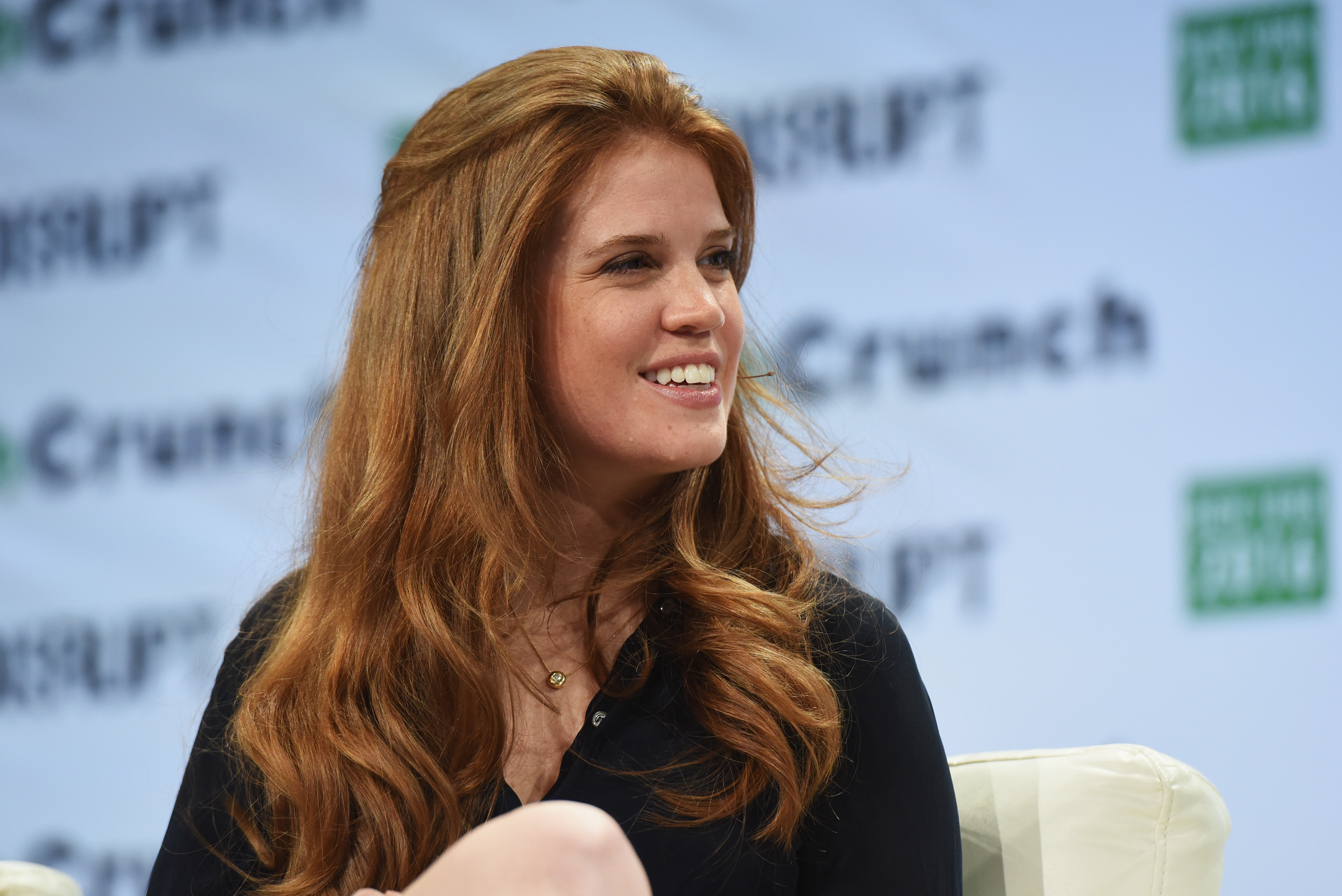
Hartnett discussed that model onstage at TechCrunch Disrupt in 2016 with John Borthwick of Betaworks and Naveen Selvadurai of Expa. The conversation covered collaboration, connections to other industries and repeat entrepreneurship. Even the panel’s title, Manufacturing Serendipity in Startup Factories, captured the attractive difficulty of the undertaking. You can arrange the room. You still need something interesting to happen inside it.
Gratitude enters her assessment of people, too. She has explained that the team initially considered happiness as a value, then settled on gratitude. It was a way of acknowledging the opportunity involved in starting companies and choosing how to spend one’s time. That criterion gives her working relationships a particular texture. Ambition can carry a person a long way; the people travelling alongside still have to spend the journey together.
Her attention extends to how founders respond as they learn. She has described looking for a rapid iterator: someone who tests, listens and develops conviction through the market’s response. The quality has a practical advantage. At the beginning, a founder’s original explanation and the customer’s actual behavior may have only a passing acquaintance. Somebody must be willing to introduce them.
A model Hartnett described in 2021: different forms of support for different stages of company building.
The guest list is part of the business
In 2017, Hartnett described a busy events calendar, ranging from small dinners to larger gatherings. The point was to bring founders and investors into conversations they might otherwise miss. She paid attention to the mix of backgrounds and perspectives. A successful evening had work to do beyond providing proof that everyone had attended an evening.
That approach suits New York. A founder can be close to people in advertising, finance, media and hospitality, each carrying a different understanding of what customers need. Hartnett has argued that the city’s combination of industries makes it fertile ground for company building. Density helps, provided somebody does the connecting. Proximity alone also produces an excellent queue for coffee.
She has made the distinction between knowing many people and understanding how they can help one another. Trust is the additional ingredient. The person making an introduction has to understand both sides well enough to make the conversation worth having. A network becomes useful through those individual judgements, repeated over time.
There is a quieter New York detail in her public interviews, too: in 2019 she named Washington Square Park as a favorite place to watch the autumn leaves change. It is a pleasing counterweight to the vocabulary of deal flow. Her city contains potential collaborators, certainly, but it also contains trees worth noticing.
The investor has to pitch, too
Building Human required Hartnett to find believers of her own. She has explained that the partners raised money into a parent-company structure so they could hire and support founders. The platform came first. A dedicated investment fund followed, with a $50 million debut in 2019. Offering practical help meant paying for the capacity to provide it.
Human Ventures’ debut fund, 2019
That sequence made the fundraising explanation more demanding. Hartnett was presenting a firm with several connected activities, rather than a proposition that fitted neatly into an established box. She has spoken about finding capital partners with compatible expectations and making an unfamiliar model understandable. The difficulty is familiar to founders: a different approach needs enough explanation to become credible without becoming exhausting.
Her interest in shared infrastructure also extended to other investors. Transact Global began in 2018 with Soraya Darabi and a group of co-founders that included Hartnett, Virginie Raphael, Alexia Bonatsos and Marina Hadjipateras. They were discussing the practical questions of starting funds and found that many of their difficulties overlapped. The organisation grew into a community for emerging fund managers.
There is a sensible economy in that arrangement. People trying to build unfamiliar organisations do not need to discover every avoidable mistake independently. A useful peer can save time, explain a process or provide the confidence to ask a better question. It is the same logic Hartnett brought to company building, applied to the people who finance it.
She has also argued for financial literacy as a way to expand women’s economic opportunities. In 2023, she connected that knowledge to the ability to make decisions and advocate for oneself. It is a practical extension of her work with founders and fund managers: access to a room becomes more useful when you understand the decisions being made there, and can participate in them with confidence.
The useful person in an AI world
In an October 2025 conversation, Hartnett returned to the role of grit, initiative and a founder’s willingness to build relationships. She called the combination human alpha: the advantage created by qualities and connections that conventional screening can overlook. Ten years after Human began, she was still asking how to recognise someone before the rest of the market has agreed.
The work has also moved into AI. In December 2025, Honeyjar announced a $2 million pre-seed round led by Hartnett and Kevin Mahaffey of SNR Ventures. Founded by communications professionals Michelle Masek and Nadia Jamshidi, it brings tasks such as media research, pitching and coverage tracking into an AI-assisted workspace. Here is a concrete version of the assistance question: which parts of a working day can software help people handle?
By June 2026, Marchese was discussing Human’s continued investments and plans for another fund. The business had expanded, but the early question remained useful. What does the founder need now? The answer might be money. It might be a colleague, a customer or somebody prepared to challenge an assumption before it becomes expensive.
Hartnett’s family expected her to build a company. She eventually built an organisation whose daily work is helping other people do precisely that. It is a rather elaborate answer to a parental question. It also gives belief something useful to do on Monday morning.