In late 2008, as the financial system was making a bonfire of certainty, Hayes Barnard took his executive team somewhere that offered very little of it. They went to a remote village in Mali to help build a school. No resort, no conference-room carpet, no tray of pastries curling at the edges. The work was physical and the lesson was awkwardly large. Barnard watched girls spend hours walking for water instead of sitting in a classroom. The problem was not hidden. It was simply far from the usual rooms where capital gets discussed.
The trip stayed with him. Years later, he wrote that it had opened an emotional chasm and given his team a more grateful view of its own luck. Such revelations can become handsome anecdotes, polished smooth through repetition. Barnard did something more demanding with his: he turned it into an institution. The experience inspired the service treks that became part of GivePower, the nonprofit he launched in 2013. By 2023, the organization had completed its 100th trek and brought nearly 1,000 participants into field projects.
The curious thing is that Barnard did not reach Mali by the usual route of a development specialist. He arrived as a salesman. His education had been in enterprise software, mortgages and the energetic American faith that almost any obstacle might yield if the offer were explained correctly. In another person, that résumé might sit strangely beside solar water farms. In Barnard's case, it is the whole plot.
Selling the difficult thing
Barnard grew up in Creve Coeur, Missouri, an only child raised by his mother, Dede. He has described her working multiple jobs and keeping a determinedly positive view of the world. He graduated from the University of Missouri in 1995 with a business degree, then went west toward the technology boom. His early work included staffing trade-show booths. From there came nearly a decade at Oracle, where he learned what software could do for scale and what a persistent salesperson could do for software.
In 2003, he co-founded Paramount Equity Mortgage. The timing would become cruelly educational. A mortgage business launched in the early years of the century eventually had to meet the collapse at its end. Yet the company survived, and Barnard's attention moved toward the roof. He started Paramount Solar in the late 2000s, applying a mortgage operator's knowledge of household finance to a product whose upfront price kept many homeowners from considering it.
That move contained the idea that would later define GoodLeap: the clean-energy transition is partly an engineering project, but it is also a monthly-payment problem. A solar panel can work perfectly and still remain economically invisible to the family below it. The bridge is financing that arrives without turning the kitchen-table decision into a graduate seminar.
SolarCity bought Paramount Solar in 2013 for a reported $120 million. Barnard became its chief revenue officer. His official biography credits him with helping grow the company from roughly 1,000 employees to more than 17,000, while monthly deployment rose from 10 megawatts to 100. Contemporary profiles caught the atmosphere around him: pump-up films, speeches pitched like locker-room addresses and occasional rapping at sales meetings. It sounds mildly alarming before coffee. It also suggests why Barnard was useful. Solar needed a missionary who understood a funnel.
One operating system, four arenas
A market on one side, a mission on the other
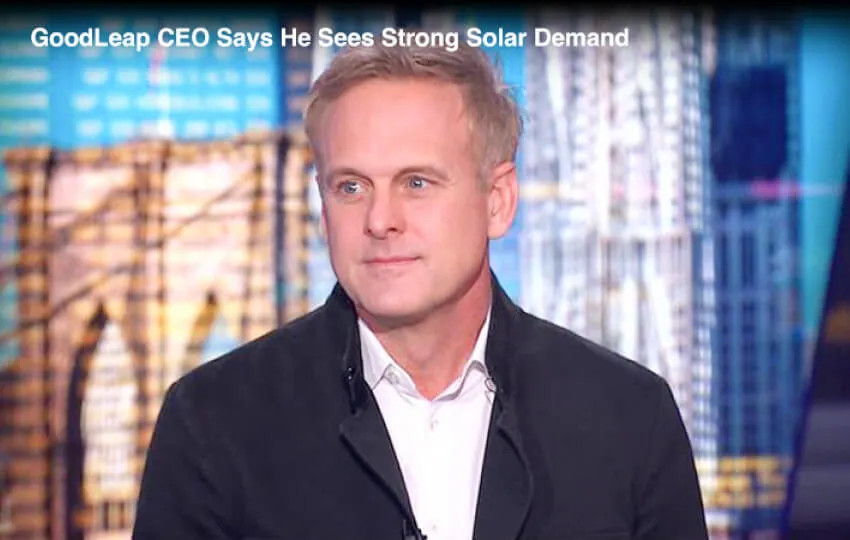
After SolarCity, Barnard returned to lead the financing company that had become Loanpal. In 2021 it took the name GoodLeap, short for “good for life, earth and prosperity.” The company gives contractors and manufacturers point-of-sale software for financing solar panels, batteries, efficient roofing, windows, lighting and heating and cooling systems. GoodLeap says its tools have supported more than $68 billion in sustainable-home solutions since the company began. Its 2021 financing round valued the private company at $12 billion.
The number is imposing. The mechanism is domestic and almost boring, which is precisely the charm. A contractor talks to a homeowner. Software makes financing available. A project that looked like a capital expense becomes a sequence of payments. In Barnard's formulation, sustainability gains momentum when the preferable option also becomes the economical one.
GivePower operates where that market logic cannot reliably carry the load. It develops solar electricity and safe-water systems in underserved communities, pairing technical teams with industry partners and donors. The nonprofit says it has reached more than 2.7 million people across 32 countries. Its solar water systems use clean energy to desalinate or purify water, turning sunshine into a utility in places where a conventional grid or water network may be absent.
GoodLeap and GivePower can look like two halves of a modern founder's biography: the valuable company and the virtuous foundation. That reading misses their resemblance. Both begin with a technology that already works. Both face a distribution problem. Both depend on getting capital, hardware and operators to arrive in the correct order. One works mainly through a transaction. The other depends on philanthropy and partnership. The craft underneath is access.
Barnard added a third piece in 2020 with GoodFinch, an asset manager focused on sustainable investments. Here again, the theme is less invention than circulation. Homes need upgrades. Contractors need payment. Investors need assets they can understand. Communities need infrastructure. Barnard's career has become an exercise in persuading money to move toward useful hardware.
The power of one, properly multiplied
At the University of Texas at Austin's 2023 commencement, Barnard stood before about 50,000 people and called the coming period “The Decade of How.” The line has the clean edges of a slogan, but the argument beneath it was practical. Large problems encourage a peculiar form of paralysis. Their scale makes every individual action seem decorative. Barnard asked graduates to begin with one thing, one problem and one person.
Reduce the enormous question until somebody can act on it. Then build the software, financing or field operation that lets the action repeat.
This is where his public language and his operating history agree. At Oracle, scale meant software sold across an enterprise. In mortgages, it meant a process that could handle another borrower. In rooftop solar, it meant a financing decision made at the point of sale. At GivePower, it means a repeatable system that can be built, maintained and entrusted to a local team. The “one” is not sentimental smallness. It is the first unit in a multiplication table.
Barnard talks about leaders needing empathy and the confidence to surround themselves with stronger talent. Colleagues and interviewers also notice the temperature of the room when he enters it. He tells stories quickly, jokes from a stage and can turn a corporate meeting into something perilously close to a pep rally. Underneath the wattage is an operator's respect for systems. Optimism, in his version, comes with plumbing.
There are hazards in putting so much moral language around a commercial enterprise. Purpose can flatter its speaker. Private-company valuations can make scale look tidier than it is. A loan still has terms; a solar installation still has to perform; a water system still needs maintenance after the visitors fly home. Barnard's work earns credibility where it accepts those dull obligations. GivePower publishes annual reports and maintains field teams. GoodLeap builds software for contractors and has expanded into payments and virtual power plants. The follow-through is the story.
What enough looks like
Forbes has estimated Barnard's fortune at $2.9 billion. It is a startling total attached to a founder who keeps returning to the number one. The contrast is useful. Wealth may measure how much of GoodLeap he owns and what somebody thinks the company could be worth. It does not explain why a mortgage executive went to Mali, why he kept thinking about water, or why a financing platform and a nonprofit came to share the same vocabulary.
The answer seems to live in an old salesman's instinct: remove the abstraction. A changing climate is abstract. A lower monthly bill is not. Water scarcity is abstract. A tap that works this morning is not. Purpose is abstract too, until it determines where the next team goes, what it builds and whether it returns.
Barnard has spent three decades enlarging the thing he is trying to sell. First software, then loans, then solar, then a way of thinking about the obligations that come with success. The pitch now contains a question. If the machinery can move this much money and hardware, what counts as enough?
His answer is not a number. It is a direction, repeated: toward the roof that can produce power, the battery that can steady a grid, the village system that can make water safe, and the next person for whom an impossible problem becomes an ordinary piece of infrastructure. One is modest arithmetic. With a good enough system behind it, one does not stay one for long.