A company can expand without moving a single desk. It hires someone across a state line. A nonprofit begins asking a wider audience for donations. An engineering firm bids on a project somewhere new. The commercial decision is easy to describe. The administrative consequences arrive in pieces, addressed to different people, carrying different deadlines.
- Harbor Compliance combines regulatory data, software, and people who handle filings.
- Its sweet spot is recurring compliance work across multiple jurisdictions.
- Customers can run the software themselves, outsource the work, or mix both.
Harbor Compliance has built its business around those pieces. Founded in 2012 by Mike Montali and Megan Danz, it helps businesses and nonprofits manage entity registrations, licenses, tax registrations, and organizational records. The interesting question is how much of that work can be made repeatable without losing the detail that makes each filing different.
First, distrust the spreadsheet
A calendar is excellent at remembering a date. It cannot tell you whether the date belongs to the right license, whether a registration is missing, or whether the government has changed the requirement. Someone has to establish the facts before a reminder becomes useful.
Harbor’s onboarding process makes that distinction unusually visible. It starts by categorizing a customer’s existing registrations and licenses. Staff then contact agencies wherever possible to check the supplied information. Verified records enter the software and connect to Compliance Core, the company’s regulatory database and processing technology. Harbor says this process uncovers and addresses unexpected issues in more than 90% of onboardings. That is a company claim, but the sequence itself is instructive: verify, then automate.
- 01Categorize
What do you have? - 02Verify
Does it match? - 03Import
Keep confirmed data. - 04Connect
Follow the requirement.
The lesson travels beyond compliance. A business adopting any new system can copy this order. Moving old uncertainty into a polished interface merely gives uncertainty better furniture. Harbor’s approach puts the uncomfortable inspection at the beginning, when a team still has a chance to correct its assumptions.
A map with consequences
Entity Manager makes registrations visible on a map and connects to secretary of state databases wherever available. It tracks status and uses Compliance Core to calculate annual report deadlines and notifications. The qualification matters: agency integration depends on availability. A map is useful because it lets a team ask a concrete question about each jurisdiction and investigate the answer.
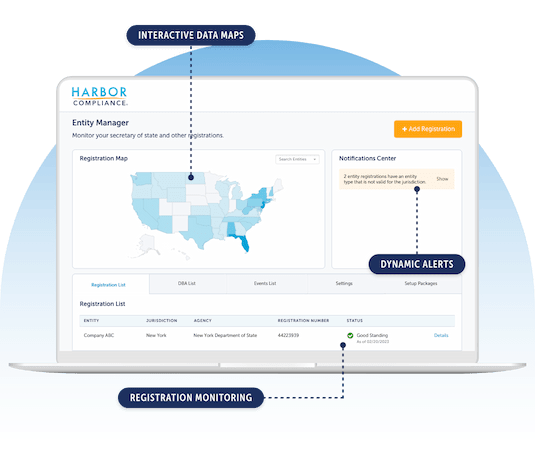
License Manager handles another layer: firm and individual licenses, renewal tracking, assigned tasks, and supporting documents. Tax Manager stores registration information and identification numbers. Records Manager keeps the organizational memory, including ownership, leadership, minutes, and resolutions. Its details are pleasingly specific: a nonprofit can track board vacancies; a corporation can track share classes.
These are different jobs with overlapping information. A new address or leadership change can matter in several places. The practical appeal of the suite is that people can work from shared company information while keeping the requirements attached to the relevant record.
Who buys relief from a recurring job?
Harbor targets businesses and nonprofits, with nonprofit and mid-market corporate customers highlighted in its investment announcement. Its current website says it has helped more than 40,000 clients. Named customer testimonials include software company ArcherPoint, professional services firm PVE, and architecture firm BB+M.
“Everything is consolidated in one software.”
Elly Combow, Controller, ArcherPoint
Company-published customer testimonial
That sentence explains the buying motive better than a feature inventory. Teams need an answer that survives an employee leaving, an adviser changing, or a folder becoming inaccessible. Harbor also courts accounting and legal firms through its Harbor Compliance Alliance, offering services and software they can bring to their own clients.
The market already has substantial alternatives, including CSC and Wolters Kluwer’s CT Corporation. Both offer technology and corporate compliance services. Harbor’s case rests on its combination of regulatory research, connected modules, and flexible service arrangements. A buyer should compare the actual jurisdictions and tasks covered, rather than assume the presence of a dashboard settles the contest.
The price of handing it over
The business model follows the division of labor. Customers can use software internally, pay Harbor to manage filings, or choose a hybrid. Recurring agent and compliance services sit alongside formation and other transaction-based work.
$159 annual renewal
plus government filing fees
Those published prices, checked in October 2026, describe separate services. Registered agent service receives legal documents and includes electronic delivery and Entity Manager access. It does not purchase every corporate filing. Annual report service costs $199 per state annually before government fees; volume discounts are available. Broader software and service packages require a sales conversation.
Scope matters as much as price. Harbor’s terms generally require notice at least 90 days before subscription renewal, and fees are generally nonrefundable subject to stated exceptions. A sensible comparison counts the renewal, the filing charges, and the work still assigned to the customer.
Formation gets a longer tail
Harbor acquired charitable registration specialist Labyrinth in 2021, with acquisition financing from CIBC Innovation Banking. In December 2025 it bought Firstbase.io, connecting its compliance operation to a platform helping international entrepreneurs form US businesses. Formation supplies a starting point for work that continues after the company exists.

That investment’s financial terms were undisclosed. Montali and Danz continued as board members and advisers. By September, Harbor reported its eighth Inc. 5000 appearance and 55% revenue growth over three years. Its current offering also includes Compliance Navigator AI, which produces regulatory research reports with citations from business and jurisdiction prompts.
Give the next action an owner
The useful boundary is straightforward. Harbor supplies software and services; its website says it does not provide legal, tax, or financial advice. A simple business with a handful of obligations may have little reason to buy a broader suite. More complicated organizations still need accurate inputs and a clear agreement about who files what.
That is the part readers can copy immediately: list the obligations, check the records, assign responsibility, and preserve the evidence. Growth creates enough surprises. The location of the annual report should not be one of them.