The unglamorous middle of fintech - getting and keeping licenses - turned into software. And, somewhat improbably, a fast-growing business.
Here is a fact about financial services that founders learn too late: before you can move a dollar, you usually need permission from the government. Often from fifty of them. To operate as a money transmitter in the United States - the plumbing under most fintech apps - you generally need a license in each state where you do business, and the requirements are neither uniform nor stable nor, in any human sense, pleasant.
Brico's entire proposition is that this misery is a product category. The San Francisco company, founded in 2023 by Snigdha Kumar and Edward Swiac, sells software that automates financial licensing - the initial applications, the endless renewals, the state-by-state compliance monitoring - for money transmitters, lenders, mortgage providers, and crypto firms. The pitch is that Brico's customers file applications up to five times faster and cut their licensing costs by as much as 90 percent, while compliance teams get back roughly three-quarters of the time they used to spend on it.
If that sounds like a narrow thing to build a company around, that is rather the point. Narrow problems in regulated industries tend to be deep, painful, and permanent. Licensing is not a one-time event you can outrun; it is a recurring obligation that grows as the company grows. You get licensed, then you renew, then you expand into three more states, then the rules change, then you renew again. Brico is selling relief from a treadmill that never stops - which, from a revenue standpoint, is a very appealing kind of treadmill to stand next to.
Licensing shouldn't be a gatekeeper. It should be a growth enabler.
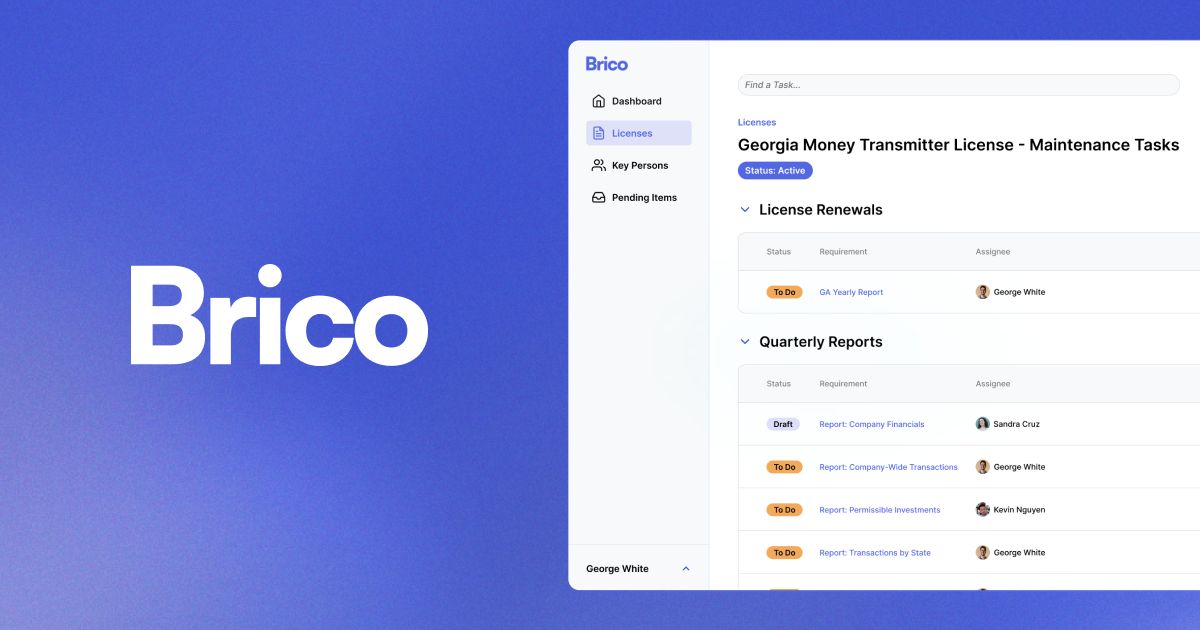
That sentence is doing a lot of work. Reframing a cost center as an accelerant is the oldest move in enterprise software, but here it lands because the underlying pain is so specific. A crypto startup waiting on a New York BitLicense - a permit famous enough to have its own reputation, and slow enough that it can take years - is not experiencing an abstraction. It is watching a launch date recede. Brico's promise is to shorten that distance, and to make the shortening legible: applications auto-filled, requirements mapped state by state, documents kept in one place instead of forty inboxes.
The most reliable pattern in RegTech is a founding team that splits cleanly between builder and domain expert. Brico has exactly that, which may be why it moved so fast.
Brico was born from Kumar's own frustration. As a product lead at Digit and later in senior product roles at Oportun, she applied for and maintained the licenses herself - and found the workflow tedious, costly, and error-prone. Most people complain about a bad process. She turned it into a company spec.
Swiac built sophisticated B2B solutions at Marqeta, the card-issuing infrastructure company. That background - shipping serious financial plumbing for other businesses - is the engineering half of the equation, paired with Kumar's intimate knowledge of the license workflow to produce fast turnaround on the product.
Around them sits a team of roughly 51, drawn from Block, Airwallex, Robinhood, and Bank of America, plus advisors including a former CFPB official and fintech-focused legal and consulting veterans. The stated culture is straightforward: the people building the tool have, as the company puts it, "walked in your shoes."
Brico markets itself as a one-stop shop for a customer's entire multi-state license portfolio - not a single filing, but the whole lifecycle. The model is deliberately hybrid: AI drafts, maps, and monitors; human compliance experts verify. In a year when much of the industry is racing to remove people from the loop, Brico kept them exactly where the stakes are highest.
Auto-filled, template-driven applications for money transmitter, lending, collection, and mortgage licenses across all US states, with smart data mapping.
Automated renewal workflows, compliance alerts, and generated reports, with a centralized documentation hub so licenses stay in good standing.
Money transmitter coverage across 50 states plus the New York BitLicense and Louisiana Virtual Currency License for digital asset companies.
A real-time engine tracking shifting licensing requirements and regulatory changes across all fifty states, so compliance teams don't have to.
Since launch, Brico has signed a roster that lends it credibility well beyond its size: card and banking infrastructure firm Marqeta, rewards company Bilt, crypto custodian BitGo, Better Mortgage, Conduit, 1Money, and Tilt (formerly Empower) all rely on it to manage complex, multi-state portfolios spanning money transmitter, lending, collection, mortgage, and BitLicense.
The money has followed the traction. Brico raised an $8.1M seed, then closed a $13.5M Series A in October 2025 led by Flourish Ventures, with Restive Ventures and Pear VC - both existing backers - participating. That brings total funding to roughly $21.6M. Investors don't re-up within a year on narrative alone; they re-up on retention, and licensing is about as retentive as software gets. The company was also named to Forbes' Top 50 FinTechs list two years in a row.
There is a version of the fintech story that is all consumer glamour - the slick app, the viral loop, the interchange fees. Brico is the other version, the one that happens backstage. Its 600% growth in a single year came not from a clever front end but from doing, at scale, the thing that makes founders groan: filling out regulatory forms correctly and on time, in every jurisdiction at once.
The competitive landscape helps explain why this works. Brico's alternatives are broad governance-risk-compliance platforms - MetricStream, Fenergo, LogicGate and their peers - or the traditional path of law firms and consultants billing by the hour. Brico's wager is that specialization beats breadth here: a tool that does financial license applications and renewals extremely well, rather than a general compliance suite that does licensing as an afterthought. Depth in a narrow lane is harder to copy than a broad feature list.
Making financial licensing easier, cheaper, and more joyful.
The word "joyful" is a small provocation, and an intentional one. Nobody expects joy from a money transmitter application. But the ambition behind it - to make the obligatory feel less punishing - is exactly the kind of framing that turns a cost into a category. Whether Brico can hold its lead as it scales, and as larger compliance vendors notice the niche, is the open question. What is already clear is that a real, recurring, universally-disliked problem has found a company willing to specialize in it. In fintech, that is often where the durable businesses hide.
Product walkthroughs and founder interviews are published through Brico's own channels. Explore the live platform and demos at brico.ai, or search "Brico financial licensing" on YouTube for recorded talks. No official YesPress-verified video is embedded here.
Snigdha Kumar and Edward Swiac start the company in San Francisco to automate financial licensing.
Restive Ventures, Pear VC, and Flourish Ventures back the platform's early build-out.
Coverage grows to BitLicense, Louisiana Virtual Currency, California DFAL, and a 50-state regulatory engine.
Named a Forbes Top 50 FinTech for a second year while reporting 600% year-over-year growth.
Flourish Ventures leads the round in October, bringing total funding to roughly $21.6M.
Sources: brico.ai · Flourish Ventures · American Banker · FinTech Global · RegTech Analyst · Crunchbase · LinkedIn. Figures are company-reported and approximate.