At a hotel breakfast, Hank Lee heard an announcement rather more specific than the usual invitation to enjoy the buffet. The manager explained how much carbon the gathering of 30 people would produce and how many carbon credits had been secured to offset it. Lee later recalled the moment in a discussion about corporate environmental preparation. Someone had counted the consequences of breakfast. For a risk adviser, that was a detail worth taking home.
There were the guests, of course, but also the air conditioning and the work of preparing the food. What interested Lee was the system capable of measuring all those activities. In his telling, a modest meeting became an example of the practical arrangements businesses would need. The coffee arrived with an accounting problem, and the hotel had an answer.
The episode offers a useful introduction to HyungKoo (Hank) Lee. His professional territory is full of large categories: risk, people, strategy. His public comments become more interesting when those categories acquire an address, a meeting room or a decision somebody must make. A breakfast’s carbon footprint. A company preparing for an assessment. An employee waiting for a first chance to manage.
First, a different kind of material
Lee’s career began in 1984 at Poongsan Metal Corporation. His undergraduate subject at Korea University was metallurgical engineering. Before consulting organizations about their arrangements, he had studied a discipline concerned with the properties of metals. The combination is unusual enough to make the later executive titles worth reading in sequence.
He completed an MBA at Boston University in 1992, the year he joined Marsh. His early work there focused on developing Korean business. The chronology then moves through vice president in 1998 and senior vice president in 1999. That same year brought an assignment in Marsh’s New York head office, working in Alternative Risk Finance.
A 2012 conference biography places that assignment within a career serving both global and Korean businesses. After a year in New York, Lee returned to Korea; his later responsibilities included managing their risk-management programs. He became a managing director in November 2003. These were changes of responsibility within the same organization, with a trip across the Pacific in the middle.
Poongsan Metal Corporation
Joins Marsh
Alternative Risk Finance
Marsh + Mercer
Read together, the dates describe a career accumulating different views of a business: engineering education, management study, domestic business development and an international finance assignment. They do not require an invented childhood ambition to be interesting. The movement itself supplies the story, with Korea remaining the place to which his work returned.
Two businesses, one appointment
Lee became CEO of Marsh Korea in April 2018. In November 2021, Mercer appointed him its CEO in Korea as well. He retained his Marsh Korea position and his responsibilities as Country Corporate Officer for Marsh McLennan. The announcement made him the first unified CEO across Marsh and Mercer in Asia.
There is a geographic detail here that matters: the appointment concerned Korea. Lee was based in Seoul. The significance lay in bringing the two country businesses under shared leadership, with insurance broking and risk advice on one side and Mercer’s people-consulting expertise on the other.
The reporting lines also crossed the two businesses. At the time of the appointment, Lee was to report to Renée McGowan, Mercer’s president for Asia, the Middle East and Africa, and Svein Tyldum, Marsh’s chief executive for North Asia. David Jacob, then Marsh Asia CEO, welcomed the combination of resources and expertise. The arrangement placed Lee within both regional conversations while leaving his operating responsibility firmly in Korea.
The organizational reasoning was explicit. Clients’ problems were becoming increasingly connected and complicated, and closer collaboration across the businesses could bring more of their expertise into the same conversation. Similar unified leadership arrangements had already appeared in Europe. Korea supplied the first Asian example.
Risk advice
Workforce expertise
On LinkedIn, Lee thanked people for their congratulations and wrote, “I am very honored to become the first combined CEO”. He asked for continued support in making the arrangement succeed. The sentence had the plainness of a new assignment being accepted. The actual test would come when colleagues and clients had reason to work across the arrangement.
The meeting that outlasted the weather
One such occasion arrived on August 10, 2023. Marsh and Mercer Korea held a joint CHRO event about people risks in overseas expansion. The discussion addressed four routes into international business: establishing a new operation, acquisitions, joint ventures and global mobility. Senior HR leaders gathered at the Marsh McLennan office in Korea.
Those routes supplied practical reasons to bring different advisers together. The event addressed HR issues and employment-practice-liability cases, including difficulties arising from cultural differences abroad. A decision to expand overseas can place employment arrangements and risk management on the same agenda. The joint meeting gave that overlap a room.
Typhoon Khanun added an unwelcome logistical consideration. The organizers thanked those who attended despite it, including Lee and colleagues from both businesses. Afterwards, he called the gathering an opportunity to see their combined value. The photograph and the exchange beneath the event announcement offer a more ordinary view of integration: people showing up, discussing cases and planning further work.
“It was a great opportunity to see the value of Mercer and Marsh as ONE.”
Hank Lee, responding to the August 2023 client event
Know where you stand
His ESG comments bring the discussion back to measurement. In a November 2022 interview, Lee explained that Marsh’s risk-assessment model was intended to help companies understand their own preparation. They could examine where they stood, identify weaker areas and decide what needed attention. Its purpose was internal use, rather than providing a rating to submit elsewhere.
That distinction matters because an assessment can serve different audiences. A document prepared to impress someone outside a business has one destination. An internal tool used to decide what to change has another. Lee’s explanation kept returning to the latter task: finding a position from which preparation could begin.
A year earlier, in a separate interview, he had pointed to the difficulty Korean companies faced answering ESG assessment questions, including basic questions about their carbon emissions. The problem he described preceded polished reporting. Companies needed the underlying information before they could offer a meaningful answer.
The breakfast anecdote makes sense beside those remarks. The hotel could describe an activity, measure its impact and explain what it had done about it. Lee presented that small example as a direction businesses should consider. There is a certain economy to teaching corporate preparation through breakfast: everyone understands the meeting, and nobody can hide behind the size of the subject.
A passenger with different priorities
In 2023, Lee made another journey connected to Korea and the United States. This one involved an adopted dog. During a period of volunteering with Re-Birth Korea, which houses abandoned dogs awaiting adoption, he accompanied one newly adopted animal to its new home in America.
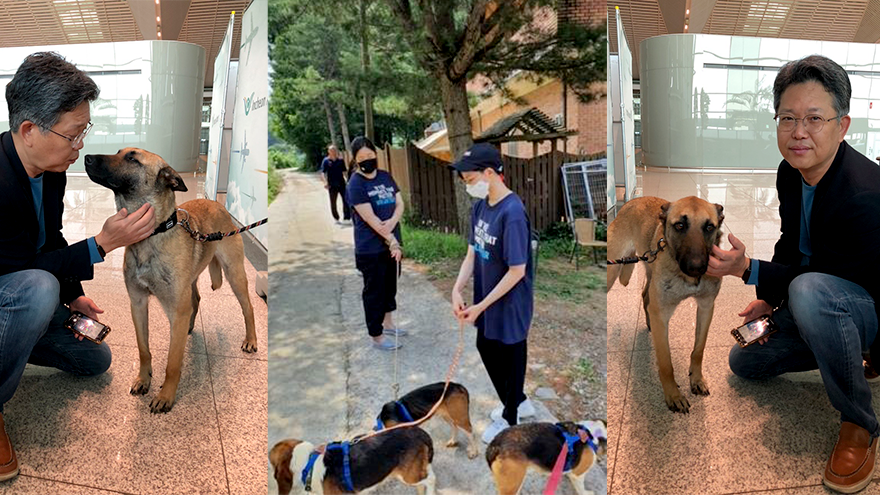
Colleagues in Korea had been spending time with the dogs and taking them for walks. The company’s account also described weekly English tuition for girls at Sundukwon Orphanage and a group of 50 colleagues clearing invasive plants on Bamseom Island. Those activities belong to the wider team’s volunteering record; the adoption journey is the episode specifically attached to Lee.
It is a pleasingly concrete addition to a biography otherwise crowded with corporate nouns. An animal had a destination, and an executive helped it get there. The trip does not need to be inflated into a management philosophy. It earns its place simply by showing a person doing something that an organizational chart would never think to record.
The first step up
By September 2026, Lee was taking part in another public conversation about how organizations work. At a women-in-finance conference at Conrad Seoul, he discussed the “broken rung”: when women miss out on the first promotion into management, fewer become candidates for executive positions later. The event identified him as a former Mercer leader.
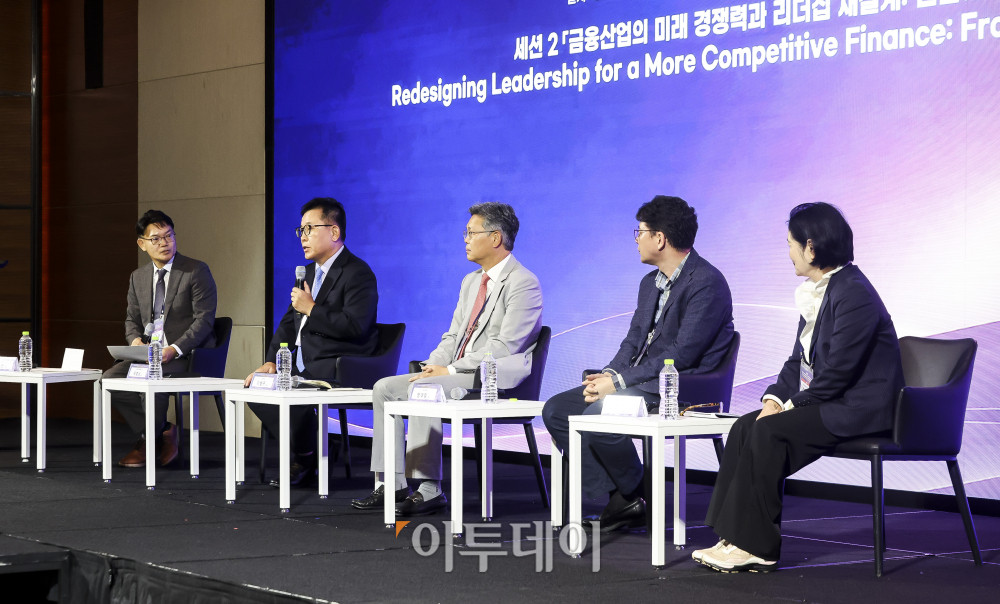
He also pointed to exclusion from informal gatherings and emphasized a manager’s responsibility to give employees opportunities to be seen. His advice to women offered leadership opportunities was to put themselves forward. Alongside that encouragement, he called for the removal of unreasonable structural barriers.
The question had moved from how advisers collaborate to how employees advance. Yet there is a recognizable practical emphasis in both discussions: examine the arrangement that produces the result. His own biography contains promotions, international experience and expanding responsibility. In Seoul, the focus was on who gets access to the early opportunities from which a career can grow.
That leaves a more useful portrait than a collection of titles. Lee’s story moves through a metals company, an American business school, a New York assignment and decades of work in Korea. Along the way, the details that linger are remarkably tangible: a counted breakfast, a meeting held through bad weather, a first promotion, a dog arriving home. Each gives the large professional vocabulary something a reader can actually picture.