Every company runs on a lie it tells itself: that the answer is written down somewhere, and someone can find it. In practice the answer lives in a stale Confluence page, a Slack thread from 2022, a Google Doc titled "FINAL_v3," and the head of a person who left in March. When a new AI assistant reads all of that and confidently blends it into a single wrong answer, the problem was never the AI. It was the mess underneath.
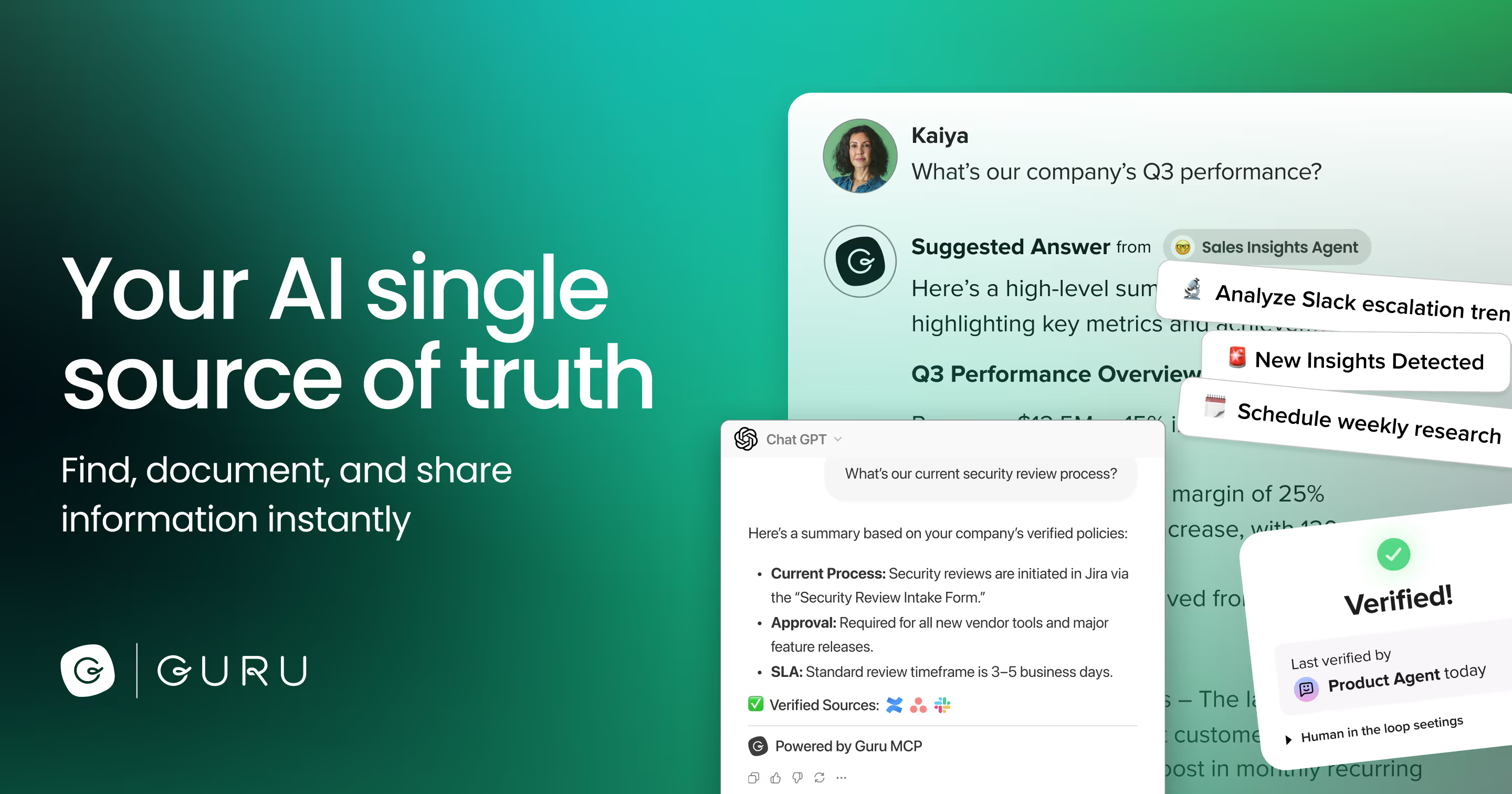
Guru, a software company that has been quietly working on that mess since 2013, sells the fix. Its pitch, printed plainly across the top of its website, is blunt for an enterprise-software brand: "Stop running your business on confidently wrong AI." The product is an AI-powered knowledge platform that pulls together a company's scattered tools, documents, and conversations, governs them into a single verified source of truth, and then serves cited, permission-aware answers to two audiences at once - the employees asking questions, and the AI agents answering them.
What Guru actually does
Strip away the category labels and Guru does three jobs. It searches across the apps a company already uses - Slack, Microsoft Teams, Google Drive, Zendesk, Confluence - and returns one answer instead of ten browser tabs. It stores knowledge in a card-based wiki and intranet, where subject-matter experts verify content so a reader can see, at a glance, whether a policy is still true. And increasingly it governs - watching for duplicate pages, contradictions between sources, and answers that have quietly gone stale.
The newest layer is the one that matters most in 2026. Guru's Knowledge Agents don't just retrieve; they maintain. They can verify and un-verify content automatically across connected sources using usage signals and AI analysis, flag conflicts, merge duplicates, and answer follow-up questions inside a Slack thread while logging each one for review. The knowledge base, in other words, starts doing its own janitorial work.
Slack · Drive · Docs · Zendesk
verify · merge · flag
cited · permission-aware
people + AI agents
Who it's for
Guru sells mostly to the teams that get asked the same question forty times a day: customer support, sales, HR, and operations. Its named customers skew toward high-growth brands - Shopify, SeatGeek, Lemonade, TravelPerk, Branch - the kind of companies that scale headcount faster than institutional memory. A new support rep at one of them can ask Guru "what's our refund policy for annual plans?" and get a cited, up-to-date answer without pinging a manager or guessing.
Half of all AI responses contain inaccuracies without verified knowledge. Guru's framing of the problem it sells against
The problem it solves
The tidy version: knowledge is scattered and nobody trusts the wiki. The 2026 version is sharper. Companies are bolting AI copilots onto everything, and those copilots are only as good as the documents they read. Feed a model contradictory, outdated inputs and it will produce a fluent, authoritative, wrong answer - the "confidently wrong AI" Guru names in its own headline. Guru's bet is that the scarce resource in the AI era is not intelligence but trustworthy context, and that governing it is a job worth paying for.
How it's different
The obvious comparisons are Notion and Atlassian's Confluence on the wiki side, and Glean on the AI-search side. Guru's distinction is verification. Notion and Confluence are excellent at storing documents and largely indifferent to whether those documents are still true; Guru treats "is this still accurate?" as a first-class software problem, with expert verification, conflict detection, and auto-un-verification built in. Against pure enterprise-search tools, Guru's angle is that search alone surfaces the mess faster - what you actually want is a governed layer that has already cleaned it up.
Products and services
The platform sells as one suite with several front doors: Enterprise AI Search across connected apps; a Wiki and Knowledge Base with verification workflows; an Intranet layer for announcements and resources; Answers, the generative-AI question box introduced in 2023; and the 2026 Knowledge Agents that add Chat, a deeper Research Mode, and Model Context Protocol (MCP) connectivity - the plumbing that lets outside AI agents query Guru's governed knowledge, and even live Slack conversations, in real time.
The business, and the founder
Guru runs a straightforward B2B SaaS model - per-seat and enterprise subscriptions that grow as customers connect more sources, add seats, and turn on governance and agents. The more of a company's tools Guru touches, the harder it is to remove. That stickiness is intentional, and familiar to its CEO.
Rick Nucci co-founded Guru with Mitch Stewart in 2013. Before that, Nucci built Boomi, one of the first cloud integration platforms, and sold it to Dell in 2010, then ran the business for Dell. His second-time-founder discipline shows in Guru's origin: the company started customer development within months, sold nothing but PowerPoints and mockups for the better part of a year, and charged real customers roughly ten months before shipping software. His stated rule, from a much-shared Medium interview: "Always be in front of customers." In a neat loop, Guru and Boomi announced a partnership in 2026 - the founder's two companies, back in the same room.
Guru at a glance
- Founded2013 · Philadelphia, PA
- FoundersRick Nucci, Mitch Stewart
- CategoryAI knowledge management
- Funding~$68M · Series C
- ModelB2B SaaS subscription
- CustomersShopify, SeatGeek, Lemonade
Expertise and where it fits
Guru's expertise is the unglamorous middle of the AI stack: not the model, not the chat interface, but the governed knowledge layer between them. For twelve years the company has been solving a problem - keeping company knowledge findable and true - that the rest of the market only started caring about when large language models made hallucination everyone's problem. That timing is the whole story. A wiki company from Philadelphia spent a decade building the exact thing enterprise AI now can't work without.
The company's culture reads a little against enterprise type, too. Its five values include "seek and share knowledge," "create advocates," "embrace the journey," "give and receive graciously," and - printed right there on the about page - "don't take yourself too seriously." It was named to Forbes' America's Best Startup Employers in 2022, runs remote-friendly with a Philadelphia hub, and has kept strong marks from its own team.
One governed layer. Powers every workflow. Continuously improving. Guru's product thesis
Whether "governed knowledge" becomes a durable category or gets absorbed into the search and model layers around it is the open question. What's clear is that Guru is no longer selling a better wiki. It is selling the thing that decides whether every AI tool a company buys tells the truth.