Somewhere inside a fast-growing company, a highly paid employee is explaining how to submit an expense, configure a dashboard or move a customer through a piece of software. They have explained it before. They will explain it again. The official tutorial is six releases old, the screenshot points to a button that moved, and the person asking for help has sensibly decided that messaging a colleague is faster than archaeology.
Guideless AI was built for this unglamorous loop. Install its browser extension, perform a workflow normally, and the Vilnius startup captures the relevant clicks and screens. Its software detects the steps, drafts instructions, adds highlights and zooms, produces captions and a transcript, applies company branding, then narrates the result with an AI voice in more than 40 languages. The finished guide can be edited step by step, shared by link, embedded or exported as an MP4.
That sounds like an AI video tool. The more interesting description is a maintenance tool. Traditional screen recordings are single frozen objects. Change one menu and the cleanest fix is often to record the whole performance again. Guideless turns the performance into a set of movable parts. Update, duplicate, translate or repurpose the pieces without asking the subject-matter expert to return to the little red recording button.
The first failure was the format
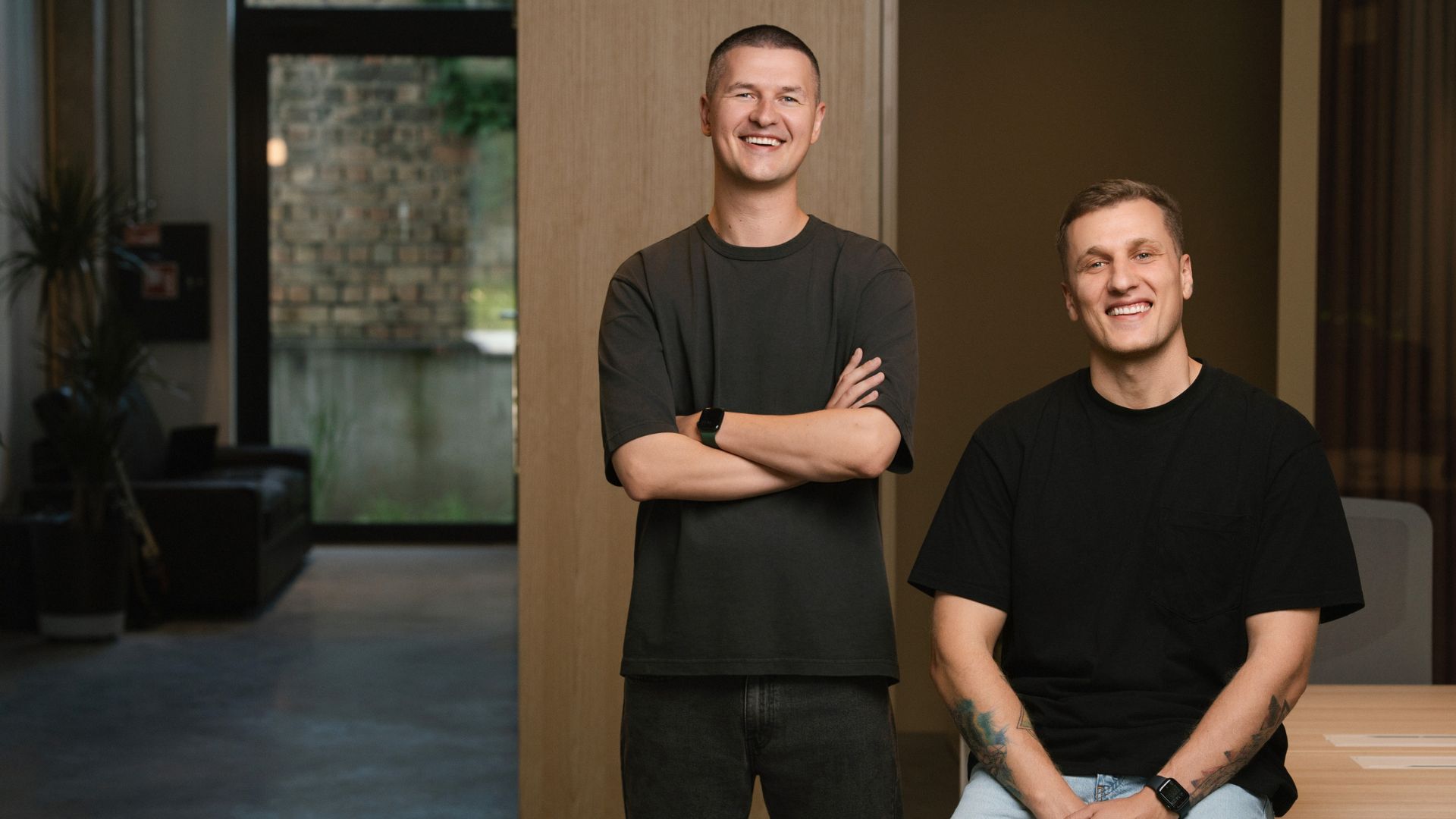
Co-founders Evaldas Bieliūnas and Dovydas Remeika soft-launched Guideless in late 2025 and incorporated the business in June 2026. Bieliūnas had spent more than a decade leading commercial teams and onboarding people across countries, including at Vinted Go. His conclusion was blunt: “Another standard documentation tool wasn’t going to solve this.”
The pair had tried existing walkthrough products and found a strange combination: too much product, not enough polish. The tools felt bloated, while the output still looked like work. Their change of mind was to stop treating documentation as a separate assignment. If the expert already knows the process, let the expert do it once. Make the documentation a byproduct.
That choice also explains the product’s personality. Guideless is trying to disappear behind the work. There is no request to write a script first, rehearse a voiceover or clean up a timeline. A customer clicks through the thing they already understand. The system performs the fiddly editorial labor afterward. The idea is easy to copy conceptually and difficult to execute well: automate around expert behavior instead of asking the expert to adopt a new creative profession.
“We walk through a feature once and the guide is ready.”Ruth Kusemiju, co-founder of RonRon AI
A narrow wedge in a crowded toolbox
Guideless lives in an awkwardly busy market. Loom is the familiar answer for quick screen recordings. Scribe and Tango turn clicks into step-by-step documents. Supademo builds interactive demos. Guidde, Clueso and Guidejar crowd the AI tutorial category. A Notion page and a patient colleague remain ferocious competitors because both are already available.
Guideless’ wedge is the narrated, polished video assembled from editable step-level capture. It is more watchable than a screenshot document, more structured than an improvised Loom and easier to revise than an ordinary recording. Multilingual narration matters for companies training employees, customers or partners across borders. The claim is not that every guide should be video. It is that repeatable software work deserves a format people may actually consume and teams can afford to maintain.
Users reported by August 2026
Languages for narration
Markets with users, including paying customers
The customers tell you where the pain concentrates. Vinted was an early adopter. Masan Consumer Holdings used the product while rolling out Workday, creating guides in English and Vietnamese. Nevada Hospital Association is named among users. Smaller case studies include RonRon AI, brand-protection platform adment.ai and ordering software company ForgetBill. Their shared problem is not filmmaking. It is explaining changing software repeatedly without scaling headcount at the same rate.
What it costs, and what the evidence says
The public pricing is refreshingly legible. The free plan includes up to three guides, sharing, AI narration and AI voices. Pro costs $29 per month per user when billed annually, with unlimited guides, insights, unlimited narration, no watermark and MP4 export. One subscription covers the workspace. Guideless has not disclosed revenue or valuation.
Its headline productivity claim is up to 10 times faster guide creation. Company claims deserve adult supervision, but there are useful behavioral clues. One Product Hunt reviewer said he moved from producing one or two onboarding videos a day to nine in an afternoon. He also asked for 4K output and reported that the team added it the next day. That is a sample of one, not a controlled trial. It is also the kind of early signal a small product team should notice: usage expands when creation stops feeling like production.
The playbook worth stealing
You do not need a computer-vision pipeline to borrow the company’s operating logic. Guideless has wrapped a sharp series of product decisions around a boring, expensive habit.
- Find the artifact that expires.Stale work creates recurring willingness to pay. Maintenance pain can be a stronger wedge than creation pain.
- Capture behavior, not recollection.Watch the expert complete the task instead of asking for a perfect written explanation after the fact.
- Make the output modular.Steps can be corrected, translated and rearranged. A monolithic recording cannot.
- Polish by default.Automation only saves time if the customer does not inherit an editing project at the end.
- Follow the same data downstream.One workflow can serve onboarding, support, sales, training and, eventually, machine context.
The business model follows naturally. A free tier proves the magic on a few workflows. The paid plan removes limits and adds the distribution features a team needs. More departments produce more guides, creating a seat-expansion path. The long-term opportunity is larger than $29 seats if Guideless becomes the place where a company stores, audits and updates how work gets done. But that future depends on the less glamorous present: guide quality, security, permissions, versioning and trust.
Where the magic stops
Guideless works best when a process is browser-based, repeatable and visible. It is a poor substitute for judgment. A nurse assessing a patient, a technician listening to a machine or a manager handling an emotionally difficult conversation is not merely clicking the correct sequence. Some work branches, some work is physical, and some work should never be captured with customer data glowing on the screen.
Physical tasks, mobile-only flows and work spread across systems the capture tool cannot observe.
Procedures where exceptions, ethics or human interpretation matter more than the normal sequence.
Workflows containing information that policy, regulation or customer promises prohibit from being recorded.
Interfaces changing so frequently that even cheap updates cost more than simply helping users in the moment.
AI narration has its own edges. Forty-plus languages make localization dramatically more accessible, but names, domain jargon, tone and compliance language still need human review. A natural voice is not the same as a correct instruction. And while editable steps reduce update costs, someone still has to own accuracy. “Living documentation” is only alive if the organization supplies a pulse.
The million-euro move from guides to memory
In August 2026, Guideless announced a €1 million pre-seed round led by Superhero Capital, joined by FIRSTPICK VC and angel investors Thomas Plantenga, Vytautas Atkočaitis and Mantas Mikuckas. The Vinted thread is conspicuous: Plantenga leads the group, Atkočaitis runs Vinted Go, Mikuckas co-founded Vinted, and Bieliūnas previously worked at Vinted Go. This is not merely a friendly cap table. Vinted had used the product and experienced the maintenance problem firsthand.
Plantenga said the company once spent weeks rebuilding guides after interface changes and could now update them quickly with little manual oversight. Guideless plans to spend the capital on product development, hiring and expansion in Britain, Europe and the United States. Its LinkedIn footprint still places the team in the two-to-ten employee bracket, which makes its advertised culture - close work among founders, engineers, customers and designers, with an emphasis on craft over titles - less a slogan than a staffing reality.
The bigger bet is that a captured workflow can become structured operational context. The same source might train a new employee today, answer a customer tomorrow and tell an AI agent how this particular company expects a process to run next year. That is more ambitious than making handsome tutorials. It also raises the standard: a cosmetic mistake in a video is annoying; stale instructions fed to an autonomous agent are operational risk.
For now, the company’s best argument is wonderfully mundane. People do not want to rebuild a tutorial because a button moved. Guideless has arranged browser capture, computer vision, generative text and synthetic speech around that tiny act of workplace defeat. The technology is modern. The irritation is ancient. That is often a useful place to start a company.