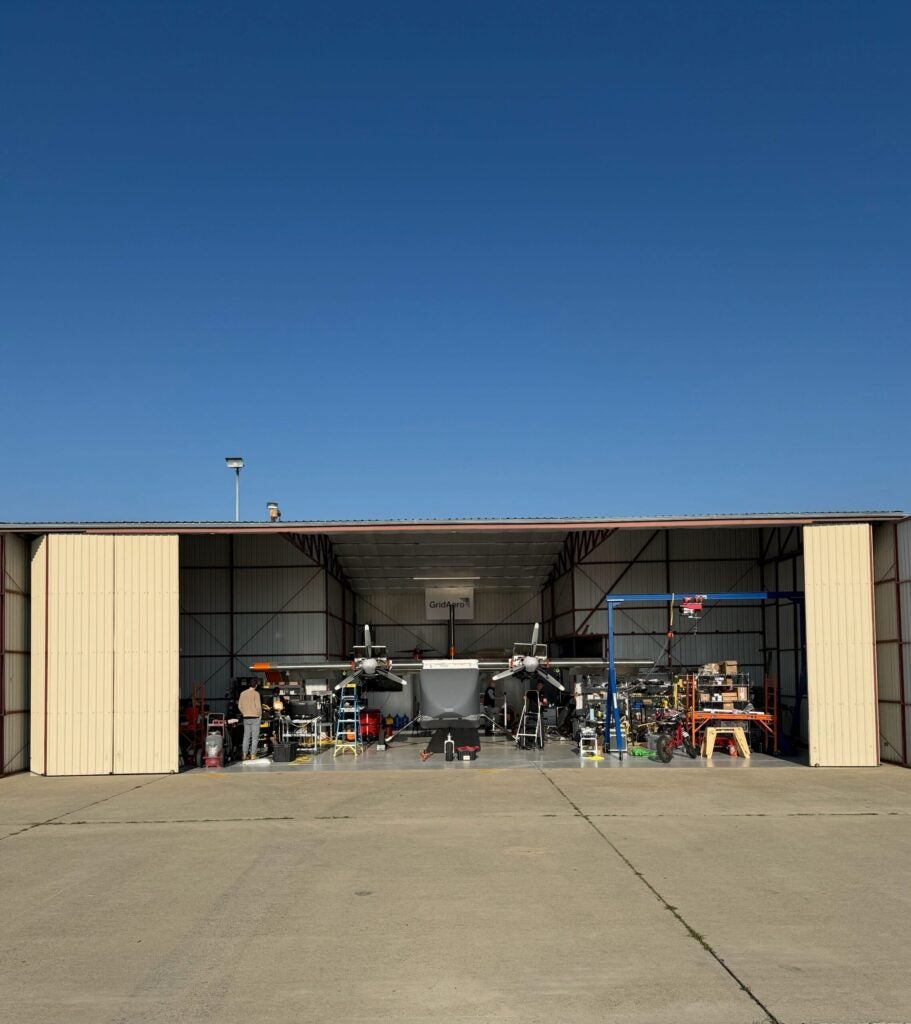
The runway in the back of the hangar
Walk into Grid Aero's facility on a Tuesday morning and the first thing you notice is what's missing. No glass-walled war room. No 18-month Gantt chart. No carbon-fiber autoclave humming behind a curtain. There is, instead, a clean-sheet airplane with the proportions of a small Cessna, the riveting of a 1950s station wagon, and the brain of a 2026 autonomy stack. It is parked next to a coffee maker. A whiteboard nearby says, in marker, "Guam → Japan, payload to spare."
The airplane is called Lifter-Lite. It is autonomous. It will, the company says, carry between 2,000 and 10,000 pounds across thousands of miles, take off from gravel, and cost an order of magnitude less per pound than anything the Pentagon presently buys. It does not have a pilot, a flight attendant, or a particularly flattering paint scheme. Grid Aero thinks that is the whole point.
A flying truck, on purpose
Most aerospace founders begin with a wind tunnel. Arthur Dubois began with a spreadsheet. He'd spent years inside Joby Aviation, helping scale a passenger eVTOL program that demanded exquisite engineering. He'd then run engineering at Xwing, building flight autonomy for cargo aircraft. Both experiences taught him the same lesson from opposite ends: exquisite is slow, and slow is the enemy of useful.
The bet behind Grid Aero is uncomplicated. Defense logistics in the Pacific - the world's largest, most contested air theater - cannot be solved with another billion-dollar jet. It needs a fleet of cheap, simple, autonomous airframes that can land on dirt, take a beating, and be replaced without a Senate hearing. So Grid Aero is building exactly that: a high-wing turboprop with a powertrain reportedly built around single-digit moving parts, an airframe stamped from sheet metal, and an autonomy stack that lets one operator fly many aircraft at once.
The company calls the fleet model "The Grid." The aircraft is the Lifter-Lite. The motto, more or less, is: stop building Fabergé eggs.
Two products, one thesis
Lifter-Lite
A clean-sheet, twin-turboprop, autonomous cargo aircraft. Designed to fly 2,000–10,000 pounds across thousands of miles and to operate from short, austere, or degraded runways. Built with commercial off-the-shelf electronics and a diesel powertrain to keep unit cost low and maintainability brutal-simple.
The Grid
A distributed fleet operations layer that lets small teams manage many aircraft across vast regions. Built for contested logistics, regional cargo, e-commerce networks, and humanitarian airlift - anywhere the math on a crewed aircraft stops working.
Where the spec sheet bites
Who is actually building this
Aerospace engineer with clean-sheet aircraft experience from Joby Aviation and Xwing, where he led the autonomy stack.
Flight-test director and aerospace engineer with deep experience in uncrewed systems, rapid prototyping, and FAA approvals.
Defense and aerospace strategist with prior roles at Northrop Grumman, Starburst, and Mandala Space Ventures.
Retired U.S. Air Force Colonel, former Deputy Director of AFSOC Logistics. 26 years in contested-logistics doctrine.
The advisory board is, as one investor put it, "a Pentagon org chart": two retired lieutenant generals, a retired major general, a retired colonel, plus operators from Oracle Cloud UK, Martinaire Cargo, and the West Point alumni network.
Eighteen months, one airplane, two rounds
Contested logistics, plainly
The phrase "contested logistics" sounds like a procurement euphemism, because it is. It means: the airfields you used to count on may not be there next week. The runways may be 600 meters of crushed coral. The C-130 you'd normally send is too expensive to risk and too few to spare. And the cargo - blood, batteries, drone spares, food - still needs to arrive.
Grid Aero's pitch to the Pentagon is that the answer is volume, not virtuosity. Dozens of cheap autonomous airframes are harder to shoot down than a few exquisite ones. They can be lost without ending a career. They can be re-tasked without a flight crew. And, importantly, they can be built in a hangar in California in six months rather than a contractor campus in a decade.
The civilian story is the same story, just quieter. Alaska bush routes, regional e-commerce hops, humanitarian airlift after a typhoon - all of these are economically broken under crewed aircraft. Grid Aero thinks "The Grid" makes them economically fixed.
Who is paying for this
$6,000,000
Co-led by Calibrate Ventures and Ubiquity Ventures, with Commonwealth Ventures participating. Funded the build of the first Lifter-Lite.
$20,000,000
Led by Bison Ventures and Geodesic Capital. New: Stony Lonesome Group, Alumni Ventures. Returning: Ubiquity, Calibrate, Commonwealth. Powers flight testing and first operational deployments.
Three details worth keeping
Sheet metal & rivets
The airframe is built like a postwar utility aircraft. The choice is deliberate: easy to fabricate, easy to repair, easy to scale without bespoke composites.
Deliberately not weaponized
Grid Aero builds the truck, not the cargo. Payloads remain configurable by the customer. The company describes itself as a logistics company that happens to make aircraft.
Six months, hangar to apron
The first full-scale Lifter-Lite was built in roughly six months. For context, comparable clean-sheet programs at incumbents typically run five to ten years.
One pilot, many aircraft
"The Grid" is the operations layer that lets a small team supervise a fleet. The economic case for autonomous cargo lives or dies on this ratio.
The runway, one year later
Return to the Palo Alto facility today and the airplane is still parked there, but the room around it has changed. The coffee maker has been moved. The whiteboard now says, in fresher marker, "first ops 2027." A second Lifter-Lite is in early build behind a curtain. Two retired generals are on a video call in the corner about exercise slots. The Series A check has cleared.
What Grid Aero is selling, in the end, is not a drone. It is a different theory of how aerospace gets built: in months instead of decades, with off-the-shelf parts instead of bespoke ones, with a small team of operators instead of a large team of pilots. The airplane in the hangar is the argument. Whether the argument wins gets decided over the next 18 months, on a runway most readers will never see, by customers who measure success in pallets delivered to people who needed them yesterday.
The flying pickup truck doesn't care if you find it pretty. It just needs to land on dirt.