Greg Frick had a recruiting business to run and a spreadsheet problem to endure. His applicant tracking system held information about the work, yet it could not show him enough of what he needed to know. Getting a useful picture meant assembling it elsewhere. The software had acquired an assistant, and the assistant was the person paying for the software.
He wanted to see how the business was doing each day. A quarterly view would arrive rather late for a recruiter stuck on Tuesday. Even a monthly report left too much room between a problem appearing and someone doing something about it. Frick wanted the detail: where work was moving, where it had stopped, and which recruiter needed attention.
He described the spreadsheets as annoying. The complaint was specific. There is something pleasingly unceremonious about that complaint. A founder can talk about strategy for an hour. An irritating report tends to reveal where the strategy meets the furniture.
Frick, the Atlanta-area CEO and founder of Qualified Recruiter, operates in recruitment process outsourcing, usually shortened to RPO. Companies bring in recruiting capacity to help find and screen people. His business connects that demand with a delivery operation in Pune, India. Across the distance, he has kept returning to a close-range question: what is everybody actually doing?
Pune, forty people later - and then some
In July 2022, Frick wrote about returning to the Pune offices for the first time since 2019. During the interval, he reported, the team had grown from 40 people to 200. His brief account made room for the food, the people and a planned return in November for a new office at The Solitaire. Expansion had become something he could walk into.
The numbers describe a fivefold change. The visit gives them a human scale. Forty colleagues and 200 colleagues make different demands on a business: more introductions, more instruction, more opportunities for a message to lose its meaning on the way to the person who needs it.
Qualified Recruiter’s company history begins with operations in a one-bedroom apartment in Pune in 2016. It records a move into a first office in Chandan Nagar in 2017, starting with four employees and reaching eight within a month. A U.S. sales hire and a first RPO client belonged to that early stage.
Those details are modest enough to be useful. The apartment tells us about the starting conditions. The first client tells us when an idea began facing somebody else’s expectations. The first salesperson in America shows how early the operation had to work across borders.
Further office moves followed. The company records a larger space in Viman Nagar in 2019, additional space in 2021 and a move into Solitaire Business Hub in 2023. The addresses changed as the operation grew. Behind those moves sat the harder requirement of making a bigger team perform work a client could recognise and trust.
The shortlist has a backstage
Qualified Recruiter’s account of its development describes a leadership team that began in staffing and became increasingly focused on finding candidates. Clients came to rely on that part of the service. The business then concentrated more deliberately on RPO, giving customers a way to bring outside recruiters into their hiring process.
It is a consequential choice. A client can admire the candidate at the end of the process while barely seeing the people who produced the introduction. Frick’s company sells access to those people and to the structure around them: training, management, screening and review.
Its published workflow starts with a manager and recruiter agreeing on the job requirements and search approach. Outreach and screening come next. A quality assurance team reviews candidate details before an approved submission reaches the client. Follow-up continues after that submission. The shortlist has already passed through several hands by the time it looks like a simple list.
A dedicated recruiter is paired with U.S.-based account management. The division puts candidate work and client oversight into the same service. For a founder operating between Atlanta and Pune, that arrangement makes communication part of the product: the person conducting a search needs to understand the job as the client understands it.
Training occupies a similar place. Frick’s Ceipal speaker biography singles out Qualified Recruiter’s training centre and the courses recruiters must pass. Recruiting knowledge has to travel from an experienced person to a newer one. A growing company cannot rely indefinitely on everyone overhearing the right conversation.
The larger question behind all this is familiar to anyone who has hired: how much confidence should a name on a page inspire? A review stage does not remove the need for judgement. It gives judgement an assigned place in the working day.
Tuesday matters to the chief executive
Frick’s education includes computer information systems at Georgia State University, alongside business administration and marketing. His professional background spans technology leadership, staffing and entrepreneurship. That combination helps explain why a recruiting system might interest him at the level of both the business and the individual report.
When he looked for a replacement applicant tracking system, he described two tests: whether it would help recruiters work efficiently, and whether it would give him the visibility required to manage the business. He also had developers examine Ceipal’s business intelligence capabilities. The purchase decision went beyond a demonstration with agreeable slides.
With more detailed reporting, he began monitoring daily candidate submissions and looking for bottlenecks. His explanation was brisk: “People do what you measure.” A metric focuses attention. Choosing one is a managerial act, with consequences for how people spend the next hour.
“People do what you measure.”
Greg Frick, discussing recruiting performance
There is an obvious tension here. Recruiting involves relationships; reporting turns work into countable events. Frick’s company places screening and quality review alongside the activity measures. Read together, those choices suggest a practical ambition: make the work visible while preserving checks on what gets sent to the customer.
There is a useful distinction between seeing that activity has slowed and understanding why. A report can identify the place to ask a question. The answer still comes from the recruiter, the manager or the client. In this reading of Frick’s approach, the dashboard creates the opening for a conversation about the work. That is also why the training and review stages matter: a number becomes more useful when someone can explain the decisions behind it.
A football shirt in the arrivals hall
The airport selfie offers a less formal introduction. Frick is at the right of the photograph, holding the camera, wearing a Liverpool shirt. Two companions stand beside him beneath the terminal lights. For a moment, the international business is three people fitting themselves into a phone screen.
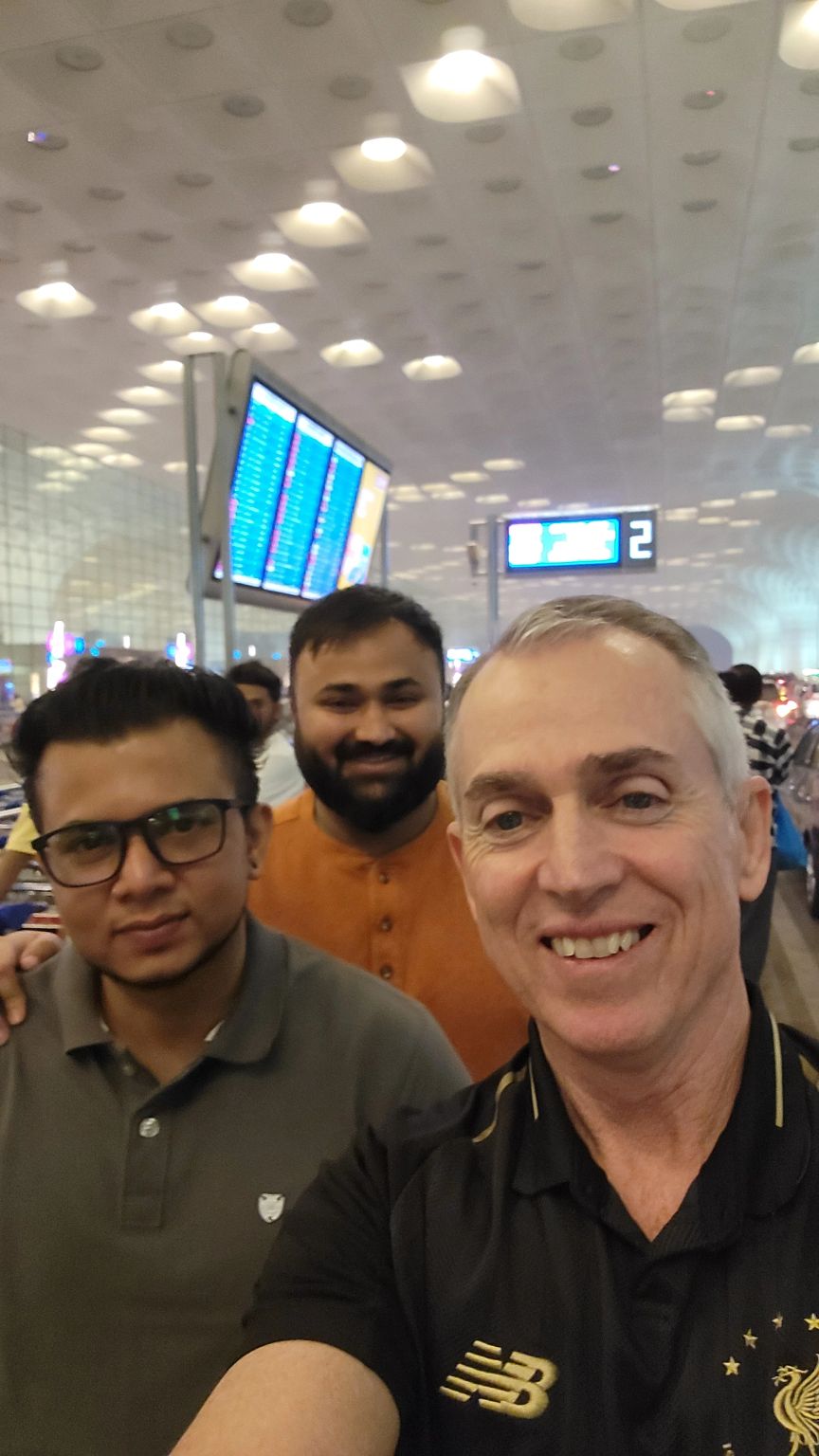
He supports Liverpool and the U.S. national team. His public biography names faith, family and football as priorities, and describes travel with his wife and three children, with Australia among his favourite destinations. The interests give the executive title a little company.
Christian faith is explicit in his account of his life and work. He places it at the centre of how he understands his accomplishments and lessons. In his response to a company post about a December 2024 Pune visit, he mentioned sharing the Gospel alongside the business and social parts of the trip.
That visit included meetings, a traditional Hindu wedding and a Christmas party. His response carried the enthusiasm of someone pleased to have been there. The itinerary had acquired considerably more life than a calendar invitation could contain.

The photographs matter because a distributed company can so easily become a collection of job titles on a screen. Here are people at an airport and around a table. Frick’s reporting interests tell us how he wants to see the operation. His travel posts show him going to see the people.
Someone still has to discuss the salary
His public industry appearances have followed recruiting technology into AI. At Ceipal Connect, he joined Divya Rajashekaran of Sophus and Venkat Swaroop of TekWissen for a discussion of using generative AI in daily workflows. The subject had moved from obtaining useful reports to deciding which parts of recruiting software could help perform.
In a later conversation with Sibitalent’s Sarvesh Sharma, recapped in October 2025, Frick stressed the importance of good underlying data and human oversight. He saw value in getting candidates to a human conversation sooner. He also warned about recruiters becoming overdependent on automated work.
“The AI is not going to negotiate salary with the candidate,” he said. It is a practical place to test a promise about automation. Somewhere beyond matching a résumé to a vacancy, two people have to discuss what the arrangement will mean for them.
That brings Frick’s story back to its recurring subject. A search needs information. A team needs instruction. A manager needs to see where the work is going. The candidate needs somebody who can hold a conversation when the questions become personal and specific. Frick has spent his recruiting career organising the work that gets everyone to that point.