Grammarly’s signature product decision is easy to miss because it appears as a tiny green button. The company did not ask writers to abandon Gmail, Google Docs, Slack, LinkedIn or Word. It slipped into those places, watched for a wobbly sentence and offered a fix before the writer could regret pressing Send. That humble act of proximity turned a grammar checker into one of software’s more useful distribution systems.
Today, Grammarly says more than 40 million people and 50,000 organizations use its writing assistance. In 2025, Reuters reported annual revenue above $700 million and profitability. The product works across hundreds of thousands of apps and websites, serving everyone from a student nursing a thesis to a support agent trying to sound calm at 2:13 a.m. It catches mechanics, suggests clarity and tone, rewrites paragraphs, helps cite work, checks originality, and gives companies controls for terminology, voice and security.
The product was a correction. The business was a habit.
Max Lytvyn, Alex Shevchenko and Dmytro Lider founded Grammarly in 2009 after Lytvyn and Shevchenko had worked on MyDropbox, a plagiarism-detection service. The first version was a paid education product. That made logical sense - students write constantly and mistakes carry consequences - but it was a narrow door. Grammarly’s own anniversary history describes the crucial early switch: from education technology to a mass consumer product, then from subscription-only to freemium.
That is the first thing that failed, or at least failed to become the giant business: the original market and paywall were too restrictive. The founders did not throw away the technology. They changed who could try it and where it appeared. A free version arrived in 2015, when the company had around one million users. Browser extensions pushed the assistant beyond a dedicated editor. By 2019, Grammarly was reporting roughly 20 million daily users.
A habit escapes the editor
Reported users, selected yearsThe company bootstrapped for eight years and was profitable before taking its first institutional funding: $110 million in 2017. Another $90 million followed in 2019, and a $200 million round in 2021 valued Grammarly at $13 billion. The expensive chapter came later. In May 2025, General Catalyst supplied $1 billion through a non-dilutive structure designed to fund customer acquisition costs. Non-dilutive does not mean free money - the capital is repaid from revenue tied to the financed spending - but it avoided pricing a new equity round while giving Grammarly a large budget for expansion.
“We created our own mass transit system to deliver AI in every app quickly and reliably.”Grammarly, explaining the infrastructure beneath the underline
ChatGPT made “better sentences” feel like a feature
Then the market changed its mind for Grammarly. Generative AI turned drafting and rewriting into table stakes. ChatGPT, Claude, Gemini and Copilot could all improve a paragraph, often inside products people already paid for. Grammarly responded first by adding generative features, but a prompt box was not much of a defense. Its more consequential answer was to recast its installed presence as rails for many assistants, not one writing assistant.
In December 2024, Grammarly agreed to acquire Coda, the flexible document-and-workflow company. Coda co-founder Shishir Mehrotra took over as CEO. In 2025 came the acquisition of Superhuman’s email client. By October, the parent company itself had adopted the Superhuman name. The suite now grouped Grammarly writing assistance, Coda workspaces, Mail, and Superhuman Go, an assistant meant to act across apps. Grammarly survived the rename as a product. The corporate identity did not.
Old promise
Improve this sentence
Correctness, clarity, tone and rewrites, delivered at the cursor without a trip to another tab.
New promise
Improve this workday
Use context from mail, documents and company systems to research, draft, schedule and act across tools.
The logic is clean. The risk is cleaner. People invited Grammarly into their browser because it handled a specific, frequent, low-drama job. They may not want one company reading enough context to mediate the entire workday. A writing suggestion is easy to inspect. An agent acting across email, calendars and internal knowledge demands a larger measure of trust. The suite must also feel integrated, not like four acquisitions wearing the same lanyard.
Authorship is the sharper AI bet
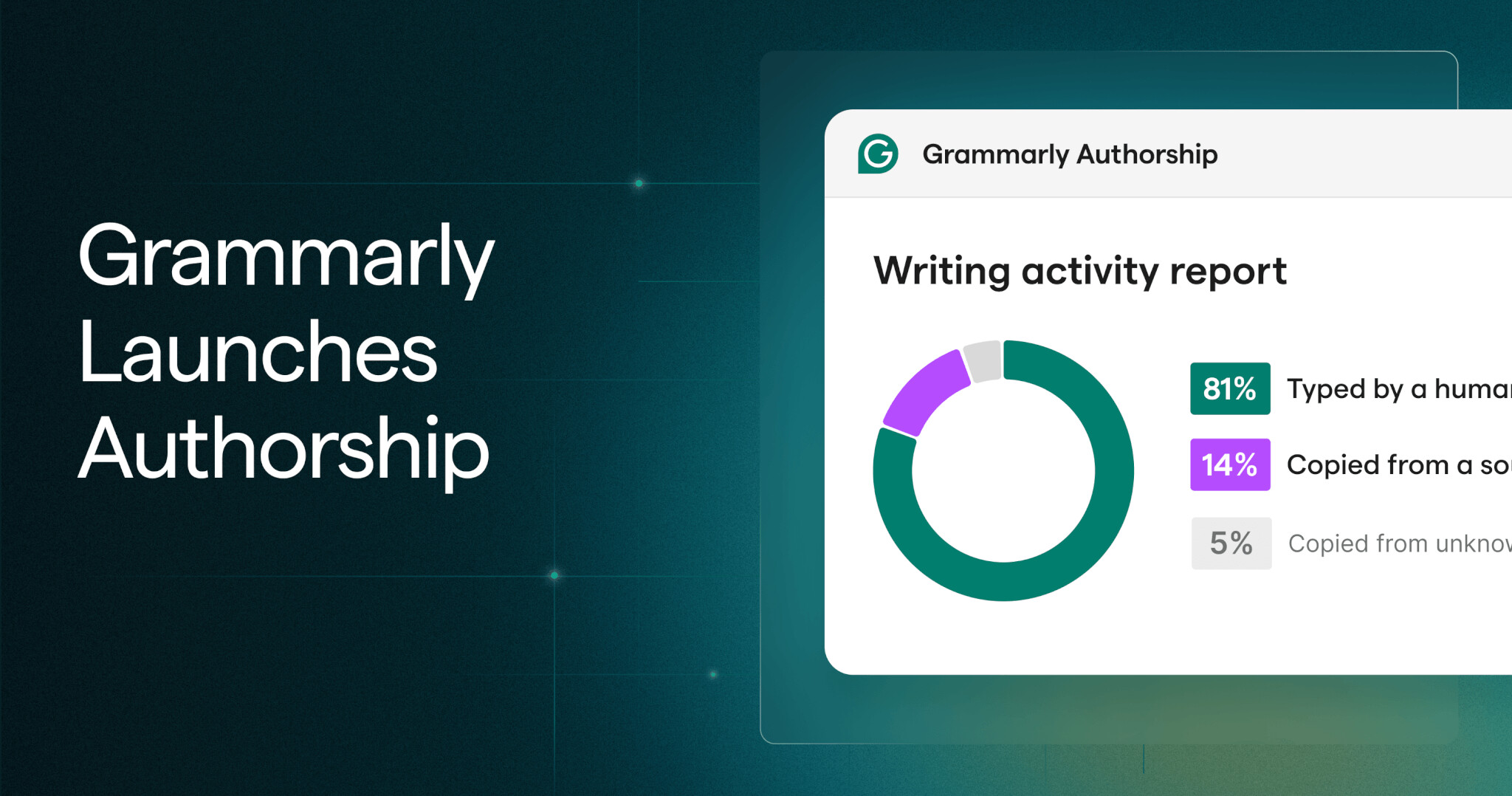
The most distinctive newer product is not a writer that types for you. It is Authorship, a tracker that shows how writing was made. Turn it on and the software categorizes text as human-typed, pasted from a source, generated by AI, modified with AI, or edited with a conventional checker. It can produce a color-coded report and replay the document’s construction.
That approach matters in education, where AI detectors make probabilistic judgments and false positives can become accusations. Authorship gathers process evidence instead. Students choose to share reports; instructors see a history rather than a magic percentage. By 2026, more than five million reports had been generated, and the tool had expanded across Google Docs, Microsoft Word, Canvas and Superhuman’s own writing surface. A 2026 update could even identify which specific agents assisted with research, generation or revision.
It is not a universal answer. Tracking must be enabled in supported workflows, policies must define acceptable assistance, and the record cannot explain whether an idea is good. But it fits Grammarly’s actual advantage: presence during the act of writing. Competitors that only inspect the finished page arrive too late.
What organizations are actually buying
Consumers buy fewer awkward emails and cleaner essays. Enterprises buy coordination. Grammarly can encode preferred product names, forbidden phrases, brand tones and snippets; administrators get deployment and analytics; security teams get certifications and controls. That places it between a writing utility and a lightweight layer of organizational policy.
The company’s published customer results make the pitch concrete. Databricks reported $1.4 million in annual savings, a 1.2-month payback period and faster support resolution after rolling Grammarly across functions. Zoom reported more than 7,000 hours saved in nine months and over 10,000 style-guide suggestions delivered. These are vendor case studies, so they are best read as evidence of what a successful rollout can look like, not a promise that every buyer gets the same spreadsheet.
The price of a cleaner sentence
The funnel begins at zero. Grammarly Free covers core corrections and a small allowance of AI prompts. As of September 2026, US list pricing for Grammarly Pro was $30 per member when billed monthly, $60 for three months, or $144 for a year - an average of $12 a month. Longer plans are charged in one payment. Enterprise and institutional buyers receive contract pricing, with the bill shaped by seats, features and deployment.
That spread explains the model. The free tier makes the green button familiar before procurement gets involved. Pro sells sharper rewrites, tone controls, originality features and larger AI allowances to individuals and small teams. Enterprise sells the less glamorous, more defensible machinery: central administration, custom style rules, analytics, company knowledge and compliance. Buyers are not merely paying for punctuation. They are paying to avoid editorial queues and to stop a global team from inventing six spellings of the same product name.
There is a hard ceiling. If a user only needs occasional proofreading, the free tier or a bundled assistant may be enough. The paid case gets stronger with frequency, distributed teams and expensive mistakes - and weaker when every suggestion creates another review task.
The widening wedge
A useful product with a limited entry point.
The assistant follows writers into the browser.
Style, security and administration become the upsell.
Coda, Mail, Grammarly and agents share the rails.
The bit worth copying - and the catch
Founders can copy the sequence, not the commas. Start with a task that happens often and has an obvious before-and-after. Deliver the help inside the customer’s current workflow. Give individuals enough value to form a habit. Charge organizations for the things groups need: consistency, governance, security, shared knowledge and proof of return. Only expand after the first behavior has earned distribution and trust.
The playbook breaks under several conditions. It does not work if the extension is unreliable, the suggestion is costly to verify, the underlying task happens once a month, or the product needs sensitive context users will not grant. It also weakens when platform owners bundle a good-enough version for free. Microsoft, Google and general-purpose AI assistants can subsidize writing help with much larger businesses.
Grammarly’s answer is that generic intelligence is not the whole product. Timing, context, deployment, brand rules and a familiar acceptance loop matter. That is plausible. It also has to be proven again as the company moves from correcting words to taking actions. The little green button earned permission one sentence at a time. Superhuman now wants to spend that permission across the day.
The red underline was the wedge. The real asset was being there before Send.
Keep the useful tabs open
Try the writing assistant, inspect its security posture, watch the product expand, or follow the engineers who publish some of Grammarly’s language research and code.