The offer has been accepted. Nobody has the keys. Between those two moments sits a procession of references, signatures, deposits, documents and people asking other people whether they have checked their email. Goodlord has made that interval its business. Its proposition to Britain’s letting agents is wonderfully unromantic: put the moving parts in one place, reduce the chasing, and get the tenancy over the line.
That gives the company an unusual vantage point. The agent is buying business software. The landlord wants a reliable tenant and rent arriving on time. The tenant wants the application to stop feeling like a second job. Goodlord has to serve all three, although their interests do not always line up. Making administration faster is valuable; making the whole rental relationship effortless is a much bigger promise.
The deal after the deal
Goodlord’s core work begins where the property search becomes a transaction. An agency can bring details into the platform, collect an applicant’s information, arrange referencing, generate agreements, obtain electronic signatures and track payments. Landlords receive documents and decisions to review. Tenants complete their part online. The small miracle being sold is knowing which step is outstanding without opening six different systems.
The company markets its platform to independent agencies and larger operators. It reports more than 3,500 agency brands using its services. Customers include McFarlane Sales & Lettings, Warren Powell-Richards and Settio. Those names matter more than a generic claim about serving “real estate”: this is software built around the routines of residential lettings, with recurring applications, deadlines and financial checks.
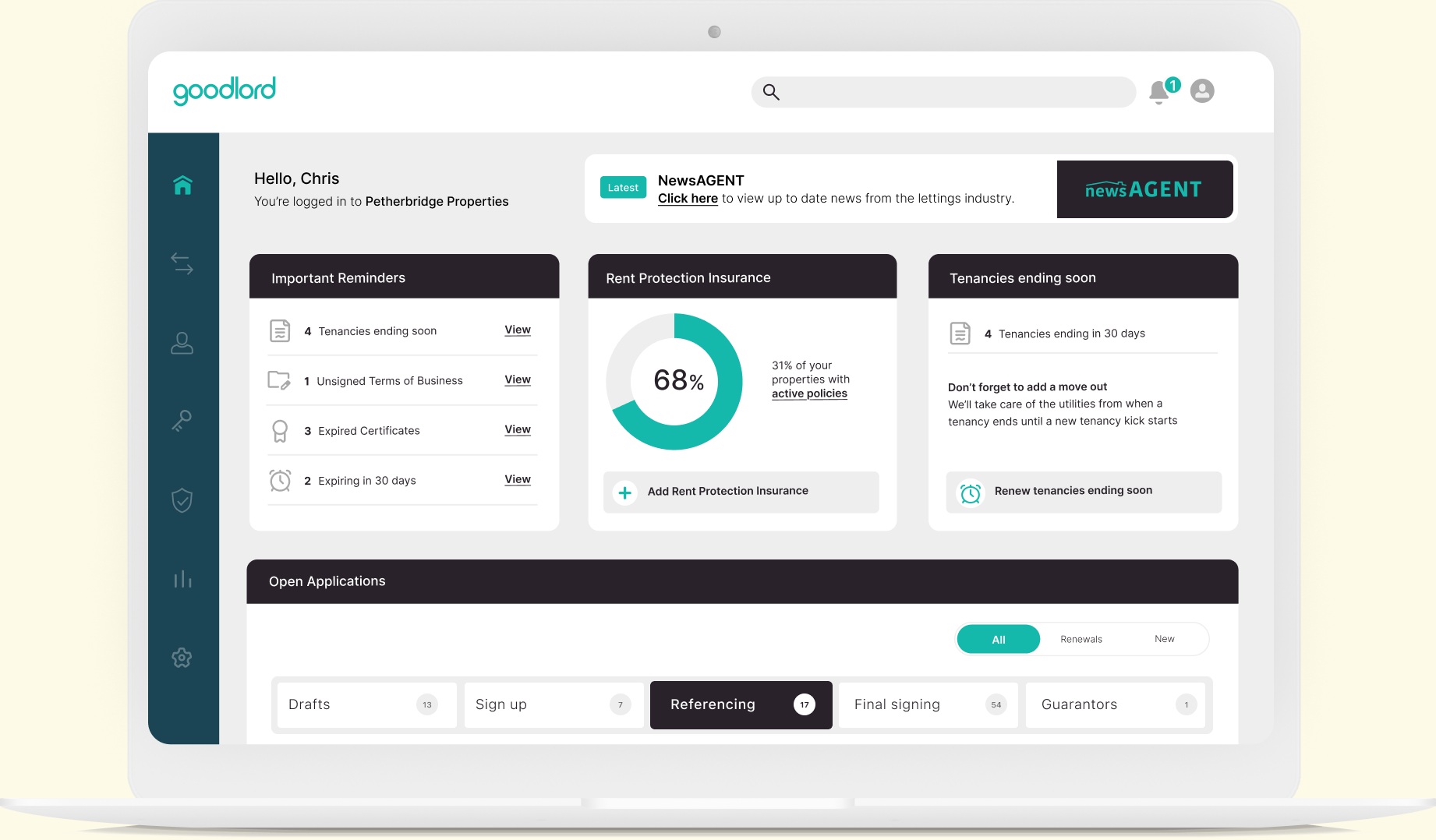
Connections to Reapit, Alto and Street.co.uk give the strategy another useful detail. An agency can keep its existing customer relationship management system while sending information into Goodlord. The company is selling a place inside the agency’s working day. Re-entering the same name, address and dates is precisely the sort of work that makes a supposedly digital office feel stubbornly analogue.
“For lettings, speed is everything”Kyle Nelson, Warren Powell-Richards
Goodlord customer testimonial
Speed, though, needs a denominator. Goodlord advertises an 80 percent reduction in admin time and more than 40 automated compliance steps. These are supplier claims, not a guarantee for each branch. A useful buyer would measure time per completed tenancy, the number of interventions still needed and the applicant’s experience. A shorter task list for the agent is only part of the result.
First came signatures. Then came a reset.
Richard White, Philip Mundy and Tom Mundy founded Goodlord in 2014. White had worked at Foxtons, giving the business an origin close to the desk where the paperwork accumulated. Its first tenancy platform appeared in 2015. Referencing followed in 2016 and rent protection insurance in 2017. Each addition put another piece of the transaction within reach.
The expansion was not smooth. In January 2018, Property Industry Eye reported that Goodlord had reduced headcount from 134 to 96, cutting 38 sales and marketing jobs. Management said it was shifting attention toward product features and automation. The concrete correction was to the organisation’s spending and staffing priorities: sales growth had not removed the need to build and operate the underlying service efficiently.
William Reeve joined as chief executive in 2018. The restructuring offers a more useful lesson than a polished founder legend. Software that promises to remove administrative work must keep improving the work itself. Hiring people to sell that promise and engineering a dependable way to deliver it are separate tasks. Goodlord’s public explanation placed greater weight on the second.
- 01Collect
- 02Verify
- 03Sign
- 04Pay
- 05Manage
One record, several handoffs. The commercial opportunity is in connecting them.
Follow the money past moving day
Goodlord’s business combines software with services attached to the tenancy. Referencing, payments, insurance and utility referrals give it several ways to earn from the relationship. Agencies can also receive revenue shares on selected products. That creates a persuasive sales argument: the system can reduce work while making additional services easier to offer.
The costs have to be read carefully. A 2024 Goodlord promotion advertised Complete Tenancy Management at £5 per tenancy per month. That is a historical offer, not a current quotation. Its 2022 accounting-product announcement described fixed transaction charges rather than a percentage of rent. Today, an agency evaluates the core package through a sales conversation and needs to distinguish platform charges from individual services.
One current price is especially tangible. Goodlord Guarantor charges a tenant an upfront fee equivalent to one month’s rent for a professional guarantor service covering up to three years. At £1,000 monthly rent, that means a £1,000 fee. It is an option for eligible applicants who need a guarantor, including those without a suitable UK contact. The convenience comes with a substantial payment at moving time.
Guarantor fee on a £1,000-a-month tenancy.
One upfront payment. Up to three years. Eligibility and terms apply.
The same product lets agents earn a revenue share. That helps explain why Goodlord wants financial services inside the application journey: the moment a problem appears is also the moment a relevant product can be offered. For tenants, clear explanations of price and alternatives matter. For agencies, a smooth purchase should still leave room for an informed decision.
Buying the next piece of the tenancy
Acquisitions extended that logic. Goodlord bought referencing provider Vouch in 2020, household bill-splitting app acasa in 2021 and tenant engagement platform Halo in 2022. Read in sequence, the deals trace a company moving from checking an applicant toward managing more of the experience surrounding a home. Rent Collection, launched in 2021, also gave it work to do after the keys changed hands.
Building that reach required capital. Goodlord announced more than £10 million in Series B funding in 2020 from Latitude, Oxx and Finch Capital. In March 2022 it announced another £27 million, led by Highland Europe with Columbia Lake Partners and existing investors participating. The stated uses included acquisitions, engineering, product development and integrations. Funding paid for expansion; it was not evidence that every new service would succeed.
The resulting company occupies crowded territory. HomeLet and Let Alliance offer overlapping referencing and insurance services. Agencies can also combine separate tools for checking tenants, signing agreements and handling payments. Goodlord’s case rests on how well the pieces work together. Its integration partners are a reminder that the market is a web of overlapping services, with cooperation and competition often sitting side by side.
The awkward cases still need people
Referencing is where the limits of a neat workflow become obvious. A payslip can look convincing without being genuine. Goodlord’s PRO service uses direct connections to income information, alongside fraud checks and specialist support. Its materials describe payroll, HMRC and open-banking routes. Verifying information closer to its origin can remove some of the dependence on documents supplied by an applicant.
But the fast route is not available to everybody. Goodlord’s published payroll and HMRC fact sheet says that route requires PAYE employment and at least three months with the same employer. That limitation matters for anyone assessing the automation promise. A new starter, contractor or person with a complicated income history may need another process. The quality of the exception handling becomes part of the product.
In 2026, Goodlord’s company timeline records RenAI, an assistant for rental-legislation questions, and a wider internal AI programme. The preceding Rosewood platform edition was designed around the Renters’ Rights Act. These developments show where its expertise is heading: interpreting sector changes and turning them into everyday workflows. The value depends on accurate implementation, reliable records and people who can resolve the cases a standard path does not fit.
A people business, including its own
Goodlord reports more than 320 employees and offices in London, Sheffield and Lincoln. Its careers material emphasises openness and learning, and it advertises Great Place to Work recognition. The language fits a company whose offering still includes considerable human service. References do not always complete themselves, and an agent with an urgent problem needs someone who understands the transaction.

Its employment record also includes a serious dispute. In 2021, referencing workers challenged proposed contract changes and pay reductions. Property Industry Eye reported that nine workers’ employment ended after the strike. Goodlord denied the union’s “fire and rehire” characterisation and said it had offered permanent roles. Reeve later acknowledged “mis-steps” in an interview reported by The Negotiator. Present-day culture claims should be read with that history intact.
Count the handoffs before buying the software
The practical idea worth borrowing is to map a transaction before trying to automate it. Record who supplies each detail, who checks it, where it gets copied and what happens when somebody stops responding. Goodlord’s product history shows how much business can sit between those handoffs. A single digital signature is useful; connecting it to the correct applicant, agreement and payment is more useful still.
The proposition is strongest when an agency has enough recurring work for integrations and standard processes to repay their setup effort. With low volumes, an incompatible CRM or many unusual applications, the balance can change. A sensible evaluation uses real tenancies, including difficult ones, and compares total charges with work actually removed. The test ends with a tenant receiving the keys and understanding what they have signed and paid for.