The first useful thing GlobalTranz discovered was not an algorithm. It was that a stranger on eBay would pay before his freight moved. In 2003, Andrew Leto had left the Navy, returned to Arizona and worked briefly at his father’s airfreight business. He had no capital beyond unemployment checks that would run for six months. Then a seller asked him to ship an item too large for the parcel networks and prepaid the bill. Leto saw the loophole: if the customer’s cash arrived first, a freight company could begin without the usual stack of working capital.
He spent roughly a month emailing eBay sellers whose goods looked too bulky for UPS or FedEx parcel. It was inelegant and perfectly aimed. These were people at the precise moment when shipping stopped being a label-printing problem and became a freight problem. Andrew and his brother Michael built the business around that seam.
The larger change had arrived earlier. Airfreight volumes had sagged after 9/11. One day, a less-than-truckload carrier representative dropped a thick tariff on the family company’s dock. The brothers wondered why booking LTL freight could not resemble booking an airline ticket online. Andrew wrote the first software; Michael shaped the model and recruited shippers, carriers and agents. GlobalTranz was born in Phoenix as one of freight brokerage’s early internet-native operators.
“We need to build the tech to let people book LTL online, just like people book air travel online.”Andrew Leto, co-founder
A search engine with steel underneath
GlobalTranz does not primarily own the trucks that carry its customers’ goods. It is a broker and third-party logistics provider: a company in the middle that matches a shipper’s load with a third-party carrier, arranges the move and manages the paperwork, tracking and exceptions. Its terms are blunt about the distinction - GlobalTranz is not the motor carrier.
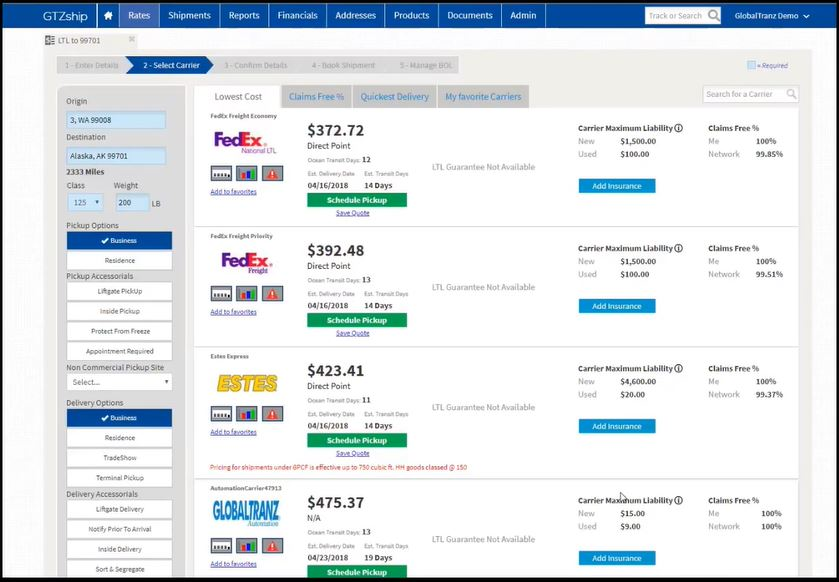
That sounds like a thin layer until you watch a shipping manager work. A pallet of machine parts might need liftgate service, a hard delivery appointment and protection from a weather system forming three states away. Rates vary by carrier, lane, equipment, season and urgency. Documents travel separately from trucks. One late pickup can turn a customer’s production line into a very expensive waiting room.
Its transportation management system puts those pieces in one control tower. A shipper can compare rates, tender a load, see pickup and delivery status, receive alerts and inspect performance data. GlobalTranz layers on managed transportation for companies that want a team to run part or all of the function. It also sells truckload, LTL, expedited, intermodal, cross-border, project, international, warehousing, final-mile and white-glove services. The product is software; the service is getting a human to answer when the software reports bad news.
The other product was distribution
Software alone did not make GlobalTranz large. Its independent-agent network did something equally important: it put entrepreneurial salespeople close to customers while headquarters handled carrier relationships, technology, accounts receivable, accounts payable, insurance and legal support. An agent could focus on winning and serving accounts instead of rebuilding a brokerage’s plumbing.
This created a practical flywheel. More agents brought more shippers. More shipment volume improved carrier relationships and produced more operating data. Better rates, tools and support made the platform more appealing to the next agent. By 2008, the company said it had added 30 franchisees or agents in ten months. Today, GlobalTranz remains the agent-heavy brand within a wider group whose other channels include direct sales and franchises.
The approach worked especially well for small and mid-sized shippers. A manufacturer moving a few dozen loads cannot negotiate like a national retailer, maintain integrations with dozens of carriers or staff an around-the-clock control tower. A broker aggregates that demand. In return, the customer gives up some direct control and pays through a brokerage margin or service fee. The model earns its keep when access, buying power and fewer mistakes are worth more than the margin.
The $530 million round trip
GlobalTranz’s financial history is almost as busy as a spot-market load board. It raised a reported $10 million Series A in 2011, $3 million in 2013 and $40 million from Providence Equity Partners and Susquehanna Growth Equity in 2014. The company’s appetite changed after Bob Farrell arrived as chief executive in 2016. He later said the business was not ready to acquire at scale, so management reorganized it to resemble a software company, installed product managers and agile methods, and aimed for $30 million in EBITDA before shopping for targets.
It reached that mark in 2018. Along the way, GlobalTranz bought brokers and managed-transportation specialists including Global Freight Source, Logistics Planning Services, Worthington Logistics Solutions, Apex Logistics, AJR Transportation, SynchOne and AFN Logistics. Circle 8 became its ninth acquisition since January 2017. The roll-up added customers, talent, geography and modes faster than organic hiring could.
The Jordan Company bought GlobalTranz for about $400 million in June 2018. Less than a year later, Providence agreed to buy it back for a reported $930 million after the company had more than doubled EBITDA. The $530 million gap is not a clean measure of value created - deal structures, debt and expectations matter - but it captures the period’s velocity. Freight brokerage had become a private-equity assembly line, and GlobalTranz was both a buyer and the prize.
Who calls when the pallet goes sideways?
GlobalTranz serves manufacturers, retailers, ecommerce merchants, food and beverage companies, construction firms and industrial suppliers. Its sweet spot is a business with recurring freight, enough complexity to hate spreadsheets, and not enough scale or appetite to build a carrier network and operations team alone. The wider corporate family markets enormous numbers - more than 100,000 customers and tens of millions of annual shipments - but those figures span multiple brands, not GlobalTranz by itself.
Competitors range from C.H. Robinson and Total Quality Logistics to Uber Freight, RXO, Echo, Redwood and J.B. Hunt 360. A shipper can also contract directly with carriers and buy a standalone TMS. GlobalTranz’s difference is the bundle: brokerage capacity, an agent-led sales channel, managed services and software inside a group that also has parcel reach. That combination is less glamorous than a pure software pitch and more useful when a trailer misses its appointment.
In 2021, GlobalTranz merged with Worldwide Express, pairing its truckload and LTL strength with Worldwide’s parcel business. GlobalTranz, Worldwide Express and Unishippers became the principal public brands under WWEX Group in 2023, sharing infrastructure and the SpeedShip platform. In June 2026, WWEX Group completed a merger with Auctane, the company behind ShipStation and Stamps.com. The new parent is ShipStation Global. GlobalTranz survives as a freight brand inside a much broader shipping stack.
Four moves worth stealing
Begin at the awkward edge
GlobalTranz found sellers whose items had just outgrown parcel. Look for the moment a familiar tool stops working and the customer becomes motivated.
Fix cash flow before scale
Prepayment let the founders purchase transportation without financing every load. Design the transaction so growth does not starve the company.
Give distributors infrastructure
Agents brought relationships; the platform supplied rates, billing, compliance and support. Make partners better at the work they already know how to sell.
Automate routine, staff exceptions
Quoting and tracking belong in software. Damaged freight and missed appointments demand judgment. Use people where variability is expensive.
There is also a cultural lesson hiding in the alumni list. Early GlobalTranz employees went on to build project44, MyCarrier, Stream Logistics, Convey and other logistics businesses. Andrew Leto described the internal habit as finding a customer problem and building technology around it quickly. A company that teaches people to spot gaps may eventually train its own future competitors. That is an excellent problem to have, right until recruiting day.
When this playbook does not work
- Shipment volume is too thin to create buying leverage or useful network density.
- The freight is so specialized that a deep niche operator beats a broad marketplace.
- Margins cannot cover claims, credit exposure and the people required to manage exceptions.
- Agents own the customer relationship but the platform gives them no durable reason to stay.
- Technology becomes decoration instead of changing cycle time, accuracy or service recovery.
The company’s own history shows the caveat. Airfreight failed first because the market changed. The response was not motivational theater; it was a new mode, a new customer-acquisition channel and a new cash-flow design. Later, software made the work faster, agents made distribution wider, acquisitions made the service catalog broader and mergers made the network larger. Each layer solved the constraint created by the one before it.
That is the durable GlobalTranz idea. Do not confuse the physical asset with the valuable one. The trucks mattered, but other companies owned them. GlobalTranz accumulated the searchable rates, customer demand, carrier relationships, operating data and people who knew what to do when the neat digital path broke. In a market full of steel, the company made the map valuable.
Keep moving
Explore the company’s current freight tools, its service catalog and the group now surrounding it.