Twenty-five years elapsed between ETQ’s founding and its first institutional investment. In the life of a software business, that is enough time for several generations of fashionable advice to come and go. Glenn McCarty, its co-founder and then CEO, arrived at the 2017 deal with TCV having built a company around work that tends to attract attention precisely when it goes wrong: quality, compliance, and the movement of information through an organization.
The interval gives his career its shape. ETQ began in 1992. Before the investment announcement, there were customers to understand, processes to automate, and decisions to make about how a business should recognize its own mistakes. McCarty’s public appearances return to those practical questions. The appeal of his story lies in the distance between a modest-sounding problem and the years of work it can support.
ETQ’s founding to its first institutional investment.
The auditor behind the software
McCarty came from auditing. ETQ’s founding history reaches back to former lead auditors at Underwriters Laboratories, and Mohammed Nobani is also identified as a founder. That origin supplies a useful way into the company. An auditor examines how an organization’s stated procedures compare with the work that actually happens. Software built for that world has to contend with both the procedure and the person trying to follow it.
A quality system has an unromantic vocabulary: records, documents, complaints, corrective actions. Each word contains a handoff. Someone records an event; someone else evaluates it; a third person may need to approve what happens next. McCarty built his career in this territory. The paperwork may be dull, but the consequences of losing track of it have a way of becoming interesting to everyone.
His 2010 presentation, Managing Your Risk Has Its Rewards, addressed a specific difficulty: organizations could record events without consistently judging their importance. Individual assessments could be subjective. Risk assessment offered a method for evaluating the impact and deciding what required attention. The underlying concern was less about accumulating information than about giving people a workable basis for action.
Which problem goes first?
At the National Safety Council’s 2010 Congress & Expo, McCarty was scheduled to explain how risk assessment and mitigation could make consequential events more visible inside a quality management system. His proposed toolkit included a quantitative risk matrix. It was a practical teaching brief, concerned with how organizations could identify critical events and reduce the chance of their recurrence.
The appeal is easy to grasp. Imagine a queue of operational problems, all demanding a response. Arrival order gives you one way to work through it. An assessment of consequences gives you another. That example illustrates the management question McCarty was discussing, rather than a particular customer’s experience. A queue can be orderly and still direct attention poorly.
- 01Capture
Record the event - 02Assess
Evaluate the risk - 03Act
Assign a response - 04Review
Check the result
Conceptual illustration of risk-based quality management; not a product screen or measured outcome.
This is where McCarty’s professional origin becomes revealing. An auditor’s questions travel comfortably into software design: where is the record, how was the decision reached, and what happens after it? His conference work concerned making those questions manageable within an organization, rather than leaving every judgment to an isolated individual.
A product with a return address
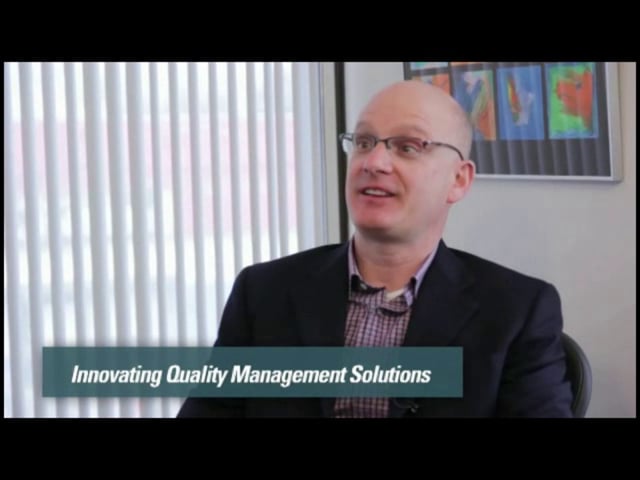
In his 2015 interview about ETQ, McCarty emphasized listening to customers and watching market needs. Reliance, the company’s web-based platform, routed information through workflows using business rules and brought records into a central repository. The machinery had a human purpose: people needed visibility into the process, and they needed to be able to trace what had happened.
He discussed supplier information, incoming goods, inspection, and corrective action. These are places where a business crosses departmental boundaries. A supplier’s problem can become a purchasing problem, then a production problem, then a customer’s problem. A useful system has to follow the information across those boundaries. McCarty’s explanation of the product stayed close to that operational journey.
In a separate 2014 interview, he described development guided by customer and market feedback, with new versions intended to match changing needs. Read alongside his later remarks, it suggests a consistent public product philosophy: the people using the system should have a continuing influence on what it becomes. Software for established processes still needs to change when those processes do.
The meeting that happened twenty times
By 2016, ETQ was announcing its twentieth annual user conference. Scheduled for Nashville’s Gaylord Opryland Resort, the gathering combined a three-day conference with two further days of Reliance training. The format gave customers time both to discuss the work and to learn how to do it with the software.
McCarty described the conference as a recurring opportunity to bring peers together, hear from customers, and turn those insights into product improvements. Here was a concrete expression of the feedback philosophy he described in interviews. It had dates, a venue, and a training schedule. Listening to customers had made it onto the calendar.
The distinction matters in a founder’s story. A commitment can remain pleasantly abstract for years. A repeated gathering creates occasions when the company must meet people who depend on its decisions. For McCarty’s ETQ, the conference was also a place where the product’s users could encounter one another, compare approaches, and make their working problems discussable.
Growing beyond the company’s walls
At the 2015 user gathering, McCarty presented a vision for a shared compliance platform and reported a 25 percent compound annual growth rate. He also discussed cloud, mobile, and analytics capabilities. The ambition was to accommodate connected processes as well as changing technology. ETQ offered Reliance for enterprises and a smaller-business offering under the Verse name.
Partnerships added another route to that ambition. In May 2017, ETQ and RegScan announced a connection that would bring regulatory updates, audit protocols, and links to a library of regulations into the platform. RegScan described coverage spanning more than 140 jurisdictions. The arrangement joined the place people performed compliance work with content that helped inform it.
The commercial case needed its own language, too. In 2014, ETQ announced a commissioned Forrester Consulting study reporting a three-year, risk-adjusted return on investment of 77 percent. The analysis drew on interviews with four customers. That figure was a modeled study result, rather than a promise to every buyer. Its place in McCarty’s story is the effort to explain quality software in terms a business could evaluate financially.
The investor arrived at twenty-five
On August 17, 2017, ETQ announced its acquisition by TCV. The terms were undisclosed. The company described the transaction as its first institutional investment since 1992, with plans to accelerate innovation, deepen product development, and expand internationally. The anniversary supplied a memorable number; the announcement supplied a change in the resources available to the business.
McCarty said ETQ had considered multiple suitors and wanted a partner aligned with its plans, bringing experience, flexibility, and resources. TCV’s Kapil Venkatachalam pointed to the company’s adaptable offering, customer focus, and execution. It was a meeting between an established software operation and an investor looking at its next stage, after a long period without institutional backing.
“We know standing still is not an option.”
Glenn McCarty, ETQ’s 25th-anniversary announcement, 2017
That anniversary remark fits the tension in the timeline. Twenty-five years can sound like a story about endurance. McCarty’s statement placed the emphasis on movement. By then, ETQ was marking its history with a brand video while continuing to describe the same broad mission: make the processes behind quality and compliance easier for businesses to manage.
A founder’s chapter, in its proper place
The next transition is clear in the dates. In December 2018, ETQ announced Robert Gremley as CEO, alongside new finance, marketing, and people-operations leaders. The business had moved its headquarters to Burlington, Massachusetts, and described a workforce exceeding 300 and a customer base of more than 500 global organizations. McCarty’s founder-led chapter belonged to an earlier stage of the organization.
In April 2022, Hexagon completed its acquisition of ETQ for $1.2 billion on a cash- and debt-free basis. That later company transaction followed McCarty’s CEO tenure. It provides a marker of what the business became under subsequent leadership; it cannot, by itself, tell us anything about his personal proceeds or wealth.
The product has continued into another corporate chapter as Octave Reliance, formerly ETQ Reliance. Its current description still centers on configurable quality workflows, document control, audits, training, and supplier quality. Ownership and branding have changed over the years. The practical work remains recognizable.
McCarty’s part in that history is substantial enough without borrowing someone else’s chapter. He co-founded a business, spoke publicly about the decisions its software was meant to improve, built customer feedback into its development story, and led it to its first institutional partner a quarter-century later. The useful ending returns to his starting territory: an organization has a problem, a record of the problem, and a decision to make. Someone has to help connect the three.