A broken storefront window creates two jobs. Someone must replace the glass. Someone must also work out which glass, in what size, with which safety requirements, while the owner wonders whether the shop can open. Glass Doctor has a wonderfully unglamorous answer to that second job: do the measuring before anything breaks.
- One brand serves homes, vehicles and businesses through locally owned franchises.
- Its commercial measurement program prepares for a repair before the emergency.
- New owners choose auto glass or home/business glass, with different tools and economics.
In its Advance Measurement System, a technician surveys a business, records pane dimensions and glass types, notes safety requirements, and numbers the panes on a diagram. Later, the customer can identify the broken pane by number. If matching glass is in stock, replacement can happen without an intermediate board-up. The humble diagram has removed a round of detective work.
The pane before the pain
This is a useful way to understand Glass Doctor. The material is familiar. The coordination is the product people discover they need. A business owner wants a secure entrance. A driver wants a usable car. A homeowner wants a shower enclosure that fits. Their common purchase is competent work with fewer loose ends.
The company began with one Seattle shop in 1962, started franchising in 1977, and joined The Dwyer Group in 1998, when its headquarters moved to Waco, Texas. That parent is now Neighborly. Local franchisees own and operate the shops; the larger organization supplies brand standards, training and operational support.
That arrangement puts Glass Doctor between an independent neighborhood glazier and a national service brand. It can offer a familiar name across the United States and Canada while leaving the local business in local hands. Service availability still depends on the franchise. A national sign cannot promise that every shop has every capability.
Three customers. Different clocks.
Residential work includes window glass, mirrors, tabletops, sliding-door glass and custom shower enclosures. Some jobs follow an accident; others begin with a renovation. A foggy double-pane window illustrates the diagnostic side: moisture between panes can indicate a failed seal. The visible fog is a clue to a problem inside the glazing unit.
Commercial customers include business owners and property managers. Storefronts, glass doors and interior glass need repair or replacement, sometimes outside working hours. Participating franchises offer emergency securing and board-up services. Advance measurement adds preparation to that response, but its one-visit possibility depends on having the right glass available.
- 01Survey + number
- 02Identify the pane
- 03Check the stock
- 04Replace the glass
If matching glass is unavailable, securing the opening comes first. Diagram explains the process; it does not promise a response time.
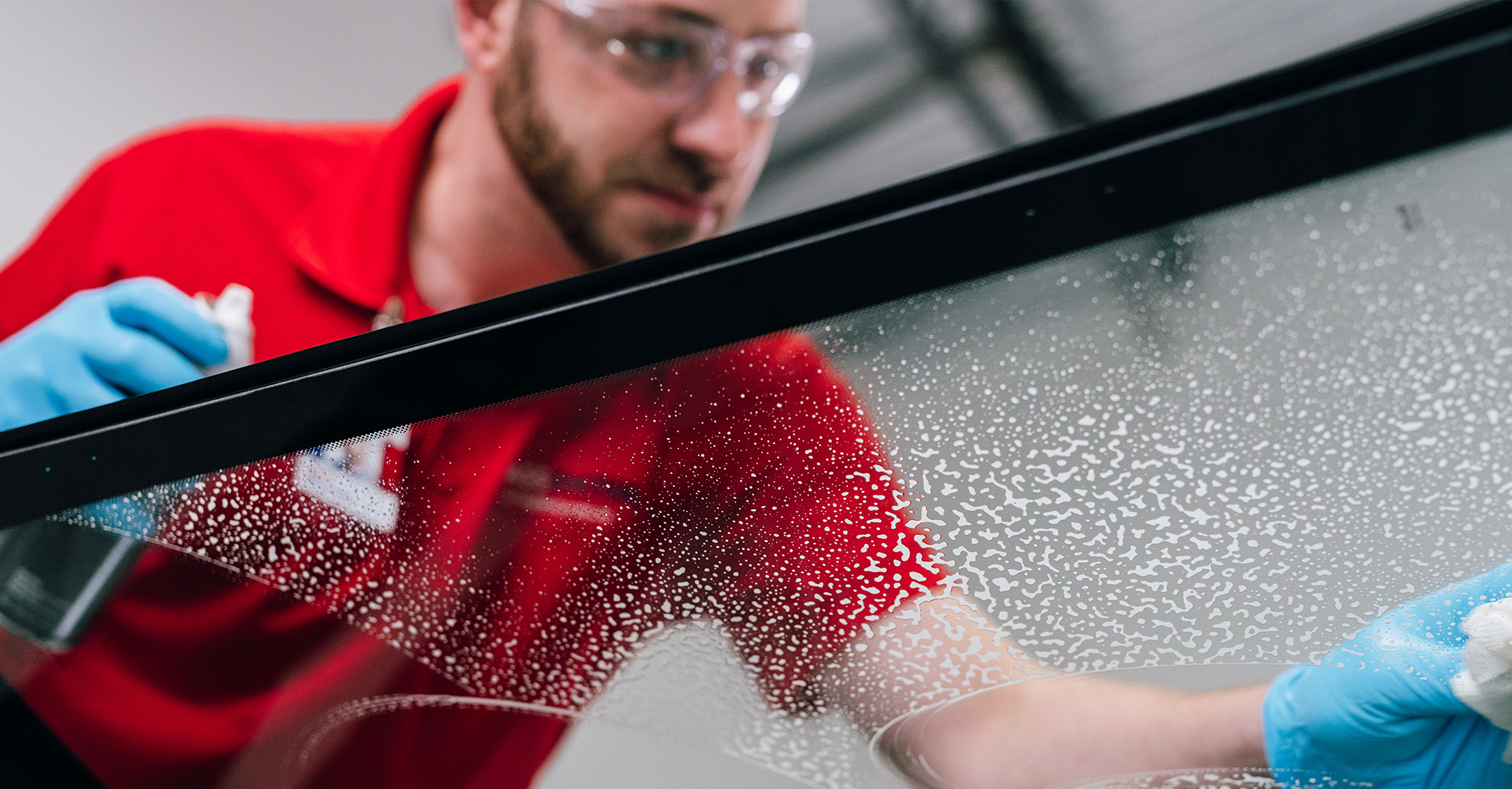
Auto customers bring a different complication. A windshield may sit in front of a camera used by driver-assistance systems. Glass Doctor advertises a sequence of pre-scan, replacement, calibration and post-scan. The work can involve fixed targets or driving-based calibration. Customers should confirm the local shop's capabilities for their particular vehicle.
Safelite also offers windshield replacement and camera recalibration. Glass Doctor's distinction is the breadth of the overall brand: the same name appears on auto work, residential glass and commercial services. That makes it a practical candidate for customers with several kinds of glass work, although the jobs may involve different local operations.
The promise has parts
Glass Doctor's slogan is cheerfully literal: “We Fix Your Panes!” Its Windshield Protection Plan deserves a less playful reading. Included with eligible replacements, it provides 12 months of coverage, unlimited chip repairs and the glass cost of one qualifying replacement. Normal road hazards qualify; collisions and storm damage are among the exclusions.
The included replacement coverage excludes labor, molding, clips, urethane and ADAS calibration. Optional upgrades can cover installation and calibration. Work must meet the plan's conditions and take place in-shop at a participating location. For a customer comparing estimates, the distinction between replacement glass and an installed, calibrated windshield matters.
Neighborly's shared values emphasize respect, integrity, customer focus and having fun. Those are ambitions for daily behavior. Glass Doctor also participates in the Done Right Promise, subject to its terms. The customer still benefits from asking who handles a concern locally and what the written coverage actually includes.
One franchise becomes two doors
In April 2020, Glass Doctor changed its franchise offering. One model covering home, business and auto became two distinct opportunities: home/business and auto. Its franchise guide describes the reasoning as less complexity, streamlined training and more focused effort. That is a revealing admission about the work: sharing a material does not make every job the same business.
Charlotte Allgood's family offers a complementary example. Her late husband already had an auto glass business when they joined Glass Doctor in 2010. In a published owner interview, she explains that the attraction was the opportunity to become a full-service shop. Her daughters subsequently became involved. This is one family's account, rather than a typical-outcome claim.
“This was giving us the opportunity to be a full service shop.”Charlotte Allgood, Glass Doctor of Dothan, on joining the franchise
The price of a familiar name
The current franchise investment page lists estimated startup costs of $154,650-$311,850 for home/business and $157,150-$326,850 for auto, referencing the 2026 disclosure document. The franchising site says those ranges include a $59,900 initial franchise fee. Ongoing licensing fees are listed at 4%-7% of annual gross sales.
In return, owners gain training, coaching, marketing resources and access to ProTradeNet supplier purchasing arrangements. Trade experience is not required of the owner; skilled employees still have to do the work. The model depends on recruiting those people, winning local customers and managing costs after the franchise fees.
The lesson another service business can copy is concrete: collect information while the customer has time, then make it useful when they do not. Glass Doctor's numbered panes express that idea neatly. A drawing cannot prevent the break. It can make the next conversation considerably shorter.