The awkward moment in a video appointment comes when the doctor needs something the camera cannot supply. A blood sample, for instance. The conversation has traveled across the internet in an instant. Now the patient has to find a laboratory, arrange a visit, and get there. A service built around staying home suddenly hands out homework that requires leaving it.
- The job: collect diagnostic samples at home or work, then deliver them to a laboratory.
- The customers: patients booking directly and healthcare organizations coordinating care.
- The catch: collection and testing are separate services, with separate charges.
Getlabs makes a business out of that unfinished assignment. A mobile phlebotomist visits the patient, collects the ordered specimens, and gets them to the laboratory. The distinction matters: Getlabs supplies the collection infrastructure. Companies such as Labcorp and Quest supply the testing. An ordinary blood draw becomes a lesson in how much effort sits between a medical recommendation and its completion.
A house call with a different passenger
Founded by Kyle Michelson in 2018, Getlabs started with a proposition that is easy to understand from a kitchen table: let the trained professional make the trip. In its early expansion, the company used existing laboratories rather than building another testing network. That decision gave its service a specific place in the market, between the clinician ordering a test and the laboratory equipped to analyze it.
For a patient, the sequence is straightforward. Choose an available appointment, provide the lab order, and meet the specialist at home or the office. Getlabs transports the specimens; results come through the laboratory or provider. A missing copy of an order need not end the booking process: the company offers to request it from the doctor's office.

The customer is buying a change in who travels. That can matter to someone juggling work, caregiving, or repeated appointments. It can also matter to a provider whose treatment decisions depend on a test actually happening. Convenience has two beneficiaries here: the person surrendering a sample and the person waiting for useful information.
The bill has two parts
There is a small accounting trap in the phrase “at-home lab testing.” Getlabs charges for the visit and collection. The laboratory separately charges for analyzing the sample. Its current consumer website says the visit price depends on date and location, and describes the collection charge as an out-of-pocket convenience fee. Laboratory insurance arrangements do not automatically settle the collection bill.
One appointment can involve two distinct charges.
Specific partnerships can have their own terms. Genova Diagnostics, for example, lists a $90 draw fee in its Getlabs booking explanation. That is a program example, not a universal Getlabs price. Enterprise partners can subsidize collection or pass the charge to patients. The business model accommodates both a consumer buying back an inconvenient morning and an organization paying to complete a clinical workflow.
One workforce. Three front doors.
The enterprise product offers three ways in. Getlabs Portal gives care teams a dashboard for scheduling and tracking visits. Getlabs API lets a healthcare company put the service inside its own software. Getlabs Link supplies a co-branded page where patients schedule themselves. The same physical collection can begin with a staff member, an embedded workflow, or a shared URL.
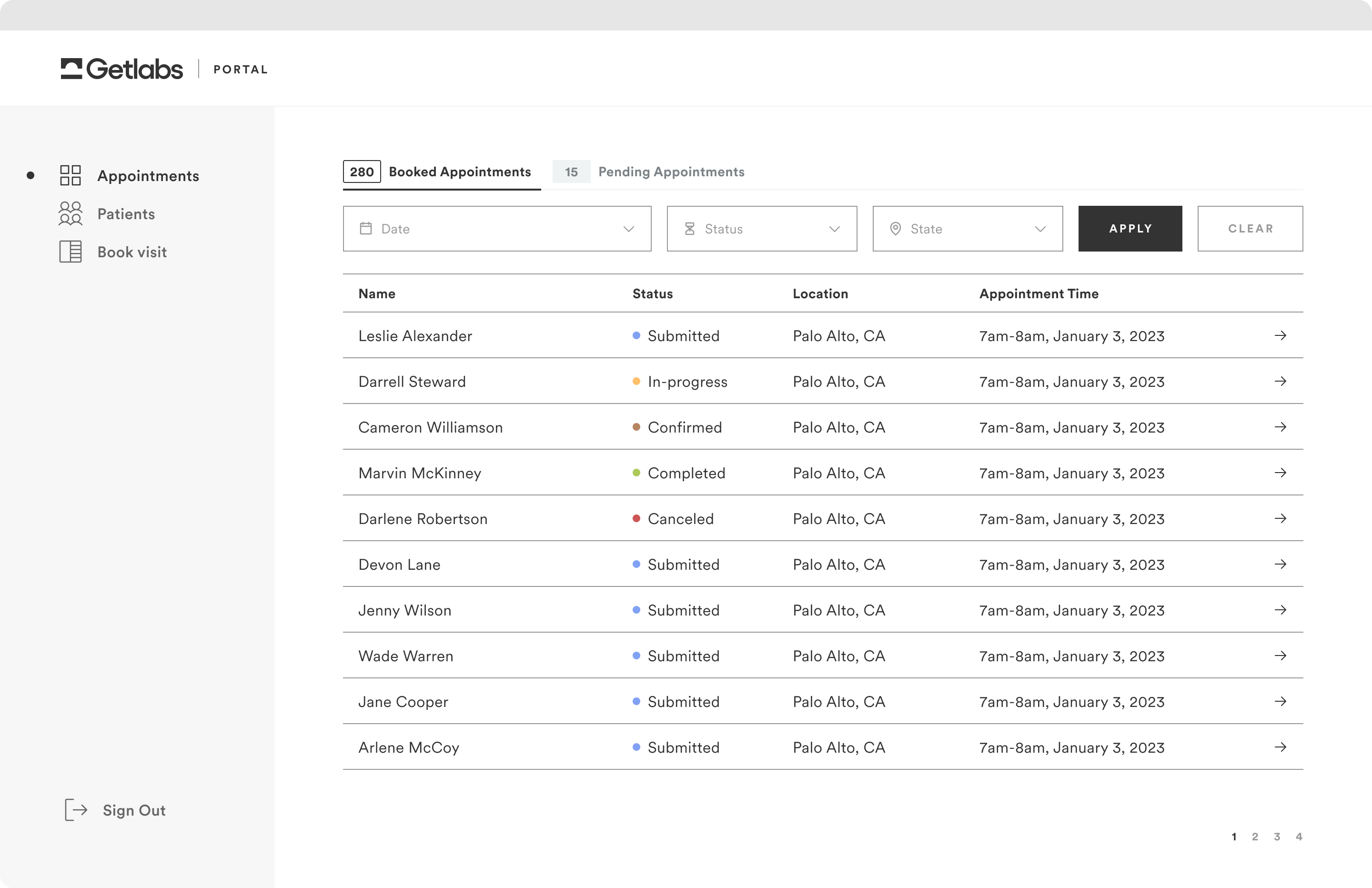
There is a useful product lesson in those choices. A practice should not need an engineering project simply to try home collections. A larger platform may want precisely that deeper integration. Getlabs provides several entrances to the same operation, letting the customer's existing habits determine how the service is booked.
- 01Clinician orders
- 02Getlabs collects
- 03Laboratory tests
- 04Provider reviews
The operation underneath remains stubbornly physical. Getlabs says it vets, hires, and trains W-2 phlebotomists. Its platform handles dispatching, routing, and clinical checklists. The published company values connect staff happiness with patient experience and favor daily incremental improvement. In this business, software quality and the conduct of a stranger entering someone's home belong in the same conversation.
The laboratory is also an ally
In February 2022, Getlabs announced a $20 million Series A led by Emerson Collective and Minderoo Foundation, alongside its API launch. Labcorp participated, then announced Getlabs for Labcorp that April. A major diagnostic company could invest in a collection service because the two businesses had complementary jobs. Getlabs could help a sample reach the laboratory that would do the analysis.
Other partnerships show the range of that role. Nice Healthcare announced a collaboration in 2023 for its in-home and virtual primary care patients. Inocras followed in 2024, adding collection to a whole-genome testing journey for cancer and rare diseases. The clinical questions differ; both arrangements need a reliable path from an order to a specimen.
Getlabs occupies a competitive market. Patients can visit laboratory collection centers; organizations can use local mobile providers or networks such as ExamOne. The practical comparison concerns coverage, available appointments, eligible tests, integration, and price. A national proposition still has to work at one particular address. Getlabs itself says enterprise services vary by region.
Why Function wanted the person at the door
Claire Hough became CEO in June 2025 after leading Getlabs' product and technology work. On April 8, 2026, Function announced its acquisition of Getlabs, saying the existing provider and partner network would keep operating. Function described an option for members to have blood drawn where they are, with AI-assisted routing intended to improve scheduling and punctuality.


“That mission doesn’t change. It scales.”Claire Hough, on joining Function, April 2026
A subsequent EHE Health partnership made the idea concrete. Announced in May 2026, it offered select executive members collection before their preventive exam, at home or work, with specimens sent to Labcorp. The point was to have results ready for the conversation. Getlabs' most transferable idea is that sequence: identify the necessary step people postpone, make it easier to finish, and let the next appointment begin with something useful already done.