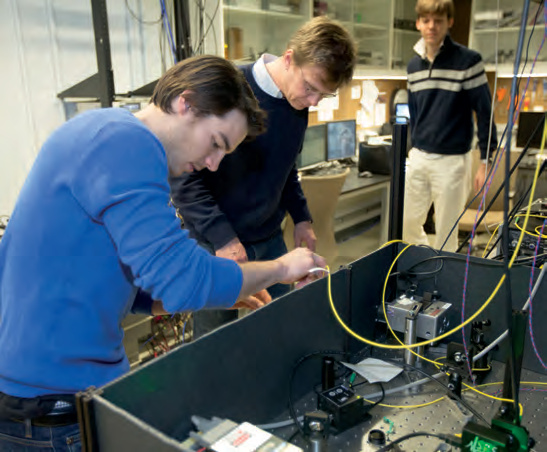
In a Harvard laboratory photograph from 2013, Georg Kucsko is bent over a workbench. Professor Mikhail Lukin stands beside him; another young researcher, Peter Maurer, is farther back. There are cables, instruments and the particular concentration of people trying to persuade nature to give a clear answer. The picture belongs to an account of quantum work in diamond. More than a decade later, Kucsko would be known as a co-founder of Suno, a company whose software can turn a few words into a song. The leap sounds improbable until one notices what stayed with him: a long interest in turning faint, complicated signals into something people can use.
The lab did not produce a melody. It studied properties of tiny defects in diamond, places where the otherwise orderly material behaves differently. A paper Kucsko led in 2013 described using those defects as highly precise temperature sensors. Another paper, which he coauthored in 2017, reported an unusual form of repeating order called a discrete time crystal in a diamond system. Both were group achievements. They also demanded patience with a stubborn medium. A useful result arrives only after an experiment has been designed, measured, argued over and tested again.
A diamond with a message inside
Kucsko arrived at Harvard after a research project in ETH Zurich's Quantum Device Lab during the winter of 2008 and 2009. At Harvard he joined Lukin's group and completed a physics doctorate in 2016. His dissertation title, Coupled Spins in Diamond: From Quantum Control to Metrology and Many-Body Physics, reads like an inventory of difficult things. The plain-language version is that diamond gave the lab a setting in which to probe and control quantum behavior. The work asked what a remarkably small system could reveal when its signal was treated with care.
A 2013 photograph makes the research visible. In it, Kucsko and colleagues are pictured working on equipment, while a nearby graphic shows a tiny sensor reporting conditions around it. The apparatus is ungainly; the ambition is neat. Read a physical state too subtle for ordinary tools. Make a measurement reliable enough that someone else can build on it.
That same insistence appears in his later career, though the signals change. A recording of an earnings call is much louder than a quantum experiment, but its meaning can be just as hard for a machine to catch. A generated song is louder still. The task becomes deciding whether the model heard the user's intent and whether the result is worth keeping. These are different sciences and different kinds of judgment. The through-line is an experimentalist's habit of asking what the output actually says.
He also built a place to argue in the margins
A small project from Kucsko's graduate years reveals something that the lab publications alone do not. With fellow physics student Erik Bauch, he made Open Rev., a tool that let researchers and students attach questions, sketches and comments to passages in papers. Harvard's teaching initiative funded work on it, and physics classes tried it. By 2014, the platform had 400 users and more than 1,000 public comments. The project won a second-place prize at an education innovation pitch competition.
The premise was almost comically modest beside quantum computing: a PDF should be discussable. Yet a scientific paper can be a sealed room for anyone outside the authors' immediate circle. Open Rev. put a doorway in the margin. A student could point to a formula; another could reply to that exact spot. Images and mathematical notation could join the conversation. The tool did not make a difficult paper easy. It made the work of understanding it more social.
The founders' hope was that archiving discussion could increase scientific collaboration. The platform had practical limits. Its two doctoral-student founders later struggled to find time for promotion and further development. But that short-lived experiment adds a distinctive note to his biography. Well before Suno, he was interested in the distance between a specialist's work and the person who wanted to take part.
“You start to need those same types of technologies.”Georg Kucsko on finding meaning in large datasets
The machine learns to listen
After Harvard came Kensho Technologies, the Cambridge company that built machine learning tools for financial information. Kucsko led its machine learning research and development. One challenge was speech: turn recordings into text accurately enough that people could search, study and act on them. An earnings call offers a model a nasty mixture of names, specialist vocabulary, accents and poor audio. A missed word may change what an analyst thinks was said.
At MIT Sloan, where he and future Suno co-founder Mikey Shulman taught a class, Kucsko described why language tools mattered to finance. A researcher might need to sift a volume of information “that no single human being could ever read.” The point was scale, but also access. The machine could make a recording searchable rather than leaving it locked in an hour of audio. Kensho's work appeared in a 2021 speech research paper on a 5,000-hour collection of transcribed financial recordings; Kucsko and several future Suno colleagues were among its authors.
His public code from this period is less glamorous than a finished song, which is precisely why it belongs in the story. A speech decoder helps translate a model's uncertain sound predictions into words. Kucsko's GitHub and Python package profiles show work on such tooling. It is plumbing, but useful plumbing. Someone has to make a research result behave when it leaves the lab and meets an actual recording.
Then the audio began making music
In 2022, Kucsko joined Shulman, Martin Camacho and Keenan Freyberg to start Suno. The four had worked at Kensho. Shulman and Kucsko were close friends, and the founders had already spent years dealing with difficult audio. They did not begin with the polished song interface that later drew attention. Their early public release was Bark, an open model able to generate audio from text. Kucsko shared its release on LinkedIn.
Bark gave users room to experiment. In a 2025 interview on The Lantern, Kucsko described how people pushed the model toward humming, whistling, singing and music. Those experiments helped steer the team toward a music product. The episode is a useful corrective to the tidy origin story in which a founder writes down an idea and then builds it exactly as imagined. Here, the people playing with a rougher tool helped show what it might become.
Kucsko also spoke in that interview about the technical shape of audio research. Text models work with sequences; image models have developed other ways to make and refine pictures. Audio sits between those areas, drawing techniques from both. A song asks the model to hold more than a phrase in mind. It has to manage timing, structure, timbre, voice and the listener's expectation that a chorus will somehow remember being a chorus. Scale helps, but it does not excuse a dull hook.
Suno emerged publicly in late 2023 with a simple invitation: describe a song and hear what happens. The simplicity of the invitation is a designed feature, not a description of the research behind it. Kucsko's role as CTO puts him at the technical center of a company building those models. It does not make him the author of every product decision or every song a user makes. The small team, the users and the changing model all matter to what comes out of the speakers.
A song prompt is a request. The model's answer still has to survive a human ear.The gap between generation and judgment
A larger room, a sharper debate
The room around Suno has grown, and so has the argument about AI music. Artists and labels have pressed questions about training, permission, credit and payment. The company has answered with partnerships and changes to its product rules. In September 2026 it introduced a v6 family of models developed with music industry partners, including Warner Music Group, BMG and Believe. The announcement described more ways to edit a section, work from audio or visual inputs, and control a result. It was a company announcement from Shulman; it is part of the setting in which Kucsko's research now operates.
There is a practical question beneath the debate. If a person uses a tool to make music, how much control should they have after the first result? Suno's newer features suggest an answer in the form of revisions, arrangement and more precise instructions. The first surprise may get someone through the door. Staying there requires being able to say, with some confidence, what happens next. That is as much an interface problem as a model problem.
Kucsko's public biography gives no neat manifesto for all of this. It offers a more interesting accumulation: an ETH research project, a Harvard lab bench, a shared annotation experiment, speech research with colleagues, an open audio model and a music company still changing its tools. His Medium bio once compressed the range into three labels: “Machine Learner | Rock Climber | Quantum Mechanic.” The line has a little dry humor in it. One profession might have sufficed for a standard business profile; three are more accurate here.
Look again at that Harvard photograph. Kucsko is close to the apparatus, hands occupied, with other researchers in the frame. It is a good image for his career because it resists the lone-inventor version of the story. The diamond experiment took a lab. The speech work took collaborators. Suno took co-founders, researchers and listeners who did something unexpected with Bark. What Kucsko carried through those settings was the patience to work on the signal, and the curiosity to see what other people might hear in it.