The first two blues songs were passable. A visiting reporter had asked Suno's new music model for an acoustic song about a sad artificial intelligence, and the machine had obliged without quite making anyone forget the machinery. Then Keenan Freyberg, one of the company's four founders, suggested a single amendment to the prompt: “Mississippi.” The next attempt, called “Soul of the Machine,” unsettled the room. It was the kind of small, practical edit that musicians make every day - a place name, a texture, a particular feeling. Here, it came from a man showing a computer how to make a song.
The episode took place in early 2024, during a demonstration of Suno's third music model. The finished track later went viral and drew an argument that a one-word prompt could never contain: whose music had taught the model to sing the blues, and who should benefit when it did? Freyberg's part in the scene was brief. His suggestion was also revealing. He understood that a song depends on particulars. A genre label alone is a filing cabinet; a place name can open a door.
That instinct had roots far from the Cambridge office where Suno was built. Freyberg grew up in Rome, Georgia, and described a father with an eclectic collection of CDs. He rowed and played tennis at Darlington School, then studied international affairs at George Washington University. Rowing remained serious enough that his graduating crew received a separate commencement ceremony in May 2016. The regular ceremony conflicted with the Eastern Sprints on Lake Quinsigamond. Some students miss graduation for a flight. Freyberg and five crewmates missed it for a race.
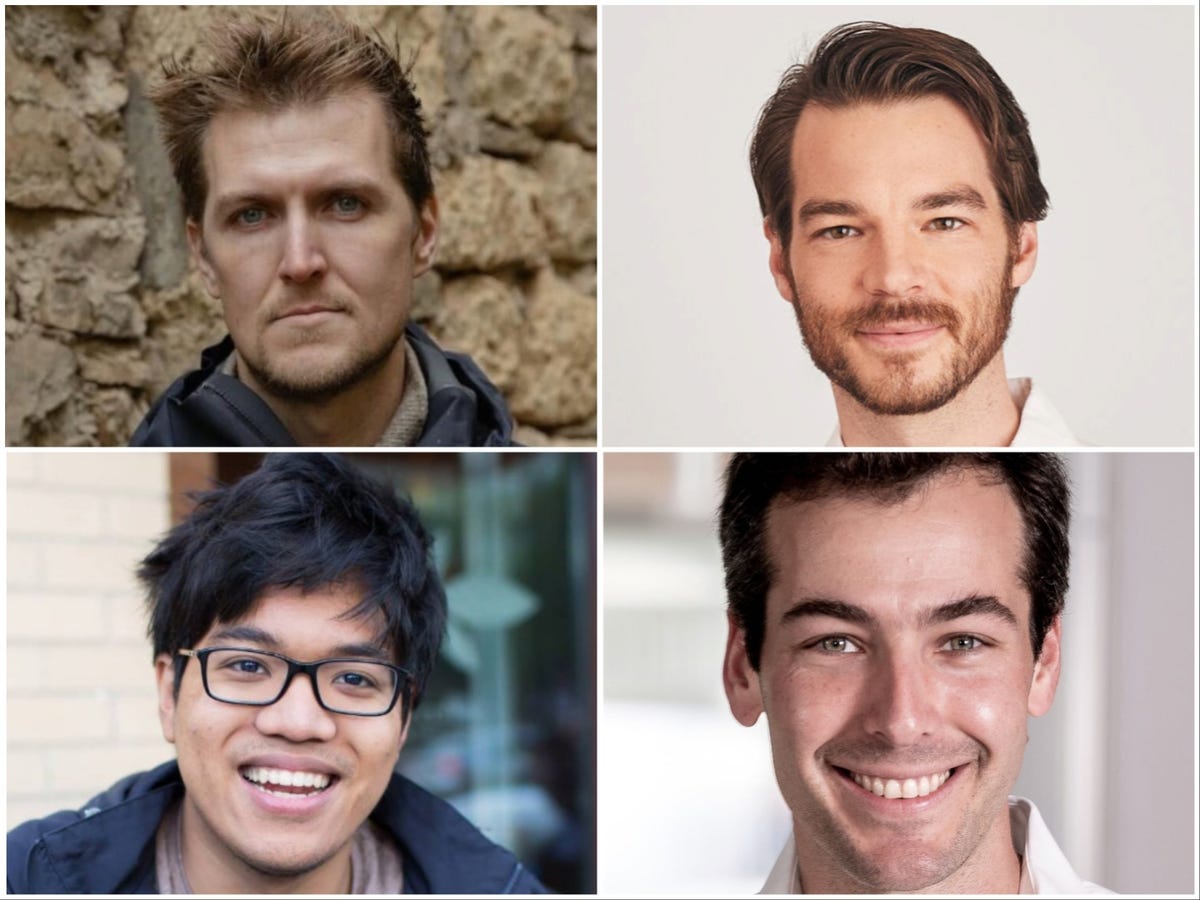
The founding team in 2024: Keenan Freyberg, Georg Kucsko, Martin Camacho and Mikey Shulman. The four portraits were published in 2024.
01 / The crew before the chorus
A rowing shell rewards a particular sort of collaboration. It moves when people pull together, and it resists anyone eager to put on a solo performance. That fact should not be made into a neat parable for startup life, but the team around Freyberg was unusually well acquainted before Suno. He, Mikey Shulman, Georg Kucsko and Martin Camacho worked at Kensho, the Cambridge company that applied machine learning to finance. Their work included software for corporate earnings calls, an unlikely prelude to AI-generated pop.
The connection was sound. Earnings calls are hours of speech, voices, timing and transcription. At Kensho, the future founders worked around audio as data. They also played music together, with jam sessions in Camacho's basement. By late 2021, they knew two things: they liked working together, and audio offered more to explore than financial meetings. They left Kensho and founded Suno in 2022. The name means “listen” in Hindi. For a company eventually accused of making too much music, it began with a command to pay attention.
Each stage kept audio at the center while changing who could use the work and what they could make with it.
Freyberg's role at Kensho was in strategic initiatives, a title that gives few cinematic clues. At Suno he became chief operating officer. The technical work belonged to a team, and the public record offers no clean ledger of who wrote which line of code. What it does show is Freyberg making the transition legible: sharing early audio demos, explaining why vocals mattered, discussing what users might want to change in a generated track. The work of a new product is part engineering, part helping other people understand what it is for.
02 / A model learns to sing
Suno's first widely noticed release was Bark, a generative audio model made available to developers in 2023. It could produce speech and other sounds. The team's attention then moved toward music, and an early model called Chirp appeared in a Discord beta. Freyberg's own announcement presented the new work as an extension of Bark's less speech-like possibilities: music and sound effects rather than spoken words. Soon, the public could describe a song and hear a version of it. The machine supplied the instrumentation and a voice.
That voice was central to the proposition. Plenty of tools could make a backing track, but a sung phrase makes even a rough idea feel strangely complete. “We want to enable anyone to have fun making music,” Freyberg said in a 2024 interview, adding that vocals were a big part of that fun. He explained that Suno generated vocals and instruments together instead of assembling them in separate passes. The all-at-once approach was harder, he said, but the team thought it made better music.
A person with a guitar can keep the chorus and rewrite the verse. Freyberg wanted the software to move closer to that kind of control. In the same interview, he talked about locking the parts of a song a user liked and regenerating the rest. His phrase for the range of possible use was “meme to masterpiece.” The joke song and the serious composition were points on one continuum, rather than rival uses of the product.
His own examples were delightfully hard to shelve. He mentioned trap sitar, Urdu jazzwave and Chinese bluegrass, combinations he said worked surprisingly well. The list sounds like a record store whose dividers have been rearranged after closing. It also says something about the lure of the software: a listener can test an unlikely musical idea without assembling a band fluent in several traditions. Whether the result honors those traditions is a different, more demanding question. The delight of a crossover does not settle the question of how its source material was obtained.
03 / A song as a gift
Not every prompt was meant to become a public performance. For Valentine's Day in 2024, Suno and a creative partner built a simple quiz: answer three questions about someone, get three personalized songs. Freyberg reached for an older analogy, the mixtape. The point, as he put it, was to say, “Hey, I made you something.” It is a modest line, and more useful than a grand claim about reinventing art. People have always used music to tell other people what they cannot quite say directly.
A cassette, of course, asked its maker to choose from existing records. Suno's gift was generated, and that distinction matters. The app could help someone who did not play an instrument produce a little occasion in sound. It also depended on a model trained on a vast musical world created by people who might never hear the resulting valentine. Freyberg's mixtape metaphor catches the tenderness of the gesture. It cannot, by itself, answer the questions underneath the technology.
Suno grew quickly enough that those questions moved from niche forums to courtrooms. In June 2024, major record companies sued Suno over the use of copyrighted recordings in training. Suno maintained that its technology was designed to create new music and defended its approach. The dispute became a test of what AI companies may learn from existing work, and on what terms. For musicians, the issue is material as well as philosophical: recordings carry careers, wages and rights, even when a prompt turns the final output into something unfamiliar.
Freyberg had told a reporter that Suno was not there to make “a better Fake Drake,” referring to voice imitation. The distinction reflected a design choice: its prompts blocked requests that named an artist's style or reproduced protected lyrics. Yet the larger argument did not disappear when a user avoided famous names. The blues demonstration showed why. “Mississippi” made an output more evocative partly because the place carries a musical history. In the room, a tiny edit produced an arresting song; outside it, the same song could sound like a warning.
04 / The next shore
Freyberg later left his operating role at Suno. His public professional profile now lists Lakehold and Seattle, Washington; a company profile identifies him as a general partner and co-founder. Lakehold describes itself as a long-term holder of businesses in the real economy. That is a change of setting from a Cambridge music app, though the available public record says little about his day-to-day work there. It would be too tidy to call it a return to operations. The concrete fact is simpler: the Suno chapter ended, and a different venture appears on his profile.
The company he helped found kept expanding after his departure, while its arguments with the music industry continued. Warner Music reached a licensing agreement with Suno; Universal and Sony remained in litigation as of 2026. The scale of the platform gives Freyberg's early choices a long afterlife, even if he no longer makes them. A product designed for a joke, a gift or a personal experiment can also change what the wider market expects a song to cost and how quickly it should be made.
His story is more particular than the shorthand “AI founder.” It includes a boy in Georgia playing two sports, a college rowing crew graduating on a different day because the race came first, an eclectic set of family CDs, and a team that learned to work together on earnings-call audio before asking a model to sing. The one-word blues suggestion endures because it compresses both sides of the enterprise. A small creative decision can make technology feel human. It can also remind us that every musical detail arrives with a history.
Freyberg once described the fun of exploring combinations that hardly belong on the same shelf. That curiosity helped shape Suno's public imagination. The work now belongs to a larger conversation among listeners, makers and rights holders, none of whom will agree on every verse. A rowing crew knows how to move together. Music has more than one boat, and the water is crowded.