Six years in, this Palo Alto startup has done what most industrial-AI pitches never get around to doing: shipped to a Fortune-scale customer, run continuously inside a production line, and produced a number the CFO can quote out loud.
A 300mm silicon disc rolls past a deposition chamber. No tweezer reaches in. No microscope swings down. Instead, a model trained in Palo Alto looks at the chamber's sensor stream - pressures, gas flows, RF power, a few thousand quiet numbers per second - and writes back a verdict on the wafer's geometry to four decimal places. The line keeps moving. That model is Panoptes. The company behind it is Gauss Labs.
For most of the last century, semiconductor manufacturers have lived with a brutal trade-off. You can measure your process - actually measure it, with calibrated tools - or you can run fast. You can't really do both. Physical metrology takes time, costs money, and only samples a fraction of wafers. The rest move through the fab on hope and on history.
Gauss Labs decided that wasn't acceptable. It also decided, more controversially, that it could be fixed in software.
A modern memory fab is a machine for converting electricity, gas, and rare materials into about 30 trillion bits of state per minute. Every tool in it is wired to sensors. Every sensor reports thousands of times per second. By the time a single wafer finishes its multi-month journey through hundreds of process steps, it has trailed a dataset that would intimidate a Fortune 500 IT department - and most of that data, in most fabs, goes nowhere useful.
That is the problem Gauss Labs exists to solve. Not "do AI in manufacturing" - a phrase that has been a slide-deck cliche since roughly 2014 - but the specific, unglamorous problem of turning a fab's data exhaust into decisions the process engineer can act on inside the same shift.
The variability that all that data should help control is not abstract. In high-volume memory manufacturing, a 1% shift in a critical dimension can cost millions of dollars per fab per quarter. Yield is the difference between a billion-dollar business and a billion-dollar liability. And yield, in a fab, is mostly an information problem dressed up as a chemistry problem.
Gauss Labs was founded in August 2020 by Mike Young-Han Kim, a Stanford EE PhD who - in a detail almost too neat for a press release - traces his academic lineage back eleven generations to Carl Friedrich Gauss himself. The company's funding story is almost as on-the-nose. Rather than raise from a generalist Sand Hill firm and look for a customer, Gauss Labs raised $55 million in seed capital directly from SK hynix, the world's second-largest memory chipmaker. The customer wrote the check.
This is not a normal startup origin. It is, in retrospect, a much smarter one. In industrial AI, the bottleneck is never the model. It is data access, on-premise deployment, and the political work of getting a process engineer to trust a piece of software that says her chamber is drifting. Starting with a captive anchor customer skips three years of selling.
The bet under all of it was this: the next decade of semiconductor productivity will be won not by another lithography breakthrough but by software that wrings more yield out of the tools already on the floor. EUV is expensive. Algorithms are not.
The Gauss Labs platform is called Panoptes, named for the hundred-eyed giant of Greek myth. The branding is heavy-handed; the engineering is not. Panoptes ships in two flavors today.
Virtual metrology. Reads sensor and equipment state from every chamber; predicts the post-process measurement on every wafer in real time. Replaces sampled physical metrology with continuous prediction.
Image metrology. Computer-vision models that lift high-precision measurements - and defect signals - out of inspection imagery the human eye would skip past.
What both products share is a deployment model. Panoptes runs inside the customer's environment, behind the customer's firewall, on the customer's data, and never leaves. For a memory fab, where a leaked process recipe is roughly equivalent to a leaked nuclear blueprint, this is the only architecture that would have ever cleared procurement.
The most common failure mode in industrial AI is the absence of a measurable result. There is always a deck, never a delta. Gauss Labs has a delta. Per SK hynix's own communications, the deployment has measured tens of millions of wafers virtually and meaningfully tightened the distribution of the underlying process.
A chart that exists because the customer published the numbers. Refreshing.
The other piece of proof is not in a chart - it is in the peer-reviewed circuit. SK hynix and Gauss Labs have presented joint work at SPIE Advanced Lithography in both 2024 and 2026. Vendor-and-customer co-authorship at SPIE is not marketing. It is the semiconductor industry's way of saying "this is real."
Gauss Labs's mission statement reads like the kind of thing you would politely roll your eyes at in a pitch meeting. "Revolutionize manufacturing with AI" has been claimed by approximately every Series B in California. The thing that makes the line tolerable here is that the company has been narrow enough to mean it.
The team has not chased pharma, automotive, food, or any of the other industrial sectors that look temptingly large from a slide. It has stayed in semiconductors. It has stayed in virtual metrology and image metrology. It has stayed inside the customer's firewall. The strategy looks small in a deck and large in production.
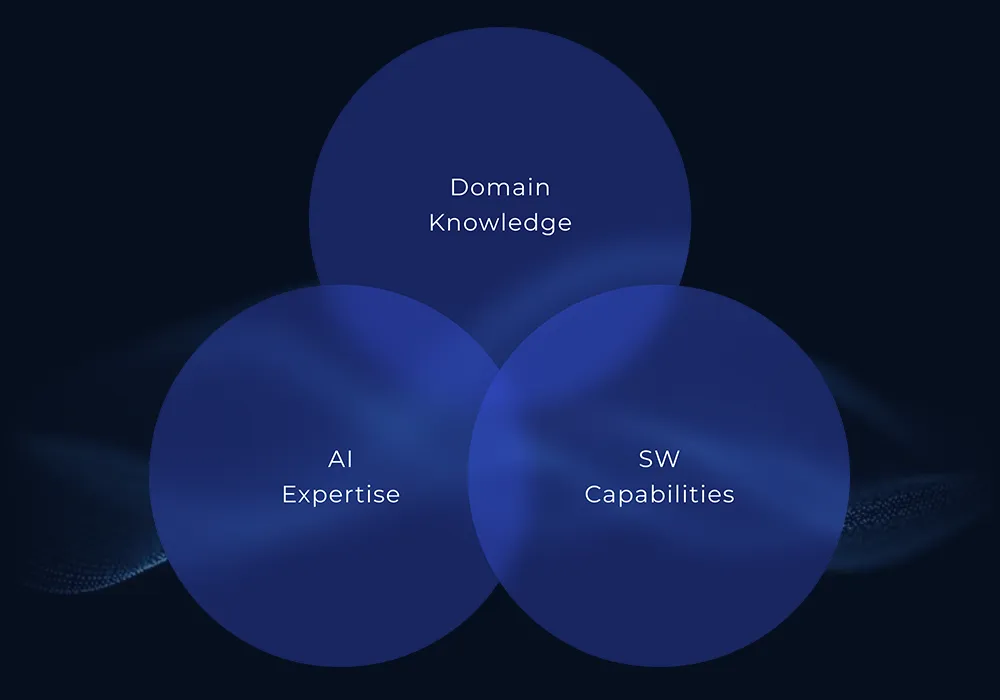
The internal culture lines up with the strategy. Gauss Labs runs a competitive global internship program, recruits across Silicon Valley, Seoul, and Vancouver, and stocks the team with a mix of PhD researchers and ex-fab engineers. The Venn diagram between "can build a transformer" and "has watched a lithography tool drift over the course of a shift" is small. Gauss Labs has been busy enlarging it.
For decades, chipmakers competed on physics. New transistor geometries, new lithography wavelengths, new materials stacks. Those races are not over, but they are getting expensive in a way that punishes everyone who plays. A single EUV scanner now costs north of $300 million. The next generation will cost more. Squeezing more value out of the tools already installed is no longer a "nice to have." It is the only lever still under most CFOs' control.
This is the structural reason a company like Gauss Labs exists - and the reason its product, which on the surface sounds like a niche statistics package, is positioned exactly where the industry's pain is moving. Every wafer it measures virtually is a wafer the customer did not have to slow down for. Every variability point it shaves off is a yield point the customer keeps.
That is also why Gauss Labs is interesting beyond semiconductors. If a startup can run a production-grade AI system inside the most paranoid, regulated, IP-sensitive manufacturing environment on earth - a leading-edge memory fab - the playbook ports. Auto plants, aerospace lines, pharmaceutical reactors, battery gigafactories. All of them generate the same kind of high-frequency, under-utilized sensor data. All of them, eventually, will need a Panoptes.
The wafer rolls past the deposition chamber. The model writes its verdict. The line keeps moving. The difference, six years into the Gauss Labs experiment, is that this is no longer a demo - it is a habit. Tens of millions of wafers have passed through this same quiet hand-off. The fab has learned to expect it.
Industrial AI was supposed to be the part of AI that never quite happened. Gauss Labs is the boring, specific, deeply technical counterexample. A company named after a 19th-century mathematician, measuring 21st-century wafers, on a street named after a Greek poet.
The future of manufacturing keeps showing up early. It just doesn't always announce itself.