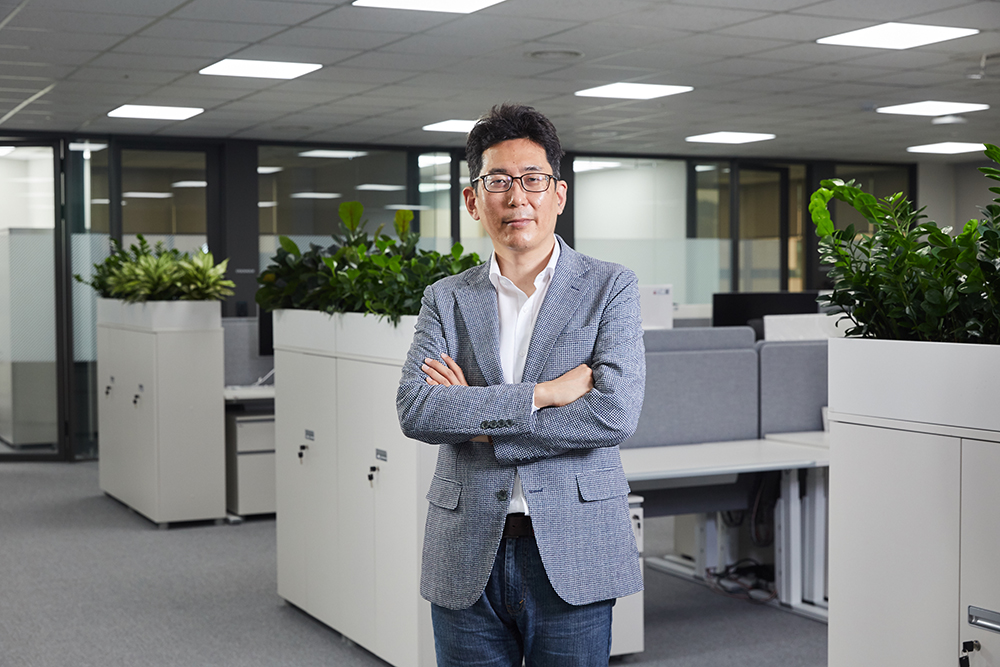
From Gauss's Shadow to the Chip Floor
In the genealogy of ideas, Mike Young-Han Kim occupies a rare position: 11 generations removed from Carl Friedrich Gauss, the mathematician who invented the normal distribution and the method of least squares. Most people find that biographical footnote mildly charming. Kim built a company around it.
Gauss Labs is not a company named after a coincidence. The Palo Alto startup Mike Kim founded in August 2020 embodies a deliberate thesis - that the deepest mathematical thinking belongs not just in journals or classrooms, but inside semiconductor fabs running 24 hours a day at temperatures and tolerances that would make most software engineers flinch. The company's flagship product, Panoptes VM, now inspects more than 50 million wafers at SK hynix facilities. It does this at one wafer per second. The semiconductor industry standard was, until recently, spot-checking 1 to 5 percent of production.
To understand why that gap matters, consider the economics. A 1% improvement in chip yield can translate into roughly one trillion Korean won in gains - roughly $720 million. Kim said this himself at Korea Investment Week in September 2025. He wasn't boasting. He was doing arithmetic.
The Long Way to the Factory
Kim grew up in South Korea, studying electrical engineering at Seoul National University from 1992 to 1996. After graduating, he spent three and a half years as a software architect at Tong Yang Systems in Seoul, where his main project was building communication infrastructure for Incheon International Airport - the kind of systems work that forces you to think about reliability, throughput, and failure at scale before AI was a buzzword.
In 1999, he returned to academia. Stanford University, where he earned both a master's in Electrical Engineering and a master's in Statistics before completing his PhD in Electrical Engineering in 2006. His dissertation solved a problem that had been open for decades: the feedback capacity of stationary Gaussian channels. He cracked it using convex optimization and functional analysis. His method was not a workaround. It was the answer.
The same year he defended his dissertation, he joined the faculty at UC San Diego's Department of Electrical and Computer Engineering. He would stay for fourteen years. During that time, he received the NSF Faculty Early Career Development Award (2008), the US-Israel Binational Science Foundation Bergmann Memorial Award (2009), the IEEE Information Theory Paper Award (2012), and the James L. Massey Research and Teaching Award for Young Scholars (2015) - the inaugural recipient of that particular honor. In 2015, he was also elevated to IEEE Fellow, the organization's highest grade of membership, for contributions to feedback communication and network information theory. He co-authored "Network Information Theory" with Abbas El Gamal of Stanford - a textbook that filled what reviewers called "a void in the vast field."
There is a lot of data in the industrial field, but the ability to select high-quality data is low, and the development of AI algorithms and applications tailored to the characteristics of each industry is slow.- Mike Young-Han Kim, AI Future Forum Keynote
The Move Nobody Saw Coming
Tenured professors at top research universities do not typically leave to start companies mid-career. The tenure system is designed, in part, to make that decision unnecessary. Kim left anyway.
The move reflected something he had noticed watching the data economy from academia: manufacturing - specifically semiconductor manufacturing - was generating petabytes of machine-sensor data that nobody knew how to use well. The factories were rich with signal. The AI stack to extract it did not exist in commercial form. The companies building AI were focused on language, image, and consumer behavior. The factory floor was an afterthought.
"There is no dominant player in industrial AI," Kim observed at the time. He saw that not as a problem but as a map with an X on it. Gauss Labs was his response: a Palo Alto-based startup that would apply serious machine learning and statistical rigor to one of the most demanding manufacturing environments on earth.
In September 2020, SK hynix - one of the world's largest semiconductor manufacturers - committed $55 million. It was SK hynix's first investment in an independent AI company. Kim had his runway. He began recruiting what he called "best players," promising them not just compensation but something harder to find in corporate AI: genuinely difficult problems. "More importantly," he said, "present exciting challenges their brains deserve."
What Panoptes Actually Does
Virtual metrology is not intuitive if you haven't spent time in a fab. In semiconductor manufacturing, metrology means measurement - checking wafers at various stages of production to ensure the process is within tolerances. Traditional metrology is physical: you pull a sample wafer off the line, measure it with a machine, and use that measurement to calibrate the process. Sampling rates are low because measurement machines are expensive, slow, and can't keep pace with production volume.
Gauss Labs' Panoptes VM takes a different approach. Instead of measuring every wafer physically, it predicts metrology outcomes using the sensor data already generated by manufacturing equipment - temperature, pressure, flow rates, timing, and hundreds of other variables captured by the machines themselves. The result is a virtual measurement for every wafer, not just the sampled ones. Near-100% coverage. One wafer per second.
At SK hynix, deployment began in late 2022 with thin film deposition processes. The initial results showed a 21.5% average reduction in process variability. By 2025, continued deployment and refinement had pushed that figure to 29%. By early 2026, the Panoptes VM system was achieving near-complete wafer inspection with a 15% reduction in process variation in the most recent measurement cycle. The PSALM framework - Purpose-Specific Automatic Learning Machine - underlying Panoptes handles model training, selection, and updating automatically. It doesn't require a data scientist to babysit each fab line.
Panoptes VM 2.0, released in August 2024, added Multi-Step Modeling, Operation-Group Modeling, and Automatic Model Selection features, significantly improving prediction accuracy and the system's ability to handle complex, multi-stage processes. The company also offers Panoptes IM (Image Metrology) for computer vision-based defect detection, and an Overlay VM product for photolithography overlay error prediction - one of the most precision-sensitive steps in chip fabrication.
The Bigger Argument
Kim's public statements consistently make a point that goes beyond his own company's products. He argues that the dominant narrative around AI - that its value lies primarily in software, consumer products, and large language models - misses where the largest economic leverage actually sits. Manufacturing, in his framing, is where AI has the highest per-decision stakes and the lowest current penetration.
At the News1 Future Industry Forum in July 2025, Kim presented a talk titled "AI by Chips, Chips by AI" - an argument that Korea's competitive advantage in semiconductor manufacturing, combined with advances in AI, creates a specific window for industrial AI leadership. "If AI innovation can occur in manufacturing, the industry we know best and are most competitive in," he said, "Korea can become a true AI powerhouse. I really want to change that game."
By 2026, Gauss Labs had grown to roughly 75 employees across its Silicon Valley headquarters, Seoul operations, and Vancouver office. In February 2026, the company and SK hynix jointly presented two new research papers at SPIE Advanced Lithography + Patterning 2026, covering explainable AI for overlay predictions and early equipment anomaly detection. The research output mirrors the academic rigor Kim brought from UCSD - the papers are not marketing materials. They are results.
The name Gauss Labs, it turns out, is not just a clever tribute. It's a statement of method: rigorous, mathematical, descending from first principles to factory-floor outcomes. Eleven generations, and the discipline is intact.