The most revealing thing about FullStac LLC is not that it sells a dashboard. Software has produced enough dashboards to wallpaper a warehouse. The revealing thing is what happened before the dashboard had a name: a working online retailer in central Pennsylvania grew faster than its back-office tools could comfortably handle. Orders, customer questions and marketplace chores multiplied. The available software offered an irritating bargain - change the way the company worked, then the software might help.
Michael Kulczyckyj declined the bargain. While working with Broco Supply, he helped launch the online seller Bargaintory.com in 2006. The shop sold through eBay, Amazon and its own site. As sales grew, the operation needed a more scalable way to process orders and serve customers. Kulczyckyj searched, came up empty and wrote an internal system around the retailer’s actual habits. That system would be revised thousands of times and used inside a business reported to average more than $5 million in annual sales.
“I hated the idea of changing how the business ran just so I could use a software package already created.”Michael Kulczyckyj, on Dashboard OSM’s origin
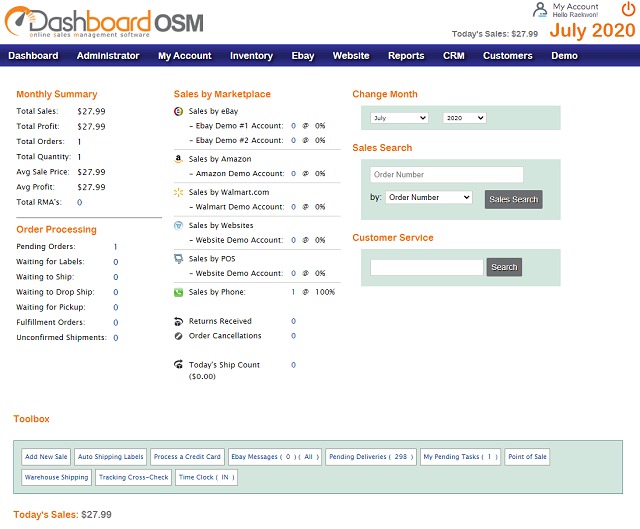
There is the company’s whole product philosophy in one sentence. FullStac, founded in Harrisburg in 2017, now sells custom cloud development, e-commerce consulting and Dashboard OSM - the commercial descendant of Kulczyckyj’s operating software. The product pulls marketplace sales, orders, inventory, customer service, shipping, accounting connections, employee tasks and reporting into one place. Its audience is the merchant who has graduated from a few cheerful notifications to a daily thicket of tabs, exports and opportunities to type the same number incorrectly.
First, the workflow failed
What failed first was not a prototype or a fundraising round. It was the conventional software shopping trip. Kulczyckyj could find packages, but not one that managed eBay sales in the way he wanted without forcing operational changes. The irritation matters. Many software businesses begin with a broad complaint - work is inefficient - and then invent a generic solution. Dashboard OSM began with a narrower grievance from someone doing the work: these orders, from these channels, need to reach accounting, labels, customer service and inventory without the business pretending it is organized like the vendor’s demo account.
By 2015, Kulczyckyj was converting the in-house package into a resellable SaaS platform. In February 2016, he and TGHW LLC debuted Dashboard OSM at the ASD Show in Las Vegas. The launch did something refreshingly specific: it sought ten small online sellers for a beta. Those merchants were offered free integration, direct access to developers and 60 days of use. In return, FullStac’s precursor wanted perspective - what did real companies need included?
That was the change of mind worth noticing. An internal tool can be wonderfully tailored to one company and useless everywhere else. The team did not assume that surviving Bargaintory’s workload made the software universally correct. It invited a small group to expose the product’s private assumptions. The number ten kept the feedback loop human. For a product sold with one-to-one onboarding and personalized support, that closeness was not merely a launch stunt. It previewed the business model.
A product, a service, or both?
Dashboard OSM is sold like SaaS but behaves partly like a custom engagement. The public plans currently run $449, $549 and $699 a month. Professional includes one seller account per marketplace, one shipping account and five user logins. Premier expands those limits; Enterprise expands them again. Onboarding costs $199 on Professional, $99 on Premier and is included with Enterprise. A custom plan covers nonstandard features, marketplaces, shippers and user counts. A 30-day trial is advertised.
Those numbers make the purchasing decision concrete. Professional costs $5,388 over twelve months before onboarding. Enterprise costs $8,388. A merchant does not need a heroic growth forecast to evaluate the expense; it can count hours spent copying orders, reconciling stock, creating labels and repairing mistakes. If that work costs less than the subscription, the all-in-one argument weakens. If it occupies a meaningful part of an employee’s week, consolidation starts to look less like software shopping and more like buying back operating time.
The fixed fee is important. FullStac says it does not take a percentage of a seller’s revenue. A merchant can process more sales without paying a larger software tax merely because the store succeeded. The company instead makes money from subscriptions, onboarding, customization, consulting and bespoke development. That creates a clean pitch against percentage-based tools and an economic test for the buyer: can one system save more than its monthly fee in labor, errors and duplicated software?
The feature list is broad: automatic order importing, Amazon FBA support, eBay and website connections, QuickBooks integration, UPS, FedEx and postal labels, returns, CRM, employee management, warehouse shipping, commissions, point of sale and reporting. Breadth is both the attraction and the danger. Merchants buy fewer handoffs. FullStac inherits more integration edges. When marketplaces change an API or a carrier changes a workflow, a tiny software team can become the narrow point through which many customer problems must pass.
The oddly useful middle
FullStac sits between two familiar choices. At one end is the inexpensive app stack: add a marketplace lister, a shipping tool, an inventory plug-in, accounting automation and a CRM, then ask an employee to remember which system is authoritative. At the other end is enterprise software, with deeper budgets, longer implementations and features a modest merchant may never touch. FullStac’s answer is a unified product that can be configured around the customer, supported by people who also sell consulting and custom code.
| Condition | FullStac fit | Why |
|---|---|---|
| Several sales channels | Strong | Consolidation reduces repeated entry and scattered status checks. |
| Complex house workflow | Potentially strong | Customization and onboarding are central to the offer. |
| One store, few orders | Weak | A simpler platform and a shipping app may cost less and require less setup. |
| Large global enterprise | Needs scrutiny | Integration, compliance and support requirements can exceed a small vendor’s capacity. |
The company’s small size is part of the proposition. FullStac describes personal, round-the-clock support and access to developers for critical needs. Its team presents itself as close-knit, versatile and constantly learning. A 2020 employee review called the work remote and task-driven and said ideas had a voice. But intimacy does not scale automatically. White-glove service works when the number and complexity of accounts remain compatible with the humans providing the gloves.
The company received a reported $100,000 investment from Ben Franklin Technology Partners in 2018. Dashboard OSM officially became a FullStac product that year, and the acquisition was announced publicly in 2019, with Kulczyckyj leading software development. FullStac later appeared among portfolio companies at the Invent Penn State Venture & IP Conference. In 2020, the company donated technical services to Queerantine.Me, a project created to help users virtually tip Philadelphia LGBTQ bar and restaurant staff hurt by pandemic layoffs. For a company whose pitch is close operational support, the contribution was unusually on brand.
What another founder can steal
- Start with a workflow you personally operate, not a market category you admire.
- Prove the tool under real volume before polishing the sales story.
- Recruit a deliberately small design-partner group and exchange unusually good access for unusually candid feedback.
- Price against the buyer’s avoided labor, errors and app sprawl - not only against a competitor’s sticker.
- State the tradeoff plainly: configurability and service are valuable, but each adds work that must scale.
The copyable part is the sequence
FullStac’s advantage is not a secret algorithm. It is accumulated context. Kulczyckyj encountered the problem as an operator, wrote the first answer, watched it run for years, converted it into SaaS, then asked other merchants where the answer was too specific. That sequence is available to any founder with access to a stubborn workflow. It is slow, unphotogenic and excellent at producing details a weekend brainstorm will miss.
It will not work everywhere. A business with one storefront and modest order volume may be happier with its commerce platform’s native tools. A company that enjoys assembling best-of-breed apps may prefer modularity. A multinational with elaborate compliance, localization and procurement demands will need to examine vendor capacity carefully. And a founder copying FullStac’s service-heavy approach without pricing the human work will discover that “white glove” can be another phrase for “margin leak.”
For the right merchant, though, the offer is easy to understand: stop moving the same order through a relay race of websites. FullStac wants Dashboard OSM to be the control room, custom development to cover the strange corners and support to keep the system attached to the business it serves. The idea was born from refusing to reorganize a retailer around somebody else’s software. Its continued appeal depends on honoring that refusal for every new customer.