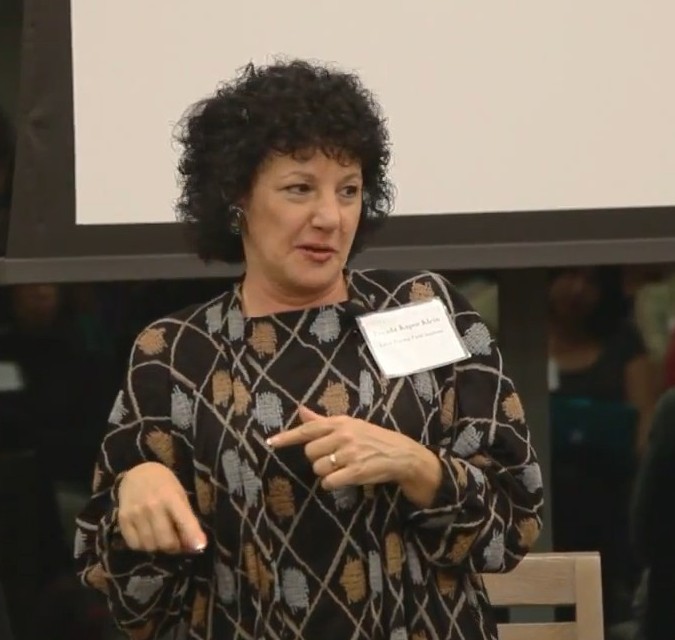
Who She Is
Forty-Nine Years of Not Waiting for Permission
The most dangerous thing about Freada Kapor Klein is not that she's right. It's that she has the receipts. When she says impact investing beats greed-only VC on financial returns, she's pointing to Kapor Capital's track record: top-quartile returns, more than 200 portfolio companies, 60% of investments directed to underrepresented founders. The data doesn't need her to explain it.
She co-founded the Alliance Against Sexual Coercion in 1976 - before "sexual harassment" was a legal concept, before it was a household term, before Anita Hill, before #MeToo. Not because it was trendy. Because no one else had done it.
There's a particular kind of person who shows up forty years before the crowd and stays. Kapor Klein is that person. When she appeared on NBC during the 1991 Anita Hill hearings, explaining to a baffled public what workplace sexual harassment actually was, she'd been working on the problem for fifteen years. The experts the media scrambled to find - she'd been doing the work since Gerald Ford was president.
200+
Portfolio companies funded by Kapor Capital
60%+
Investments directed to underrepresented founders
Top 25%
Financial returns vs. peer VC firms industry-wide
1976
Year she co-founded the first US workplace sexual harassment org
8
University campuses running SMASH today
50%
Female participation in SMASH since day one, 2003
Origin Story
From the Living Room Floor to the Boardroom
She grew up in the San Fernando Valley - her father a doctor, her mother from a Russian-Jewish family that had lost most of its relatives in the pogroms. The weight of history was not abstract in that house. She was cutting middle school classes to march with Cesar Chavez and the United Farm Workers before most of her classmates understood what a strike was.
At UC Berkeley in the early 1970s, she volunteered as a peer counselor for Bay Area Women Against Rape, one of the country's first rape crisis hotlines. Sitting on her living room floor taking calls from strangers. No training playbook, no institutional support. Just a phone and the willingness to listen when no one else was.
Field Notes
She didn't just counsel victims - she interviewed rapists. As part of her research, she facilitated a support group called "Prisoners Against Rape" at Lorton Prison outside Washington, D.C. That work appeared in the 1983 documentary Rape Culture. She was 31.
By 1976, she and collaborators had built something with no precedent: the Alliance Against Sexual Coercion, the first US organization dedicated entirely to preventing and addressing workplace sexual harassment. The term "date rape" didn't exist yet. Neither did "marital rape." She was working on problems that didn't have names.
She went on to become Executive Director of Help for Abused Women and their Children at 26. Then Brandeis. A Ph.D. in 1984 with a dissertation on - of all things - sexual harassment in federal employment. It was not a hot research topic.
The Lotus Years
Building the Most Progressive Workplace in America - Before That Was a Thing
In 1984, Mitch Kapor was running Lotus Development Corporation - the company that had just shipped Lotus 1-2-3 and was redefining what personal computers were for. He was looking for someone to build a workplace culture from scratch. He found Freada Kapor Klein.
She became Lotus's first Head of Employee Relations, Organizational Development, and Management Training. The goal, stated plainly: make Lotus the most progressive employer in the United States. She built anonymous tip lines ("Lotus Grapevine"), discretionary employee assistance funds, and grievance processes before HR departments knew what those were.
He was smart enough as the CEO to not hit on the person who co-founded the first group on sexual harassment in the U.S. He's very bright.
- Freada Kapor Klein, on Mitch Kapor
The romantic irony of the story is not lost on her. Kapor hired her specifically for her expertise in workplace harassment - and then had the self-awareness to not be that guy. They didn't begin their relationship until years later, long after she'd left the company. They married in the late 1990s.
The three years at Lotus were a laboratory. She learned that progressive workplace culture wasn't just ethics - it was an operational advantage. Companies with fair cultures retained talent. Companies without them bled it. She had the data. She left in 1987 to build Klein Associates, a consulting firm that would spend decades helping Fortune 500 companies figure out what Lotus already knew.
The VC Chapter
Proving That "Diversity Lens" Isn't Code for "Lower Returns"
The mythology of venture capital has always rested on a single premise: bias is a feature, not a bug. Pattern matching. The Stanford-to-Google pipeline. The 23-year-old in a hoodie. The story went that investing outside those patterns meant accepting worse returns - that diversity and performance were in tension.
Kapor Capital has spent more than a decade destroying that argument with evidence.
Founded formally in 2011 alongside Mitch Kapor, the firm focuses exclusively on seed-stage tech startups that close "gaps of access and opportunity" for low-income and underrepresented communities. More than 60% of investments go to underrepresented founders. The firm was the first in the industry to mandate founder diversity commitments in 2016.
The Investment Thesis
"Genius is evenly distributed by zip code, but opportunity is not." Kapor Capital bets on the genius that other firms are too pattern-matched to see. The track record: top-quartile financial returns against peer firms that invested with no such mandate. The thesis is simple. It's the willingness to test it that was rare.
Portfolio companies include Pigeonly, which reduces the cost of prison phone calls - a problem no Sand Hill Road firm was looking at. That's the point. The gaps in access and opportunity are also gaps in the market. The underserved are underserved because capital went elsewhere. Capital goes where the pattern-matchers send it. Kapor sends it somewhere else.
The Moment That Defined Her in Tech
The Letter That Shook Silicon Valley
In February 2017, engineer Susan Fowler published a blog post about her year at Uber. It was an account of systematic sexual harassment, HR inaction, and a culture that protected bad actors as long as they hit their numbers. The post went viral. The question became: what would Silicon Valley actually do?
Most investors did what investors do. They waited. They watched. They protected their positions.
Kapor Klein and Mitch Kapor were Uber investors. They wrote a letter. To the board. To fellow investors. Publicly.
We have chosen to speak out because we believe that investors in high-growth companies rarely call out inexcusable behavior and almost always put their financial interests above their stated values.
- Kapor Klein & Mitch Kapor, Open Letter to Uber Board, 2017
The backlash was immediate. Other VCs attempted to poach her portfolio companies. The message was explicit: if you call out misconduct, we'll go after your people. The "code of silence" she'd named in the letter was instantly demonstrated by the people trying to punish her for naming it.
She didn't retract. She didn't qualify. The letter stands as one of the clearest public statements by an insider on how the investor class enables the cultures it claims to oppose.
The Institutions She Built
She Doesn't Just Talk About the Gap. She Builds Bridges.
The criticism of diversity advocates in tech usually lands in the same place: "You're not building anything." Kapor Klein's answer is a list of organizations:
SMASH
2003 • 8 campuses • 50% female
A rigorous three-summer STEM residential program for low-income high school students of color. 50% female since inception.
Level Playing Field Institute
2001 • Research + Programs
STEM access programs and original research on workplace unfairness. Published "The Tilted Playing Field."
Project Include
2016 • Co-founded with Ellen Pao
Customized DEI guidance for startups with 25-1,000 employees. Eight co-founders including Tracy Chou and Y-Vonne Hutchinson.
Alliance Against Sexual Coercion
1976 • First of its kind in the US
The original. Co-founded before the term "sexual harassment" existed as a legal or social concept.
DAIR Institute
Co-founder • AI Research
Independent, community-centered AI research that operates outside corporate or academic control.
Hollywood Commission
Founding Member
Commission to eliminate sexual harassment in entertainment. Recruited Anita Hill as Board Chair.
The pattern across all of them: she identifies a gap where no institution exists, builds the institution, hands it to people who can run it, and moves on to the next gap. The Level Playing Field Institute became SMASH. SMASH is now on eight university campuses. That's compounding institutional infrastructure, not a press release.
The Shelf
Writing the Playbook While Running the Play
2023
Closing the Equity Gap
With Mitch Kapor. HarperCollins. A field guide for values-based venture investing - how to close racial and economic gaps while generating top-quartile returns. The book Silicon Valley's traditional VC community wishes didn't exist.
2007
Giving Notice
The data behind the departure. Based on rigorous Level Playing Field Institute survey data, the book quantified unfair workplace treatment as costing US businesses approximately $64 billion annually in voluntary turnover. Nobody could argue with the number.
2014
Pattern Recognition: How Hidden Bias Operates in Tech Startup Culture
Published in ACM's XRDS magazine. Documented the gap between how engineers of different races and genders experience supposedly "meritocratic" tech cultures. Academic precision applied to a problem the industry preferred to ignore.
1977
Myths and Facts About Sexual Harassment
One of the earliest publications on the subject. Written when the conversation was so new that the publication had to define its terms.
Career Timeline
Five Decades of Showing Up
1972-1974
Peer counselor, Bay Area Women Against Rape - one of the US's first rape crisis hotlines. UC Berkeley undergraduate.
1976
Co-founded Alliance Against Sexual Coercion - the first US org dedicated to workplace sexual harassment, before the term existed.
Late 1970s
Executive Director, Help for Abused Women and their Children, at age 26.
1984
Ph.D. from Brandeis University, Heller School - dissertation on sexual harassment in federal employment.
1984-1987
First Head of Employee Relations at Lotus Development Corporation - building America's most progressive workplace culture.
1987
Founded Klein Associates - workplace fairness consulting for Fortune 500 companies.
1991
NBC commentator during Anita Hill hearings. Contributed to the Civil Rights Act of 1991.
2001
Founded Level Playing Field Institute to advance STEM access for underrepresented students.
2003
Launched SMASH - now on 8 university campuses, 50% female since inception.
2011
Formally co-founded Kapor Capital with Mitch Kapor - social-impact VC, top-quartile returns.
2016
Co-founded Project Include (with Ellen Pao et al). Kapor Capital mandates founder diversity commitments - first VC firm to do so.
2017
Published open letter to Uber board - broke investor silence on founder misconduct. Backlash followed. She didn't blink.
2023
"Closing the Equity Gap" published by HarperCollins. The roadmap goes mainstream.
2025
Forbes Women 50 Over 50 honoree. Still building. Still speaking. Still showing up.
Education
The Academic Foundation
University of California, Berkeley
B.A. in Criminology
1970 - 1974
Brandeis University
Ph.D. in Social Policy and Research
Heller School • 1984
The Details
The Specific Facts That Tell the Whole Story
She co-founded America's first anti-workplace-harassment org 40 years before #MeToo - in 1976, before the phrase "sexual harassment" was commonly understood.
Her 2007 book "Giving Notice" put a number on unfair treatment: $64 billion per year in voluntary turnover. Hard to argue with a number.
SMASH has had 50% female participation since its launch in 2003. Not 40%. Not "improving toward." Fifty percent from day one.
After her 2017 Uber letter, rival VCs tried to poach her portfolio companies - demonstrating the investor "code of silence" she'd described in the very same letter.
She appeared in the 1983 documentary "Rape Culture" for her work running the "Prisoners Against Rape" support group at Lorton Prison.
She skipped middle school to march with Cesar Chavez and the United Farm Workers. The activism was not a career decision - it was factory-installed.
Former NAACP President Benjamin Jealous called her "the moral center of Silicon Valley" and "an O.G. in technology." In 2015. The OG title predates any Twitter usage of the term.
Kapor Capital was the first investment firm to mandate diversity commitments from founders at the time of investment - in 2016, when most VC firms were still debating whether the problem existed.