There is an awkward question hiding inside every consulting business: if the work succeeds, should the client need the consultant more, or less? Formation PR + Brand has chosen the less lucrative-sounding answer. It says the client should end up in the driver's seat. The agency listens, researches, creates the identity or campaign, and leaves behind tools a team can actually use. The service is not merely a logo, a media hit or a handsome annual report. It is the transfer of confidence.
This is a curious proposition for a company that earns money by remaining useful. Yet it explains why an 11-person agency in Hendersonville, North Carolina, has found work well beyond Hendersonville. By 2023, Formation said it had served nearly 300 clients in 10 states and the District of Columbia. Its recurring cast is not a parade of soda brands and sneaker drops. It is community colleges, health systems, foundations, libraries, nonprofits and regional-development organizations - institutions doing work that is socially important and verbally unruly.
The complicated-story business
Consider Dogwood Health Trust. It was created from the sale of a hospital system, holds a $1.5 billion endowment and distributes nearly $80 million in grants each year across western North Carolina. That is not one story. It is finance, health, place, power and public accountability sitting at the same table. Formation supported Dogwood from its beginning, acted as an extension of its communications team, and led a full rebrand in 2022 that launched in January 2023. The work spread across strategy, identity, print, digital assets and an interactive annual report.
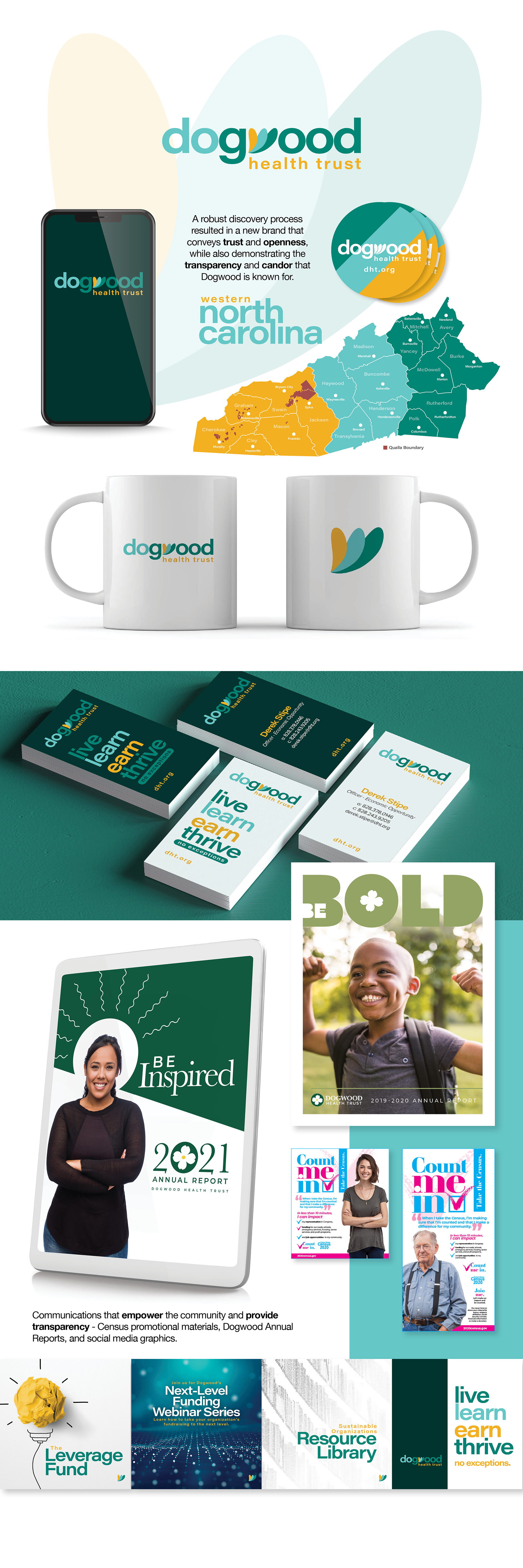
The agency's other case studies rhyme. Blue Ridge Community College began with a narrative and messaging shift, moved through enrollment campaigns, and reached a comprehensive rebrand in 2018. UNC Health Pardee has relied on Formation since 2015 for public relations and crisis communications, including media inquiries, expert newspaper columns, radio interviews and community engagement. The National Association of Development Organizations has worked with the firm since 2014 on a new identity, website, conference materials and training. Transylvania County Library got stakeholder research, a narrative, a logo, a website, T-shirts, stickers and rack cards capable of making yoga and ukulele look at home beside the stacks.
“We can tell you and your team really listened to what we had to say.”Erica Allison, describing the client feedback Formation values most
That sentence contains the business. Formation's competitors can buy the same media, hire capable designers and write polished copy. Listening is harder to display in a pitch deck because it looks like nothing while it is happening. But for an institution with board members, donors, patients, faculty, students, public officials and residents, the listening phase is where the dangerous simplifications are caught.
The first thing that fails is the shortcut
Formation's public-relations page contains a sentence many agencies would hide until after the contract is signed: smart PR usually takes at least six months to produce meaningful results. It will write a single press release, but says an ongoing relationship is where the work performs. This is not mystical patience. Reporters learn which sources are useful. An organization learns which stories it can substantiate. The agency learns where approval gets stuck and which executive can explain a complicated issue without turning it into oatmeal.
A release, a launch and a wish that strangers care on schedule.
Relationships, monitoring, repeated messages and a client team learning the system.
Public cost signals are similarly sober. Formation does not publish a rate card. Agency marketplace The Manifest lists a minimum project size of $5,000 and places its one reviewed engagement in the $10,000 to $49,000 range. Treat those as a doorway, not a quote. A stakeholder-heavy rebrand, retained crisis counsel and a one-day workshop are different animals.
The conditions matter. This model fits an organization with a real mission, access to decision-makers, patience for research and someone internally who will own the work. It is a poor fit for a buyer hunting guaranteed overnight coverage, unwilling to involve stakeholders, or seeking a decorative logo while strategy remains untouched. Formation also says it evaluates prospective projects for positive impact. A company that considers values irrelevant may find the chemistry strained before the first brainstorm.
The agency rebranded itself first
Erica McArthur Allison founded the business in 2007 as Allison Development Group. She brought degrees in political science, not a factory-issued advertising biography. That turns out to make sense. Institutional communication is often the study of constituencies: who has authority, who feels ignored, who needs evidence, and which words create a coalition rather than a fight.
On the firm's tenth anniversary in 2017, Allison Development Group became Formation PR + Brand. The new name narrowed the promise to public relations and branding and tied it to a four-verb mission: Listen. Create. Empower. Impact. Two years later, the company moved from Flat Rock into Hendersonville's Historic Seventh Avenue District. Allison and her husband bought the Locust Street building, placed the agency alongside a bicycle shop, and made a local-development bet while serving clients across the country.

The focus did not make the service menu tiny. Formation handles brand strategy, design, websites, digital strategy, annual reports, paid media, workshops, reputation work and crises. The concentration is elsewhere: in the types of problems and clients it understands. That distinction is worth copying. Specialization need not mean selling one artifact. It can mean knowing one family of anxieties unusually well.
A playbook worth borrowing
Three moves travel well. First, choose clients with related institutional problems, not merely similar industry codes. A community college and a philanthropic trust look different on paper, but both must explain public value to several audiences at once. Second, make discovery visible. Surveys, interviews and stakeholder sessions are not preamble; they are part of the product. Third, leave an operating system behind: a style guide, message architecture, crisis plan, resource center, campaign logic or trained team.
The reward is not just client goodwill. It is compounding context. A decade with NADO and long relationships with Pardee and Blue Ridge mean less time relearning the alphabet of each sector. Formation can spot the difference between a story that sounds nice and one that helps enrollment, trust, donations or public understanding.
In 2021, the firm won a Platinum Hermes Award for Dogwood's digital annual report and Gold for a Pisgah Legal Services campaign about Affordable Care Act enrollment. The latter generated 1.5 million impressions across nine western North Carolina counties using print, radio, digital and streaming media. Awards are pleasant. The more revealing outcome is that an intimidating eligibility question reached people in forms they could encounter and act on.
That is Formation's quiet argument about communications. Attention is not the product. Understanding is. And the best sign that understanding has taken hold may be the day a client can tell the story clearly without the agency in the room.