The awkward part of buying a token can arrive before the token does. A newcomer encounters wallets, networks, bridges and transaction fees, each demanding a decision in a vocabulary nobody uses at lunch. Somewhere between downloading an app and acquiring the right gas token, curiosity becomes administration. fomo has built a business around the suspicion that this is a terrible way to welcome a customer.
- One account and balance for trading across supported blockchains.
- A social feed puts transactions, profiles and commentary together.
- Desktop access and perpetuals broadened the product in 2026.
- Its three announced funding rounds add up to $94 million.
Founded in 2025 by Paul Erlanger, Se Yong Park and Prashan Dharmasena, the New York company launched publicly that May. Its early team had worked together at dYdX. Familiarity mattered: these were people who already understood the machinery and wanted to change what customers had to do with it. The pitch was consumer software, with the complicated bits pushed backstage.

The balance is the product
Consider the seemingly small choice to give someone a unified dollar balance. A customer can discover an asset on Solana, then another on Base, without personally moving money through a bridge. fomo also supports other networks, including BNB Chain and Monad. The chain still exists; the customer’s evening no longer has to revolve around it. That is a useful distinction when judging the product.
The wallet is there, too. fomo’s terms name Privy as its wallet infrastructure provider and describe the trading wallet as non-custodial, with keys users can view and export. Familiar login methods reduce setup work. They also make control of the associated credentials consequential. An easy entrance does not abolish the responsibilities on the other side.
Apple Pay supplies another familiar door. Post-launch Apple Pay reportedly accelerated growth. By January 2026, fomo had integrated Coinbase’s native onramp. In the same month, it added biometric app locking and Awaken tax reporting. The sequence is revealing: getting people in, protecting everyday access, and helping them deal with the records that trading leaves behind.
A trade becomes a post
Convenient funding explains a first visit. The social product helps explain why someone might return. fomo lets users follow traders, receive notifications and inspect activity through feeds and leaderboards. Its own explanation separates social trading from automatic copying: users observe other people’s decisions, then make their own. Watching is part of discovery, rather than a mandate to imitate.
January’s trade-thesis feature added a reason to the transaction. A trader could explain a purchase or sale in a token’s feed. February brought those theses into the global feed, alongside profit-and-loss information and balances. A bare buy signal became something closer to an argument. Readers could ask whether the explanation made sense, rather than merely admire a green number.
“fomo seems simple but under the surface there is a lot of technical complexity.”
Prashan Dharmesena, co-founder · June 2026
This puts fomo between categories that already have formidable occupants. Coinbase offers consumer trading; Phantom combines wallet access and discovery; Moonshot courts people buying speculative assets. fomo’s particular emphasis is the relationship between execution and reputation. A position, its explanation and its audience inhabit the same product. That combination gives the company a clearer identity than another promise of quick trades.
Bigger screens, a longer menu
The desktop launch on April 29, 2026 kept the existing account, positions and following intact. Users could open a trade on one screen and see it on another. The company also announced TradingView charting, with indicators, drawing tools and social overlays. For active traders, the product could offer more analytical room without requiring another identity or a separate social circle.
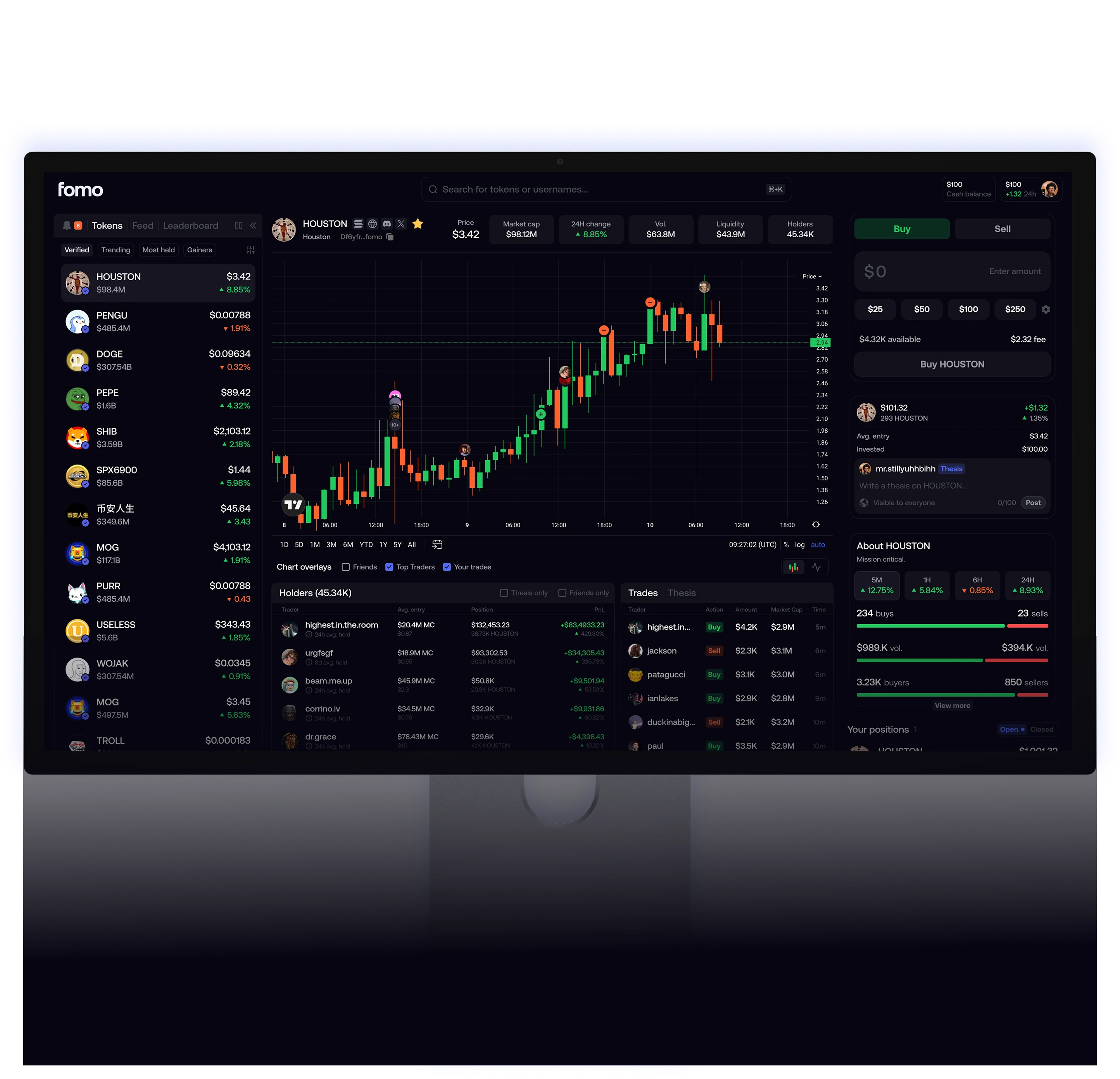
On June 11, the menu widened again. Perpetual futures, powered by Hyperliquid and Trade[XYZ], introduced derivative exposure across crypto, equities, indices and commodities, with some pre-IPO contracts. These are derivatives, not a purchase of the underlying shares. The launch included isolated margin and take-profit and stop-loss support. It also explicitly excluded U.S. Persons. A global ambition still meets national boundaries.
The financing followed that expansion. A $2 million angel pre-seed preceded Benchmark’s $17 million Series A. Index Ventures then led a $75 million Series B announced on June 22, with Union Square Ventures and Benchmark participating. Three rounds, $94 million in announced capital. Investors were financing a broader trading and social product, rather than just a more agreeable token checkout.
The bill survives the beautiful interface
fomo earns transaction fees. Its current terms say spot charges depend on transaction size, type, token and routing, with the applicable fee displayed before confirmation. Perpetuals carry a 0.05% platform fee per transaction, in addition to protocol charges and funding payments. Liquidity-pool fees, gas on selected networks and changes in execution price can also matter. Convenience has a bill; read it before approving the trade.
Nor does visibility make another trader’s judgment transferable. Thin liquidity can move the price between a quote and execution. Someone arriving after an alert may get a different entry. fomo’s own educational material warns about overconfidence, revenge trading and chasing an already-rising token. A social feed can supply context and temptation in the same scroll. The interface cannot decide which one the reader will take.
The growing audience needs careful reading. The homepage displayed 2.5 million traders when checked in October 2026; June’s announcement had reported 625,000 people joining. Those figures describe reach, without telling us how many people trade regularly or return after a losing week. A social finance company needs both the entrance and the return visit to work. A signup counter answers only one of those questions.
Copy the choreography
For product builders, the useful lesson is to examine the chores surrounding the central action. fomo brings funding, discovery, explanation and execution closer together, then carries that continuity onto desktop. Its hiring materials describe an in-person Soho team whose members trade themselves. That proximity gives engineers firsthand experience of the annoyances they are trying to remove.
There is a second lesson in the early financing. More than 140 angels supplied the pre-seed, including operators and traders. That mix could supply product feedback as well as introductions. An app about discovering people began with a network of its own.
The approach depends on dependable payment rails, available liquidity and customers who want their trading lives to be social. Private investors may dislike public positions; U.S. users cannot access its perpetuals. The achievement is making a complicated journey easier to navigate. Whether the destination was a good idea remains the trader’s question.