Adam Morvitz’s first product was a favor. In 2011, while traveling often for work, he became unusually good at the small-print sport of turning credit-card points and airline miles into long-haul seats. Colleagues noticed the results: business class to Europe for a few thousand points. Then came the question every useful obsession eventually attracts. Could he do it for them?
He could, and did. The requests became Juicy Miles, a concierge reward-flight booking service. It was a sensible business built around an absurdly intricate task: check loyalty programs, compare partner airlines, account for transfers, inspect availability, and explain to a traveler why the currency displayed by one company might buy a seat operated by another. Airline miles resemble money until one tries to spend them. Then they become theatre, with rules printed on the underside of the stage.
Morvitz knew the script. A financial consultant for much of his career, he enjoyed the research, the trade-offs, and the small triumph of finding an itinerary hidden behind an unpromising search. The work followed him into lunch breaks and late nights at NBC. Years later, when point.me appeared on the Today show, he called it a full-circle moment. The tidy television cameo had a decidedly untidy prehistory.
There was a public notebook alongside the private labor. Morvitz created Point Me to the Plane, a travel site whose name already contained the impatience that would shape the later company. The blog and the concierge business occupied different ends of the same question. One explained the culture and opportunity around points; the other accepted responsibility for producing an itinerary. Together they gave Morvitz a close view of both curiosity and intent. Readers wanted to know what was possible. Clients wanted the booking finished.
That distinction matters. Information can make a complicated market interesting without making it usable. A dazzling redemption story may persuade someone to collect rewards, while the actual search still requires a dozen tabs and an unnerving transfer into a program they barely know. Morvitz’s advantage was not simply fluency in the rules. He kept encountering the exact point where fluency failed to travel from expert to customer. Each concierge request was a small usability test conducted with real plans, real balances, and a departure date that refused to negotiate.
The route from knack to network
When the manual work becomes the map
Juicy Miles eventually grew to 60 agents. This was success with a warning light. Every new customer required a knowledgeable human to repeat searches across a jumble of systems. The company could keep adding experts, but agent number 61 would inherit the same maze as agent number one. Morvitz saw that the bottleneck was not demand. It was the absence of a common search layer.
That recognition contains the most useful part of his story for builders. The software specification arrived after years of service work. Morvitz did not have to imagine what users found confusing or which steps absorbed the most time. His team had lived the problem at volume. The repetition provided a map: gather the scattered options, normalize them, show meaningful comparisons, and guide people through the transfer and booking steps.
“Redeeming points is typically a time-consuming, complicated and frustrating process.”Adam Morvitz
In 2019, Morvitz co-founded point.me with Tiffany Funk, a longtime friend whose career included leadership at the travel site One Mile at a Time and the consultancy PointsPros. Their experience overlapped, but their strengths differed. Later, the founders described that difference as essential: a co-founder should share your values and bring abilities you do not. It is a warmer idea than “division of labor,” and a more durable one.
point.me launched publicly in February 2022. Its proposition was easy to say because the machinery was hard to build: search reward flights across many airlines and loyalty programs in one place, then tell the traveler how to book. It offered filters for programs, airlines, routes, and balances. The old concierge judgment had become an interface.
A currency that needs an interpreter
The phrase Morvitz uses to frame the market is sharper than the usual vocabulary of perks: “Points are a form of wealth.” It changes the moral temperature of the problem. If points are merely a promotional trinket, confusing redemption is an annoyance. If they represent stored spending power, then clarity matters. A poor search experience can leave real value stranded in an account.
The strange thing about this wealth is that it has no simple price. A point can be worth one amount in a bank portal and another after a transfer to an airline partner. The answer changes with inventory, timing, route, and fees. Consumers may possess several currencies at once, all with different rulebooks. The expertise required to earn points is advertised lavishly. The expertise required to spend them is often left to blogs, group chats, or heroic patience.
point.me’s business sits in that last mile. It does not mint the currency or fly the plane. It tries to make the exchange legible. The platform now says it supports more than 150 airline and loyalty programs, has helped over two million travelers, and has unlocked more than $50 million in member value. Those figures describe scale, but the product’s emotional unit is smaller: the moment a traveler realizes the trip is possible.
The enterprise departure gate
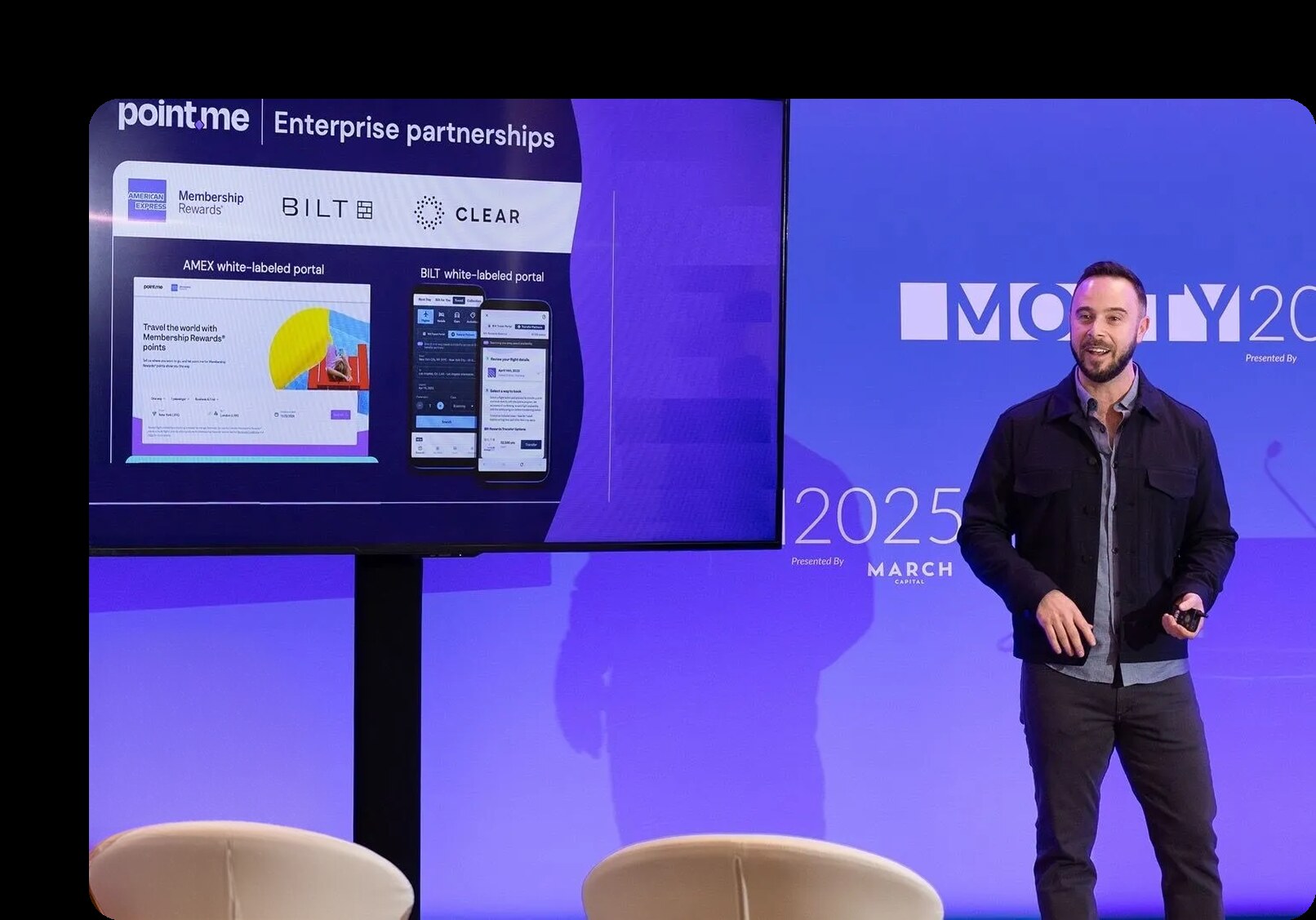
The consumer search box was not the end of the route. Banks and loyalty programs face the same redemption problem from the opposite side. They issue points to create affection and engagement, only to watch customers leave their products to learn what those points can do. point.me began offering its technology to enterprises, including white-label experiences connected with American Express and Bilt Rewards.
In 2024, Morvitz announced an exclusive experience for American Express Membership Rewards card members after more than two years of partnership and planning. His language was revealing: the launch demonstrated the sort of large enterprise build the team could deliver across loyalty, memberships, employee perks, and financial technology. The company was no longer only helping a traveler decode a bank’s rewards. It was helping the bank become easier to decode.
Capital for the next connection · $27M announced
Capital followed the widening ambition. point.me announced a $2 million seed round in 2022, a $10 million Series A in 2023, and a $15 million Series B in September 2024. Nyca Partners and Citi Ventures co-led the last round, with Samsung Next and other investors participating. Morvitz said the company had increased monthly recurring revenue fourfold since the Series A, grown its user base tenfold, and enabled 18 million trip searches.
The partnerships kept moving outward. A multi-year agreement with IAG Loyalty carried a private symmetry for Morvitz: his first trip to Europe had been on British Airways, and that experience helped spark his enduring interest in travel. Sitting with the leaders of its loyalty program years later felt surreal to him. The childlike pleasure of a first trip and the adult machinery of enterprise software had found themselves at the same table.
Instinct, after the advice
Scaling brought a different kind of abundance. Morvitz and Funk observed that founders fortunate enough to grow are soon surrounded by expert suggestions, thoughtful recommendations, and competing analyses. Their lesson was not to close their ears. It was to listen and still develop trust in their own instincts. Advice is useful luggage. Someone still has to choose the destination.
That balance appears in point.me’s current shape. The company has moved toward enterprise distribution without abandoning its consumer premise. In July 2026, it announced a strategic partnership with The Points Guy, connecting an audience learning how to accumulate rewards with the search tools needed to put that knowledge into action. Education leads to intent; search leads to a seat.
“Points are a form of wealth, and consumers should recognize that those points increase spending power.”Adam Morvitz
Morvitz’s career makes a persuasive case for taking niche enthusiasm seriously. The enthusiast sees distinctions that the casual observer overlooks. With discipline, those distinctions become expertise. With enough customer contact, expertise becomes a process. Then, occasionally, the process becomes infrastructure.
There is also something pleasingly literal about his work. A search product promises movement. The value stored in an account becomes a visit, a reunion, a first view of a city through an airplane window. The company’s technical challenge is normalization, data access, and accuracy. Its human promise is departure.
The next chapter is larger institutions and a broader public, but the original scene remains intact: one person who enjoys the puzzle, another person who would rather skip it, and a ticket hiding somewhere in the rules. Morvitz built a service around finding it. Then he built a company around making sure the answer did not have to remain a secret.