There is a peculiar moment in every reputation crisis when the people inside a company discover that they do not know what the company looks like from the outside. They know the press release. They know the chief executive's preferred biography. They know the facts that legal has approved. Then someone types the name into Google - or, increasingly, asks ChatGPT - and meets a different organization entirely.
Five Blocks has built its business inside that gap. The New York firm, with a second office in Jerusalem, helps corporations and public figures inspect and improve the version of themselves assembled by search engines, Wikipedia, knowledge graphs and AI systems. Its customers are described rather than named: Fortune 500 companies, fast-growing brands, hedge funds, multinationals, prominent executives and celebrities. Discretion is not merely etiquette here. It is part of the merchandise.
The work sounds like SEO until you ask what is being optimized. A conventional SEO campaign wants one website to rank for useful phrases and attract traffic. Five Blocks cares about the whole page when someone searches the brand, the chief executive, a lawsuit or a brewing controversy. The unit of analysis is not a click. It is the impression left by everything on the screen.
“You cannot manage what you have not measured, and you cannot fix what you do not understand.”Five Blocks' operating conviction
The business it failed into
The company traces its beginning to 2003, when founder Sam Michelson took over a domain he and his siblings had used for online projects and built an e-commerce and SEO operation around it. The first idea did not collapse in some theatrical shower of sparks. Something more useful happened: the team noticed that making a company visible online changed how people trusted it. The reputation problem was more durable - and more interesting - than the shop.
By 2007, Five Blocks had made the pivot. It stopped treating search as a sales channel and began treating it as a public record that happened to reorder itself every day. That change of mind remains the most copyable part of the story. The firm did not defend the original business model. It followed the repeated customer anxiety hiding underneath the work.

That specialty grew. Five Blocks appeared on the Inc. 5000 in 2014, 2015 and 2016, then again every year from 2020 through 2023. Its best rank in that run was No. 2,243 in 2021, following reported three-year revenue growth of 190 percent. Today the company says more than 70 specialists work across its two offices. The supplied company record estimates annual revenue at roughly $10 million, though Five Blocks does not publicly confirm the figure.
A reputation is a chain of evidence
The industry has long attracted promises of deletion, suppression and miraculous cleanups. Five Blocks argues for a less cinematic approach. First, map what people actually see. Then trace the result back to the sources that search engines and answer systems trust. Finally, improve those sources - an accurate company page, a clearer executive biography, structured data, credible earned media, or a Wikipedia entry handled transparently within the site's rules.
Its tool kit reflects that loop. IMPACT monitors branded Google results across time, peers and geography. GeoSearch shows what Google displays from a chosen location. WikiAlerts watches edits to relevant Wikipedia pages. The advisory team combines the data with crisis work, entity optimization, owned content, earned media and Wikipedia strategy.
This also explains where Five Blocks fits in the market. It is not quite a PR agency, because it does not lead with media relations. It is not quite an SEO shop, because traffic is not the central outcome. And it is not merely software, because much of the work requires analysts, writers and account leads. The company often sits behind PR firms and law firms as the technical reputation layer. The agency keeps the client relationship; Five Blocks supplies monitoring, analysis and source-level interventions.
Then Google became a paragraph
For most of Five Blocks' life, Google presented a useful kind of ambiguity. Ten blue links could disagree. A searcher had to scan, compare and click. An AI assistant does something socially different: it reads the sources, compresses them and speaks in one confident voice. The old reputation problem was where a link ranked. The new one is which claims survive the compression.
Five Blocks calls the result a “synthesized reputation.” In 2025, it began testing a new internal system on live client work. The tool monitored brand answers across major AI engines, compared the narrative with peers and identified the sources feeding those answers. After roughly a year of refinement, AIQ launched publicly on March 31, 2026.
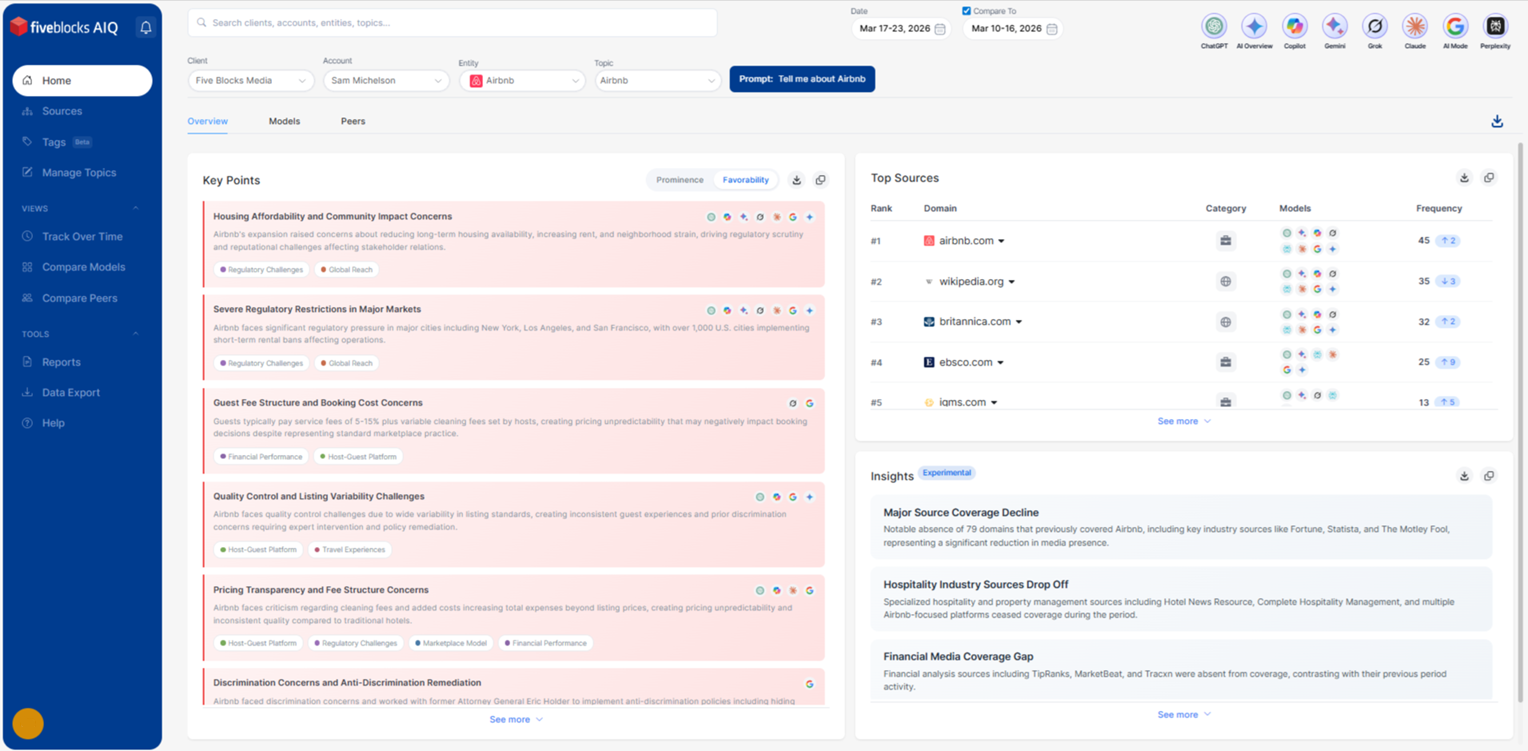
AIQ tracks ChatGPT, Copilot, Gemini, Google's AI Overview and AI Mode, Perplexity, Grok and Claude. It is designed around a distinction that most generative-engine-optimization tools blur. A marketing team asks, “How often are we mentioned?” A communications chief asks, “What exactly is being said, by which sources, with what sentiment, and is it getting worse?” AIQ is built for the second question.
Five Blocks' May 2026 knowledge page advertised a self-serve starting point at $99. Its current public pricing page lists Professional at $399 a month, Premium at $799 and Enterprise at $1,000 per brand, with a volume discount. Advisory engagements are scoped separately. In other words: check the live menu before ordering.
The pricing marks a meaningful change. A private consultancy, whose expertise once arrived through an account lead, now has a self-serve product an in-house team can operate. That is the classic path from service to software, but with a sensible twist: AIQ was tested inside paid engagements before it was sold outside them. The repeated expert task became the product specification.
What a communications team can copy
The most useful Five Blocks lesson requires no proprietary dashboard. Make a list of the questions that matter to customers, investors, recruits, regulators and journalists. Ask those questions in search and across several AI systems. Record the answers. Note which sources recur. Correct inaccuracies at the strongest, most authoritative source available. Publish direct, specific material where the record is thin. Repeat the test after the systems have had time to recrawl.
It is boring in precisely the way reliable work often is. The point is not to flood the internet with flattering copy. The point is to make a true, well-supported account easier for machines to retrieve than an obsolete or incomplete one. Five Blocks says it refuses fake reviews, spam tactics and campaigns designed to damage competitors. Those constraints matter because modern search systems are increasingly good at discounting manipulation - and because a reputation repaired with fiction is simply another crisis waiting for a date.
Where the method has leverage
- The underlying facts are accurate and supportable
- The client can improve owned pages and source material
- PR, legal and leadership coordinate
- There is time to monitor, publish and recrawl
Where it loses leverage
- The demand is instant deletion of legitimate reporting
- The preferred narrative lacks credible evidence
- The client disappears after assigning the problem
- A platform has not refreshed its training data
That final condition is the oddest one. Five Blocks has documented AI systems citing Wikipedia material that had been deleted or never indexed by Google. A search result can change after a recrawl. A model's trained memory may persist until its maker updates it. This is why the same technique will not work equally across every system or on every timetable. You can improve the evidence available to a machine; you cannot reach into its weights and erase a sentence.
The real product, then, is not control. No honest reputation firm can offer that. It is a clearer instrument panel and a better set of moves. Twenty-three years after Michelson began with an e-commerce site, Five Blocks is still studying what happens between a question and an impression. Only now the search box talks back.
Continue exploring