The interesting thing about teaching a machine to see is how quickly a photograph becomes too small. A camera catches a chair, a doorway, a patch of light. To do anything useful in that room, a machine must also grasp where the chair sits, what lies behind the door and how the view changes when it moves. Fei-Fei Li has spent much of her career widening that frame. First she helped computers identify what was in an image. Now she is trying to help them understand the space that continues beyond its edges.
The latest turn came on September 28, when AMD announced an agreement to buy World Labs, the company Li co-founded in 2024, in an all-stock transaction valued at approximately $8.2 billion. The deal is expected to close by the end of 2026, subject to approvals. Afterward, Li is expected to become AMD’s executive vice president and chief scientist, reporting to CEO Lisa Su. It is a striking destination for a scientist whose early work asked a deceptively modest question: how does a computer know what it is looking at?
A life with more than one map
Li grew up in Chengdu, China, reading science, science fiction and European literature. She has said the books gave her an independent mind, though teachers did not always regard her as a model student. As a teenager she moved with her family to New Jersey. The suburb felt startlingly empty after the city she knew. English arrived by dictionary, schoolwork and necessity. At home, the family's practical problem was earning enough to keep going.
One high-school math teacher, Bob Sabella, saw room for a bigger problem set. When the school did not offer the AP math course Li needed, he created a one-student class during lunch. Later, he helped her move in and out of college dorms and remained close to her family. Li received a full scholarship to Princeton; the news surprised her enough that she asked two advisers to examine the acceptance letter. She studied physics there, but her weekends often led back to the family dry-cleaning shop.
She has said she helped run that business for seven years, from her first year of college into graduate school. Her English made her useful behind the counter, and her responsibilities did not politely pause for the academic calendar. She learned to fit ambition into the space left by obligations. The experience also sharpened a conviction she would carry into AI: technology has to answer to the ordinary lives it enters. A customer with a garment due on Monday is a useful corrective to any idea that cleverness alone is a complete philosophy.
“Being a scientist is about resilience because science is exploring the unknown, just as an immigrant is exploring the unknown.”Fei-Fei Li
Fifteen million ways to ask “what is that?”
At Caltech, where she earned a doctorate in electrical engineering in 2005, Li moved deeper into the study of vision. Computer vision researchers then had algorithms and ideas, but a common shortage of examples large enough to test them convincingly. Li and her collaborators built ImageNet, a collection that grew to roughly 15 million images across about 22,000 categories. The associated challenge gave teams a shared way to measure how well a system recognized objects. The catalog had the scale of a small civilization’s filing cabinet, with rather more dogs.
ImageNet did not make a computer understand a picture by itself. It made different approaches comparable, and that mattered. A shared test showed when new methods improved and by how much. In 2012, deep neural networks posted a breakthrough performance in the ImageNet competition. The work became part of the foundation for the computer-vision advances that followed. Li has described the dataset as a bet on giving learning algorithms enough real-world examples, at a time when the bet was far from universally popular.
The team effort can get lost when the story is condensed to one famous name. The ImageNet paper included Jia Deng, Wei Dong, Richard Socher, Li-Jia Li and Kai Li alongside Fei-Fei Li. Labeling at that scale also depended on human work. The result was a scientific tool, built by people, that helped other people test their ideas. It is worth remembering the human labor behind a system often described as if it had simply woken up able to recognize a cat.
The room outside the photograph
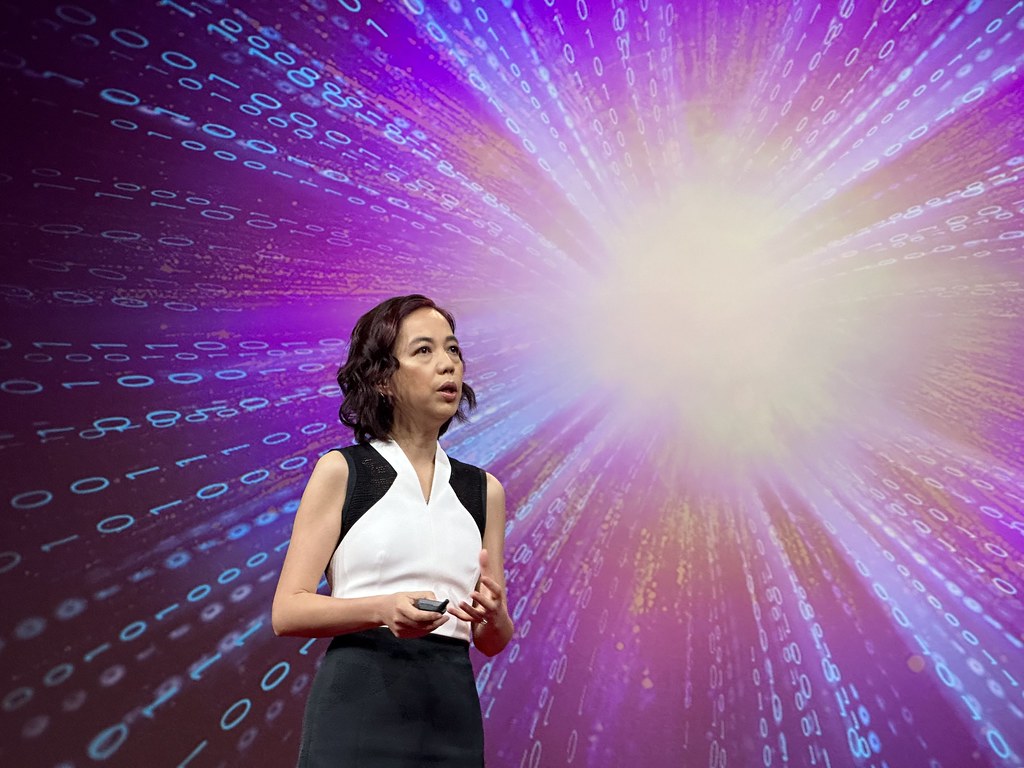
By 2024, Li was arguing for the next problem in a TED talk: spatial intelligence. A still image contains useful evidence, but it does not hand over the room’s geometry or the rules of movement. A person can glance at a doorway and imagine walking through it. A robot needs that understanding in a form it can use. World Labs was founded to build models that generate, reconstruct and simulate three-dimensional environments from inputs such as images, video and text.
At World Labs, Li worked with co-founders Ben Mildenhall and Justin Johnson. In 2025 the company released Marble, a model that creates explorable 3D worlds. In September 2026 it introduced Atlas, designed to work across text, images, video and 3D. Its demonstrations include predicting new camera views from a small number of pictures and reconstructing scenes. The promise is more practical than a clever camera trick: a designer might inspect a possible space, while a robot researcher might build and test a simulated environment.
Labeled examples and a shared recognition challenge.
Interactive 3D environments generated from visual and text inputs.
New views, reconstruction and spatial simulation.
Li puts the limitation of text-based AI plainly: “The universe isn’t made up of words; it’s made of real things.” That line is a research program as much as a sound bite. Language can describe a table; physical understanding also needs the table’s position, surfaces and possible uses. World Labs’ work is still research and product development, with boundaries visible in every demonstration. The company says Atlas can imagine unseen parts of a scene when evidence is sparse. That is useful for creation, but it also means a generated view is not automatically a faithful record of a real place.
The question of who holds the camera
Li’s work has also followed a second thread: who builds AI and who gets to shape its use. In 2015 she and Olga Russakovsky started SAILORS, a Stanford summer program for girls interested in AI. It later became part of AI4ALL, which widened the effort to bring more students into the field. In 2019 Li became a founding leader of Stanford’s Institute for Human-Centered Artificial Intelligence with John Etchemendy. The point was to bring technical work into conversation with policy, education and the public.
She has argued that people must retain agency over the future of AI. That is a less flashy position than predicting what machines will do next, and more demanding. It asks researchers, companies and governments to make choices in public. Li has spoken to policymakers, written about the subject and used her 2023 memoir, The Worlds I See, to place the field’s progress alongside her own history of migration, mentors and work. The title is well chosen for someone who keeps returning to the gap between an image and an experience.
Her path through institutions has been unusually varied. She directed Stanford’s AI Lab from 2013 to 2018, served as a vice president and chief scientist of AI and machine learning at Google Cloud in 2017 and 2018, and remained a Stanford professor. Those roles gave her different views of the same tension: the resources needed to build powerful AI increasingly live in companies, while universities and public institutions help ask what those tools should serve. World Labs was another answer to the scale problem, this time built as a company from the start.
“We have to make the choices of how we want to build and use this technology.”Fei-Fei Li
A new address for an old question
The AMD agreement brings the two threads of Li’s career into a fresh arrangement. In her account of the move, she says the companies had been working together on training and inference using AMD hardware. She describes Lisa Su as an early investor in World Labs and a friend. AMD says bringing the research team inside the company will help it understand emerging model workloads and shape future computing systems. For now, the transaction remains pending. Li continues to lead World Labs, and her AMD title is a planned next role.
There is a neat circle in the deal, though life rarely traces circles neatly. ImageNet helped create the conditions in which new algorithms and powerful computing could transform machine vision. World Labs is trying to take vision into places a still photograph cannot quite reach. AMD designs the processors that may help run that work at scale. The transaction’s dollar figure makes a headline, but Li’s original question survives beneath it: what does seeing allow an intelligent system to do?
Back in the New Jersey dry cleaner, a young Li learned that a question has consequences beyond the page where it first appears. A shop had to open, clothes had to be ready, and schoolwork had to fit around both. That grounded sense of responsibility runs alongside the curiosity that took her from physics into vision, from ImageNet into worlds. The next image she wants AI to understand may be a room. The people who live and work in it remain the reason the question matters.